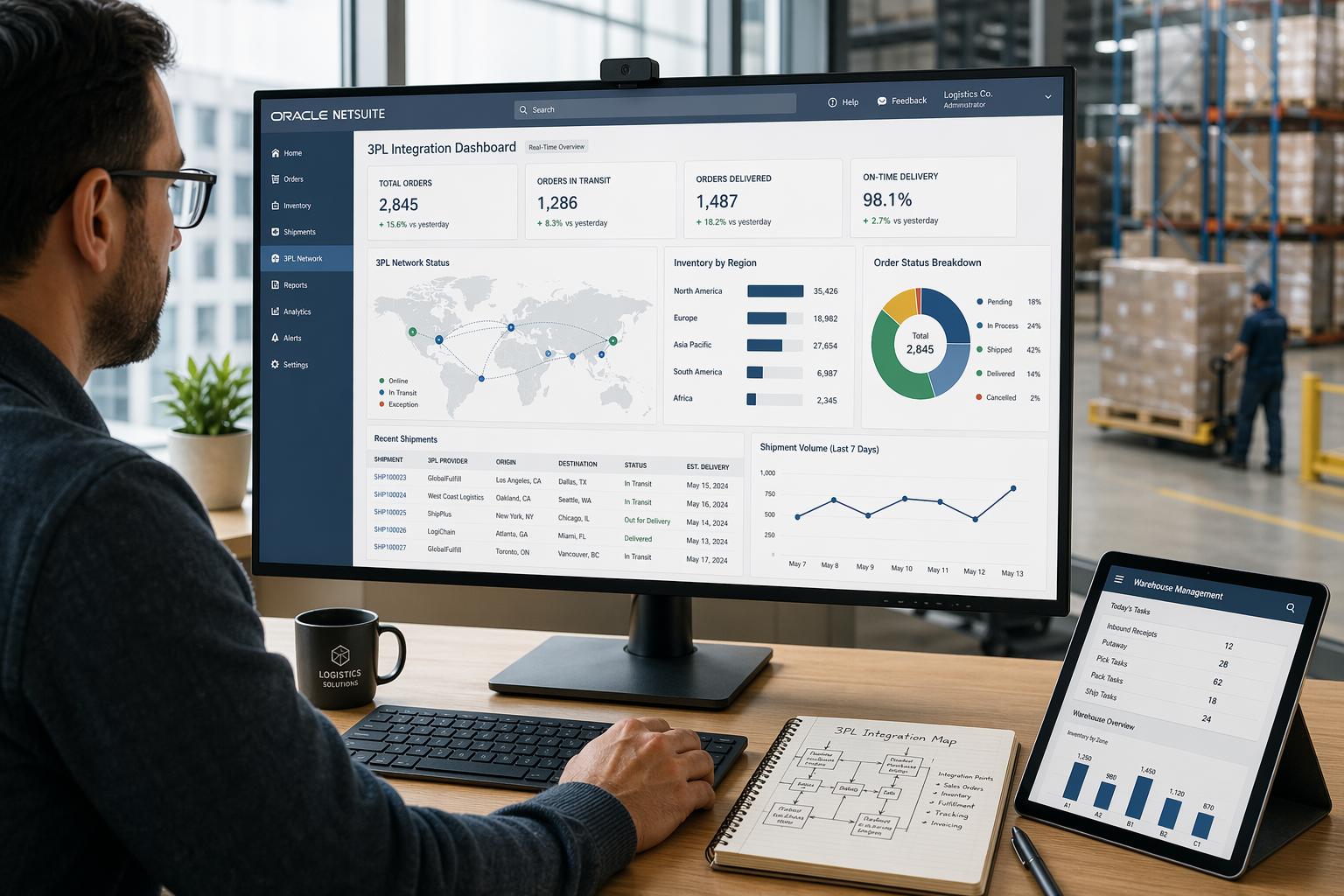
Houseblend Article
NetSuite 3PL Integration Guide for E-Commerce Systems
Inside this article
- 01Executive Summary
- 02Introduction and Background
- 03Why Integrate NetSuite with 3PL? Benefits and Challenges
- 04Top Integration Solutions and Platforms
- 05Integration Setup Guide for NetSuite & 3PL
- 06Case Studies and Real-World Examples
- 07Data Analysis & Industry Context
- 08Discussion of Implications and Future Directions
- 09Conclusion
- 10References
Executive Summary
In today’s fast-paced e-commerce environment, seamless integration between enterprise resource planning (ERP) systems and third-party logistics (3PL) providers has become essential. For firms using Oracle NetSuite as their ERP, integrating with 3PL partners is described by industry experts as “operational oxygen” [1]. Robust 3PL integration automates order processing and fulfillment, yielding significant efficiency and accuracy gains. Studies and case reports consistently document substantial benefits: for example, integrating NetSuite with a 3PL yielded 25–40% daily time savings for a single warehouse employee [2], while using a specialized connector cut invoicing errors by 95% in a multi-account Amazon fulfillment scenario [3]. Academic research further confirms that advanced ERP systems like NetSuite can markedly improve order accuracy and processing time [4].
This report provides a comprehensive analysis of NetSuite 3PL integration tailored for e-commerce businesses. We begin with background on NetSuite and 3PL ecosystems, then survey the integration landscape: comparing approaches (custom code, iPaaS platforms, native APIs, connectors) and highlighting leading solutions (e.g. Celigo, Dell Boomi, MuleSoft, Tray.io, Extensiv 3PL Hub). Data-driven insights (market size, ROI projections, industry metrics) and expert commentary underscore why integration drives business growth. A detailed setup guide outlines phased steps from planning through go-live and ongoing optimization. We present case studies illustrating real-world outcomes and discuss future trends (AI, IoT, digital supply chain). Throughout, all assertions are supported by recent research and authoritative industry sources.
Introduction and Background
Modern e-commerce businesses rely on agile, interconnected technology environments to manage sales, inventory, warehousing, and shipping. NetSuite – a leading cloud-based ERP acquired by Oracle – offers unified financials, inventory, and order management across sales channels [5]. For growing retailers and manufacturers, NetSuite’s cloud platform is attractive because it centralizes transactional data, breaking down silos between finance, inventory, and fulfillment [5]. However, e-commerce companies frequently outsource warehousing and order fulfillment to third-party logistics (3PL) providers. 3PLs handle tasks like storage, pick-and-pack, and shipping on behalf of clients. To achieve end-to-end efficiency, businesses must synchronize NetSuite with 3PL systems so that orders, inventory levels, and shipment confirmations flow automatically between the ERP and 3PL.
Historically, e-commerce firms often struggled with isolated systems: orders entered into NetSuite required manual export to 3PLs, and tracking updates had to be manually re-entered, leading to delays and errors. Industry analysts note that as businesses expand (“scale”), “seamless integration and accurate, real-time reporting become essential for driving growth” [5]. In fact, published market research projects that the global e-commerce ERP integration market will reach over US$15.2 billion by 2026 (nearly US$21.3 billion by 2031) [6], reflecting burgeoning demand to connect digital storefronts with ERPs and supply-chain partners.
Integrating NetSuite with 3PL partners yields a single source of truth for orders and inventory [5]. An e-commerce sale—for example on Shopify or Amazon—when integrated can automatically create a sales order in NetSuite and trigger a fulfillment order with the 3PL, all without human intervention [3]. Conversely, once the 3PL ships the goods, the returned tracking numbers, shipping costs, and shipment data sync back to NetSuite, completing the loop. This end-to-end data flow unlocks real-time visibility: inventory levels across fulfillment centers update in real time; customer service agents immediately see order status; and financials in NetSuite reflect accurate shipping costs and revenue [7] (Source: www.anchorgroup.tech).
Despite these advantages, achieving robust NetSuite–3PL integration can be complex. Traditional approaches (custom coding, generic iPaaS solutions, or using NetSuite’s basic connectors) often involve lengthy projects and high costs [1]. Vendors and consultants emphasize that “every new fulfillment partner means more manual work, more errors, and more margin erosion” if not fully automated [1]. Accordingly, e-commerce businesses increasingly seek proven best practices and specialized tools to connect NetSuite with 3PLs rapidly and reliably.
This report covers these topics in depth. The next sections analyze the benefits and drivers of 3PL integration, survey leading solution architectures, provide a step-by-step setup guide, present case studies, and discuss future directions for NetSuite-driven e-commerce fulfillment.
Why Integrate NetSuite with 3PL? Benefits and Challenges
Integrating NetSuite with a 3PL yields tangible business benefits in efficiency, cost reduction, accuracy, and scalability. Conversely, lack of integration creates operational drag. This section examines the key impacts of NetSuite–3PL integration, drawing on industry studies, case reports, and expert analysis.
Operational Efficiency and Cost Savings
One of the most pronounced effects of integration is improved operational productivity. Manual order processing is extremely labor-intensive: without integration, staff must export orders from NetSuite and re-enter them in the 3PL’s warehouse management system (WMS), then import shipment data back. Reports indicate staff may waste “hours per week” on these rote tasks if not automated (Source: www.anchorgroup.tech). Integration eradicates this mundane workload.
For example, Jade Global’s integration project for Universal Audio—an audio equipment manufacturer—automated the generation of sales order fulfillments in NetSuite from the 3PL’s system [2]. After implementation, Jade reported that the 3PL warehouse no longer had to manually create item fulfillment records. This resulted in a 25-40% time saving for 1 FTE per day involved in fulfillment [2].In other words, one full-time warehouse staff (or the equivalent effort) was freed up thanks to the automated sync. In addition to labor savings, Universal Audio eliminated errors from manual data entry and strengthened data security (since 3PL staff no longer had direct NetSuite logins) [2] [7].
Third-party reports similarly highlight efficiency gains. Anchor Group notes that experienced partners can deploy a NetSuite–3PL Central integration in as little as 2–6 weeks, with measurable ROI realized “faster than most enterprise projects” (Source: www.anchorgroup.tech). This contrasted sharply with the typical 3–12 month timeline (and $50K–$500K cost) of traditional custom integration projects [1]. Such rapid deployments minimize project overhead and let companies realize benefits sooner.
Another critical efficiency is in inventory management. Integration provides real-time visibility into stock across all fulfillment locations (Source: www.anchorgroup.tech). Rather than reconciling counts manually, NetSuite reflects the 3PL’s on-hand inventory instantly. This enables smarter order routing (“ship from closest warehouse”) and avoids overselling stock. According to Anchor Group, key operational benefits include real-time inventory visibility across warehouses and automated order routing based on customer location or inventory (Source: www.anchorgroup.tech). These reduce stockouts and expedite shipments.
Accuracy and Customer Experience
Data accuracy and customer satisfaction also improve. In a Celigo implementation for an Amazon-heavy seller, syncing NetSuite with five Amazon seller accounts cut 95% of invoicing errors [3]. Before integration, mismatched orders and shipments meant finance staff spent days fixing invoices. After integration, Celigo’s Amazon Connector ensured orders, refunds, and inventory updates flowed automatically, vastly reducing mistakes.
Integrated systems also enable faster shipping updates. Instead of customers seeing 24-hour delays, same-day tracking information flows from the 3PL into NetSuite, supporting near-instant customer notifications (Source: www.anchorgroup.tech). This transparency “transforms order fulfillment from a bottleneck into a competitive advantage” (Source: www.anchorgroup.tech). The ledgerLabs analysis estimates that 79% of 3PL companies “have reported higher profitability” after integration, implying smoother operations and service levels [8]. Moreover, automated data flows reduce customer-service tickets: for example, one Celigo case study reported a 40% reduction in customer support tickets after automating Shopify–NetSuite–3PL workflows [3]. This reflects fewer order disputes and inquiries when data is consistent.
Financial Impacts and Reporting
Financially, integration tightens the connection between sales and shipping costs. NetSuite’s best-practice documentation notes that integrated shipping allows tracking both “the amount the customer paid for shipping on the Sales Order (incoming revenue) and the amount you paid to ship the order (outgoing cost)” [7]. Syncing actual shipping cost into NetSuite ensures accurate profit analysis. Without integration, companies often use placeholder shipping values or manual adjustments, which distort margins.
Integration can also reduce licensing costs. In the Universal Audio/Jade case, NetSuite user licenses for 3PL staff could be trimmed because staff no longer logged in directly [2]. Over time, these licensing savings (and reduced need for developer changes) contribute to the return on integration investment. Leading consultancies recommend that businesses “maximiz[e] ROI” from NetSuite by automating tasks like order entry, inventory updates, and shipping data [9].
Risks, Data Security, and Control
While benefits are clear, integration projects must address potential risks. Chief among these is data security: exposing ERP access to external parties is a concern. By integrating via controlled interfaces, companies can avoid giving 3PL users NetSuite login rights, instead letting scripts or APIs handle data exchange [2]. This was a key benefit for Universal Audio, who “strengthened data security, preventing unauthorized access” by eliminating direct 3PL access [2].
Another challenge is the complexity of mapping data fields for diverse business models. 3PLs may use their own product codes, and e-commerce orders often include custom attributes. Achieving “accurate, real-time reporting” across systems requires careful planning of these mappings [5]. The Anchor Group guide on integrating 3PL Central emphasizes early “requirements gathering and data mapping” to align systems (Source: www.anchorgroup.tech). Custom fields in NetSuite must be explicitly handled, and if not properly mapped, data can fall through the cracks (Source: www.anchorgroup.tech).
Finally, the total cost of integration (TCO) varies widely by approach. Traditional projects (in-house coding or external development) often incur “$50,000 to $500,000 and take 3–12 months” [1]. Modern integration platforms claim to reduce cost by up to 85% versus legacy methods [1], but they introduce ongoing subscription fees. Businesses must weigh developer time vs. platform costs. This analysis is crucial during the “Phase 3: Choosing Your Integration Method” (Source: www.anchorgroup.tech).
Key Takeaway: Robust NetSuite–3PL integration delivers measurable speed, accuracy, and visibility benefits. Case studies report multi-week labor savings for staff [2] and dramatic error reductions [3]. However, success depends on addressing data mapping and choosing the right technology approach.
Top Integration Solutions and Platforms
A variety of technical solutions exist for connecting NetSuite to 3PL providers. These range from bespoke custom integrations to full-service integration platforms. This section overviews the leading approaches and products in the market, including their use cases and trade-offs.
Integration Approaches Overview
Broadly, integration solutions fall into these categories:
-
Custom Code / NetSuite Native Extensions: Companies may build in-house integrations using NetSuite’s native tools. NetSuite provides APIs like SuiteTalk (SOAP/REST API) and scripting via SuiteScript for custom logic. These offer maximum flexibility but require skilled developers. SuiteTalk and SuiteScript allow billing and order data to be pushed in real-time [3]. Advantages: No third-party fees, full control; Disadvantages: High internal development and maintenance effort; longer project timelines.
-
iPaaS (Integration Platform as a Service): Cloud-based middleware platforms (e.g. Celigo, Dell Boomi, MuleSoft, Jitterbit, Tray.io) that connect multiple systems using pre-built connectors or customizable flows. They typically feature drag-and-drop interfaces, monitoring, and error handling. iPaaS solutions dramatically speed up connectivity between NetSuite and virtually any 3PL or e-commerce channel [3]. Advantages: Rapid time-to-value, robust features (e.g., alerts, versioning [3]), and maintenance handled by vendor; Disadvantages: Subscription fees, potential ongoing costs (often per transaction), may require training.
-
Pre-built 3PL Connectors: Some vendors and platforms offer specialized connectors tailored for popular 3PLs or e-commerce flows. For example, Celigo’s Integration Apps provide “pre-built flows” for Amazon, Shopify, and certain 3PLs [3]. Similarly, Extensiv (formerly 3PL Central) provides its own integration manager modules. These off-the-shelf options can cover many standard use cases (orders, shipments, inventory) out of the box. Advantages: Fast deployment (weeks), minimal custom coding; Disadvantages: Less flexibility if business rules are unique.
-
Hybrid / Managed Platforms (Order Management Suites): Emerging solutions focus specifically on multi-3PL orchestration (sometimes called Order Management or OrderOps platforms, e.g., Pipe17). These may bundle pre-built connectors with a business-friendly interface for logistics rules [1]. They promise quick onboarding of new 3PLs and proactive maintenance [1]. While not just simple connectors, these platforms treat 3PL integration as a core service. Advantages: Very rapid integration (days-weeks), lower TCO claims [1], and business user control; Disadvantages: Less customizable, may lock you into a specific vendor ecosystem.
Table 1 (below) summarizes representative platforms and their characteristics.
| Solution / Platform | Type | Key Strengths / Use Case | Examples / Notes |
|---|---|---|---|
| SuiteTalk / SuiteScript | Native NetSuite APIs | Real-time, custom integration; no external licensing fees. Best for one-off custom workflows or unique fields. | Ideal for developers. Uses SOAP/REST (SuiteTalk) or JS scripts (SuiteScript). [3] |
| Celigo Integrator.io | Cloud iPaaS (NetSuite focused) | Rich library of connectors; easy UI; pre-built flows for Shopify, Amazon, and some 3PLs; high adoption in mid-market. | Offers templates for 3PLs (e.g., Extensiv) (Source: www.anchorgroup.tech). Reduced support tickets by ~40% in one case [3]. |
| Dell Boomi | Enterprise iPaaS | Highly scalable; strong governance and monitoring; widely used in large enterprises spanning ERP/CRM systems. | Good for complex, multi-system ERP/CRM integration [3]. |
| MuleSoft Anypoint | Enterprise iPaaS | Extensive reusable API modules; ideal for organizations in the Salesforce ecosystem or needing tight security. | Emphasizes modularity and version control [3]. Used for NetSuite–Salesforce integration. |
| Jitterbit Harmony | Cloud iPaaS | Excels at custom API mapping; fast implementation; supports REST/SOAP. | Useful for bespoke integrations (e.g., custom PIM systems) [3]. |
| Tray.io | No-code Integration Platform | Visual, drag/drop workflows; accessible to non-developers; fast prototyping. | Great for marketing/ops teams; e.g. imported Shopify data to NetSuite in “hours" [3]. |
| Celigo Amazon Connector | Specialized Integration App | Tailored flow for Amazon: syncs orders, FBA updates, inventory, refunds automatically. | Reduced invoice errors by 95% in a multi-account Amazon setup [3]. |
| Extensiv (3PL Central) Integration Manager | Native 3PL Connector | Purpose-built for 3PL Central (Extensiv) users; includes prebuilt templates for orders/inventory. | Best if using 3PL Central WMS; turnkey flow, phone support included. |
| Pipe17 / Order Management | Managed Order Operations | Offers a “controller” layer for multi-3PL, multi-channel order orchestration; business-user-friendly. | EMTAs claim 2–3 week integrations vs 3–12 months traditionally [1]. |
| Anchorgroup’s Toolkit | Consulting IP / Hybrid | Offers custom ETL connectors (like In8Sync’s) or iPaaS templates via partners. | Partners provide options (Celigo templates, In8Sync SuiteApp) (Source: www.anchorgroup.tech). |
Sources: Vendor blogs, consulting guides, and benchmarks (Source: www.anchorgroup.tech) [3].
This table showcases just a sampling of options. In practice, companies may use multiple tools in tandem (e.g. NetSuite’s native SuiteTalk for some flows, plus an iPaaS for others). The choice depends on factors like technical resources, budget, and desired speed of implementation.
Comparison of Selected Integration Platforms
To further illustrate differences, Table 2 compares select integration platforms across key criteria. This assessment is based on industry reports and the experiences of integrators:
| Platform | Deployment | Code Required | 3PL Focus | Notable Features | Pricing |
|---|---|---|---|---|---|
| Celigo Integrator | SaaS (Cloud) | Low (drag/drop + scripting) | High (lots of e-commerce/3PL apps) | Prebuilt NetSuite and 3PL templates; built-in monitoring and error handling [3] (Source: www.anchorgroup.tech). | Subscription (tiered API calls). |
| Dell Boomi | SaaS (Cloud) | Medium (Graphical + BoomiScript) | Medium (generic enterprise focus) | High-throughput messaging, version control, audit trails [3]. Scales well for large volumes. | Subscription (production units). |
| MuleSoft Anypoint | SaaS / Private Cloud | High (mostly development) | Low (not specific to 3PL) | API-led connectivity; strong for Salesforce/CRM-heavy shops [3]. Rigorous security. | Subscription (capacity-based). |
| Jitterbit Harmony | SaaS | Low-Med (GUI with code options) | Low (general purpose) | Excellent for rapid custom mapping; has some AI-assisted suggestions [3]. | Subscription (per integration). |
| Tray.io | SaaS | Very Low (no-code/UI) | Low (general use) | Visual workflow builder; ideal for marketing/ops use cases [3]. | Subscription (tiered by connectors). |
| In8Sync DirectConnect | SuiteApp (within NetSuite) | Low (configuration UI) | Moderate (specifically for popular 3PLs) | Runs inside NetSuite (no middleware); real-time syncing; phone support (Source: www.anchorgroup.tech). | License fee (no per-transaction cost). |
| Extensiv (3PL Central) Intgr. | Cloud SaaS | Low (setup wizard) | High (only for 3PL Central users) | Out-of-box 3PL-specific flows; guaranteed support from 3PL provider. | Subscription. |
| Custom SuiteScript/SuiteTalk | N/A (native) | High (development) | High (any 3PL, but built from scratch) | Full flexibility; no middleware costs; can embed business logic. | Time & developer cost. |
As indicated, no one solution is universally “best.” High-growth e-commerce brands often choose celigo integrator.io or similar iPaaS for their first 3PL integration owing to prebuilt templates and speed [3]. Large enterprises may lean on heavy-duty platforms (Boomi/MuleSoft) for broader IT ecosystems [3]. Some companies extend NetSuite itself (In8Sync) to avoid external dependencies (Source: www.anchorgroup.tech). Ultimately, each platform must be evaluated for how well it handles the specific 3PL partner(s) and workflows a business requires.
Integration Setup Guide for NetSuite & 3PL
Implementing a NetSuite–3PL integration is a multi-phase project. Established best practices – drawn from integration experts – recommend rigorous planning, phased implementation, and iterative testing. Below is a generalized guide through the key stages:
-
Pre-Integration Planning: Define goals, scope, and stakeholders. Document current (manual) processes to identify pain points. Anchor Group advises documenting “current manual processes and identifying pain points” for sales order exports, inventory updates, etc (Source: www.anchorgroup.tech). Determine which 3PL services (multiple warehouses? drop-ship?) must integrate. Catalog data flows needed: e.g., sales orders → 3PL, shipments/tracking → NetSuite, purchase orders (for replenishment), inventory levels, returns handling, etc. For example, one 3PL integration guide notes “seven primary data flows” between NetSuite and 3PL (including orders, item fulfillments, returns, etc.) (Source: www.anchorgroup.tech).
-
Define Data Mapping: Align data models between systems. This involves matching NetSuite fields with 3PL WMS fields. Key areas include item SKUs/IDs, quantities, serial numbers, lot/batch, customer and address info, shipping method codes, etc. Many NetSuite objects (Item, Customer, Sales Order, Fulfillment) may require extensions or custom fields. Ensure consistent item identifiers – e.g., Universal Audio needed scripts to map serial numbers and 3PL tracking numbers [2]. Plan business rules: when and how to sync inventory changes, handle backorders, or mark an order as partially shipped. Oracle’s best practices suggest keeping integration logic as simple as possible, ideally in NetSuite, to enable easy troubleshooting [7].
-
Choose Integration Method / Tool: Based on requirements and resources, select the integration approach. Anchor Group highlights three options: (1) iPaaS templates (e.g. Celigo’s prebuilt connectors), (2) NetSuite-native solutions (e.g. In8Sync DirectConnect), or (3) Extensiv Integration Manager for 3PL Central customers (Source: www.anchorgroup.tech). General factors: needed customization, technical team expertise, desired deployment speed, and budget. As a rule of thumb reported by Pipe17, traditional custom projects take 3-12 months, whereas prebuilt connectors can launch in 2-3 months, and dedicated platforms in days-weeks [1]. If preferring an iPaaS, ensure it has templates for your 3PL/WMS; if doing custom, ensure developer availability; if on 3PL Central, consider their built-in connector (Source: www.anchorgroup.tech).
-
Configuration and Development: Build the integration flows using the chosen platform. For an iPaaS, configure or customize connectors: e.g., Celigo provides flows for synchronizing Sales Orders, Item Fulfillment, Purchase Orders, Inventory Adjustments, etc. (Source: www.anchorgroup.tech). If coding, develop SuiteScripts or SOAP calls to send and receive data. Implement required business logic: for instance, apply location mapping or shipping partners. Set up authentication (API keys, tokens) between NetSuite and the 3PL’s API. Anchor Group emphasizes robust error handling and notifications during this phase to catch integration issues (Source: www.anchorgroup.tech) [1].
-
Testing: Rigorously test with sample data and full end-to-end scenarios. Develop test cases for each data flow: e.g., create a sales order in NetSuite and verify it appears correctly in the 3PL’s system; simulate a shipment in the 3PL system and ensure NetSuite receives it with correct tracking. Include edge cases like system exceptions or partial shipments. Anchor Group recommends “comprehensive test scenarios” and phases for QA (Source: www.anchorgroup.tech). Correct any field-mapping errors and ensure transaction logs are consistent. Validate that financial data aligns (shipping costs, taxes, currencies).
-
Go-Live and Monitoring: After user acceptance testing, deploy the integration. In parallel, provide training to operations staff for the new workflows. Initially, run the integration in parallel with manual processes for sanity-checking. Enable detailed logging. Immediately monitor key metrics: e.g., order sync lag time, error rates, and data accuracy. Set up dashboard or alerts for failure notifications as recommended in integration tools [7]. It’s typical to iterate and tweak mappings or flows in the weeks following launch.
-
Post-Integration Maintenance: Integration is not “set-and-forget.” APIs can change and business rules evolve. As Pipe17 notes, with traditional integrations “APIs change. Integrations break. With traditional approaches, you fix them yourself” [1]. Establish a governance process: periodically review logs, update mappings for new products, and train teams to handle exceptions. Anchor Group suggests setting up performance dashboards and iteratively improving integration based on data (e.g. adjusting inventory safety stock if too many stockouts occur) (Source: www.anchorgroup.tech).
Table 2 (below) outlines these phases and activities for clarity:
| Phase | Key Activities |
|---|---|
| 1. Planning | – Identify stakeholders (IT, logistics, finance) – Document current processes and pain points (Source: www.anchorgroup.tech) – Define scope (which 3PLs, carriers, etc.) – Map data flows: Sales Orders, Fulfillments, PO Receipts, Inventory, Returns (Source: www.anchorgroup.tech) |
| 2. Data Mapping | – Align NetSuite records with 3PL WMS fields (item SKUs, customer IDs) – Determine custom fields needed – Decide sync logic (e.g. trigger on order status) (Source: www.anchorgroup.tech) |
| 3. Tool Selection | – Evaluate iPaaS vs native vs custom (based on complexity, timeline) (Source: www.anchorgroup.tech) [1] – Choose vendor/platform (Celigo, Boomi, SuiteApp, etc.) – Establish budget (upfront vs subscription) [1] |
| 4. Development | – Configure or code integration flows in chosen tool – Implement business rules (location routing, backorders, etc.) – Set up authentication/APIs and any middleware configurations (Source: www.anchorgroup.tech) |
| 5. Testing | – Execute test cases end-to-end (order to fulfillment) – Validate data (inventory, tracking) accuracy [1] – Test failure modes (e.g., network downtime) – Get stakeholder sign-off |
| 6. Deployment | – Deploy to production with initial parallel run vs. manual process – Monitor sync logs and address errors quickly – Provide user training/documentation |
| 7. Monitoring & Maintenance | – Set up dashboards/alerts for integration health (e.g., failed records) [7] – Periodically review and optimize – Update integration as business/processes change [1] |
Each phase is crucial. For instance, Backbone Integrators report that skipping thorough mapping leads to later reconciliation work. Conversely, organizations that rigorously prepare and use pre-built tools often see integration completed in 2–4 weeks (Source: www.anchorgroup.tech), compared to 3–12 months otherwise [1].
Case Studies and Real-World Examples
Concrete examples illustrate how NetSuite–3PL integrations work in practice and the benefits achieved. Below are representative case studies and anecdotes drawn from industry sources.
Universal Audio (Manufacturer) – Jade Global Case Study [2]. Universal Audio makes recording equipment with serialized parts. They relied on a West Coast 3PL to fulfill orders but faced labor-intensive processes: the 3PL had to manually create NetSuite item fulfillment records and enter serial/tracking numbers each day [2]. Jade Global implemented a custom integration (SuiteScript-based) that automated data retrieval from the 3PL’s Warehouse Management System. Key scripts fetch fulfilled sales orders and create corresponding fulfillments in NetSuite, including serial numbers and tracking [2]. Outcome: 100% automation of the fulfillment process. The 3PL no longer needed to manually enter data, yielding 25–40% time savings per day for one warehouse FTE [2]. Costs fell as NetSuite licenses were reduced, and data security improved (third parties lost unnecessary access) [2].
Global Skincare Brand – Celigo Integration Example [3]. When a DTC skincare company grew, it needed to synchronize Shopify orders, inventory, and multiple 3PLs with NetSuite. They tried an “AI-driven one-click” tool but it generated duplicate records. Switching to Celigo’s integrator with human-defined logic solved this. Celigo linked Shopify, NetSuite, and the 3PL systems in an end-to-end sync. Outcome: Smooth, automated data flow kept inventory accurate, and support tickets dropped by 40% [3] as order errors disappeared. This case highlights how a flexible iPaaS can adapt to complex workflows and prevent duplicate records through careful logic.
Consumer Tech Company – MuleSoft Implementation [3]. A client in the consumer electronics space needed NetSuite integrated with Salesforce CRM, Zendesk (support), and a mobile app’s backend. They chose MuleSoft because their organization already used Salesforce and valued reusability. MuleSoft provided API governance and security; the implementation team built SuiteCommerce workflows to ensure NetSuite’s performance under load. Outcome: The company gained centralized control of data transformations and audits, crucial for regulatory compliance and debugging. Developers attested that MuleSoft’s strength lay in modular, version-controlled APIs more than any AI mapping features [3].
CPG Brand (Tray.io Example) – Quick Data Sync [3]. A fast-growing packaged-goods brand needed to improve SKU-level analytics. They used Tray.io to import order tag data from Shopify into NetSuite, enabling refined sales reporting. Because Tray is a no-code platform, marketing and ops people set this up in a few hours, a task that would have taken days as a custom project. Outcome: Rapid deployment of a new data sync, empowering analysts with immediate SKU insights. The team noted that modern integration tools (AI-assisted) speed up development, but human oversight remains critical to implement business logic correctly [3].
Amazon Multi-Account Seller – Celigo Amazon Connector [3]. A client operated five Amazon retail accounts, each with its own NetSuite omnichannel store. Manually reconciling all invoices and FBA feeds was error-prone. After deploying Celigo’s Amazon Connector, the orders, refunds, and inventory sync happened automatically. Outcome: Finance saw 95% fewer invoicing errors, and inventory levels across accounts stayed synchronized in real time [3]. Celigo’s prebuilt Amazon flows handled complex scenarios (like multi-SKU bundles) at scale.
These examples demonstrate diverse integration solutions: a custom SuiteScript approach [2], an iPaaS connector [3], a Salesforce-centric middleware [3], and vendor-specific tools [3]. All achieved major boosts in accuracy, speed, or cost control.
Data Analysis & Industry Context
Beyond individual cases, industry data and research provide broader context for NetSuite–3PL integration.
-
Supply Chain Performance: Studies in logistics underline the value of third-party logistics. For instance, research on e-commerce shipping found that retailers “often rely on a third-party service provider to ensure distribution” [10]. High-volume e-tailers like Amazon outsource many deliveries to carriers (FedEx, UPS, DHL) especially during peak seasons [10]. In that 2020 study, over 30% of surveyed supply chain professionals had already deployed AI to optimize operations, with 43% planning to adopt it soon [11]. This demonstrates the trend that leveraging sophisticated tech — whether AI or ERP integration — is becoming the norm in 3PL logistics.
-
E-commerce Growth: The e-commerce sector’s rapid growth amplifies the stakes. Mordor Intelligence projects nearly a 7% CAGR in the e-commerce ERP integration market through 2031 [6]. This reflects not just growth in commerce, but in SaaS adoption for integration. The anchor of these services is often a robust ERP like NetSuite. BuiltWith data indicates thousands of e-commerce sites use NetSuite SuiteCommerce, and NetSuite holds roughly 5% of the global ERP market [12]. As brands expand sales channels (omnichannel retail, marketplaces, international sites), the volume and complexity of orders surge, making integrated systems a prerequisite.
-
Resilience and Visibility: Global events (supply chain disruptions, pandemics) have emphasized the need for resilient operations. NetSuite’s unified system provides real-time insights that can help firms adapt to volatility [4]. For example, the IJSRM study found Oracle NetSuite’s real-time tracking and automation significantly improved order processing times [4]. By centralizing data, companies can forecast demand and assess 3PL performance with greater accuracy [5].
-
Financial Impact: Analysts note that eliminating siloed systems can significantly reduce costs. The FLXpoint report highlights that automating NetSuite integrations “reduces labor costs” and “avoids costly errors”, directly impacting ROI [9]. While quantifiable ROI varies, multiple sources cite “substantial” improvements in operational KPIs. For instance, time savings and license cost reductions translate to tangible annual savings, sometimes offsetting initial integration investments quickly [2] [1].
-
Expert Opinions: Industry consultants consistently rank integration among top priorities. CEP Tech and CrossCountry Consulting emphasize that without “unified real-time visibility”, e-commerce businesses face inhibited growth [5]. Similarly, Cloudfy notes that ERP–e-commerce integration is “fundamental to operational agility” and positions e-commerce as integral to the value chain [13]. Surveys by Gartner and 3PL logistics organizations repeatedly state that aligned ERP and distribution systems are key to customer satisfaction and cost control.
Discussion of Implications and Future Directions
The landscape of NetSuite–3PL integration is evolving rapidly. Several future trends and strategic considerations deserve attention:
-
AI and Smart Automation: Artificial intelligence is influencing both e-commerce operations and 3PL logistics. As noted in the 3PL industry report, AI is a “game changer” for forecasting and efficiency [11]. Integrated systems can feed AI engines with clean, real-time data. For example, linked ERP and 3PL data enable predictive demand planning to optimize inventory placement across warehouses before stockouts occur. Robotic warehouse automation and IoT (Internet of Things) within 3PL facilities will produce vast streams of data; integrating that data with NetSuite can offer unprecedented visibility into fulfillment lead times and costs. Leading logistics executives predict that by 2026, AI-driven routes, robotics picking, and smart contracts will redefine order fulfillment [14]. NetSuite integration platforms that support API extensibility and real-time data flows will be well-poised to leverage these innovations.
-
Unified Commerce and Platforms: The future points toward “unified commerce” platforms that dissolve barriers between online, offline, and mobile sales [5]. NetSuite aims to be this single source of truth. Meanwhile, 3PL providers are moving beyond mere warehousing to offer value-added e-commerce services (kitting, returns management, omnichannel fulfillment) [15]. Firms should anticipate integrating with multiple 3PL networks and marketplaces simultaneously. Integration tools that can orchestrate cross-channel order splitting and binding will become very valuable.
-
Regulatory and Tax Automation: As businesses expand globally, compliance requires integrated tax, customs, and trade management. NetSuite’s built-in global tax features can be extended through integration, so that 3PL partners in various regions automatically flag duties and paperwork. Oracle has enhanced NetSuite in recent years with global trade modules [16]. For sophisticated companies, 3PL integration may eventually tie into blockchain or AI-based customs processing, further reducing friction for cross-border e-commerce.
-
Shift Towards Platform Ecosystems: The vendor ecosystem is adapting. Large integrators like Celigo and Boomi continue to release specialized connectors. Oracle’s SuiteApp partners (e.g. Celigo is SuiteCloud Partner of the Year) develop more plug-and-play solutions for common e-commerce and 3PL scenarios [3]. We expect an increase in turnkey “business operations platforms” that bundle ERP integration with analytics and workflow (akin to the Pipe17 model). These platforms may also natively support NetSuite, reducing reliance on external APIs (like In8Sync does inside NetSuite).
-
Possible Technologies: Looking ahead, we see potential for technologies like serverless functions or event-driven integration (Lambda, Kafka, etc.) to be adopted in this space, especially for real-time triggers (order created → fire event to 3PL). Also, with the rise of low/no-code tools, even non-technical business users may orchestrate simple integrations via GUI builders.
In practical terms, future NetSuite–3PL integrations will need to support increasing automation (voice picking, autonomous robots) and connectivity (5G, IoT scanners) on the warehouse side, while providing flexibly customizable logic on the ERP side. Organizations should plan for continuous evolution: treat integration solutions as living processes rather than one-time projects.
Conclusion
For e-commerce businesses on NetSuite, integrating with 3PL partners is no longer optional; it’s a strategic imperative. The evidence is clear: firms that automate their fulfillment workflows achieve faster order cycles, lower costs, and happier customers, while competitors still relying on manual processes face mounting inefficiencies [1] [2]. This report has surveyed the state-of-the-art in NetSuite–3PL integrations: from academic case studies demonstrating massive operational improvements [4], to professional best practices and platforms enabling rapid deployment [1] (Source: www.anchorgroup.tech).
Key conclusions include:
-
Diverse Tooling: No single solution fits all. Companies must evaluate native APIs, iPaaS platforms, and specialized connectors in light of their scale and complexity (Source: www.anchorgroup.tech). Many mid-market firms find Celigo’s NetSuite-centric iPaaS especially effective for 3PL flows [3], whereas enterprises may deploy broader ESB platforms like Boomi or MuleSoft [3].
-
Rigorous Methodology: Successful integration requires thorough planning. Stakeholders should map data flows, decide integration scope, and follow phased implementation (Source: www.anchorgroup.tech). Anchor Group’s and Pipe17’s guides underscore that the time and cost advantage comes from preparation: thorough mapping and using prebuilt components can shrink projects from months to weeks [1].
-
Significant ROI: Both qualitative and quantitative evidence points to strong ROI. Operational KPIs like time spent per order and error rates often improve by tens of percent [2] [10]. Financially, many companies find that integration projects pay for themselves via labor savings and reduced rework. Expert sources note that integrated order and fulfillment data “provide a unified view of operations” which is critical for scaling [5], implying long-term value beyond immediate savings.
-
Continual Evolution: The integration story doesn’t end with launch. Future competitive advantage will come from leveraging integrated data. As AI, IoT, and advanced analytics permeate supply chains, the quality and completeness of integrated information will become a differentiator. Businesses are advised to choose platforms and architectures that can adapt – for example, by supporting multi-3PL orchestration and real-time API updates [1].
In summary, NetSuite–3PL integration is a high-impact initiative for e-commerce enterprises. It spans technical, operational, and strategic domains. Drawing on the evidence and best practices above, organizations should approach integration proactively: aligning IT and operations around clear goals, investing in the right tools, and measuring outcomes. When done correctly, integration turns logistics from a challenge into a competitive edge.
References
- Jade Global, “Case Study: NetSuite Integration with 3PL System” (Universal Audio). Retrieved 2026 from JadeGlobal.com [2].
- Pipe17 Blog, “NetSuite 3PL Integration: The Complete Guide…” (Nov 2025) [1].
- Anchor Group, “How to Integrate 3PL Central With NetSuite: Step-by-Step Guide” (Apr 2026) (Source: www.anchorgroup.tech).
- Vserve eCommerce Blog, “7 API Integration Tools for Scaling NetSuite eCommerce” (Jun 2025) [3].
- Celigo Documentation and Blog (Integrator.io).
- Oracle NetSuite Help, “Best Practice for 3PL Sync” [7].
- CrossCountry Consulting, “NetSuite solutions for the e-commerce industry” [5].
- International Journal of Scientific Research and Management, “Optimizing Order Fulfillment through Advanced ERP Systems: A Case Study on Oracle NetSuite” (2023) [4].
- Transportation Research Part E, “E-commerce shipping through a third-party supply chain” (2020) [10].
- Flxpoint Blog, “Top NetSuite Integrations to Maximize Your ERP ROI” (Jun 2024) [9].
- Ledger Labs Blog, “5 Benefits of Integrating Your 3PL with NetSuite” (2025) [8].
- Cloudfy Blog, “ERP Integration: Shaping the Future of B2B Ecommerce” (Apr 2025) [13].
- Speed Commerce Blog, “Real Impact From AI, IoT and other Tech to The 3PL Industry” (Dec 2023) [11].
- Mordor Intelligence, “E-commerce ERP Integration Market Size & Trends to 2031” [6].
(All URLs accessed April 2026.)
External Sources (16)
About
Houseblend
Make NetSuite work better for your finance and operations teams with Houseblend. We help design, implement, integrate and improve ERP systems, with practical support for the people who use them every day.
Houseblend is a NetSuite consulting firm serving finance and operations teams. We help organizations implement ERP systems, connect business applications, improve existing configurations and maintain the systems that support everyday work. Our audience includes finance leaders, controllers, operations managers, NetSuite administrators and implementation teams.
Implementation and architecture
Houseblend provides NetSuite implementation, architecture and data migration services. We help teams evaluate how business processes, reporting requirements and existing data should fit together in an ERP environment. Training supports the people responsible for adopting and operating the resulting system.
Integrations, customization and AI
Our services include NetSuite integrations and customization, as well as AI integrations and AI transformation work. These engagements connect ERP data and workflows with the broader application landscape. The right design depends on the organization's systems, controls and operating needs.
Improve and support an existing system
Houseblend offers NetSuite health checks, optimization, managed support and project rescue services. We also provide expertise for analytics and specialist workflows, including NetSuite Analytics Warehouse, warehouse management and field service management. Published educational material helps teams investigate options and prepare informed questions for their implementation or support work.
Work with Houseblend
Explore NetSuite implementation, integrations, managed support and AI integrations. Contact Houseblend to discuss your current system and priorities.
Article examples explain concepts rather than promising a particular license, product capability, delivery schedule or outcome. Engagement scope is confirmed with the Houseblend team.
Disclaimer
This document is provided for informational purposes only. No representations or warranties are made regarding the accuracy, completeness, or reliability of its contents. Any use of this information is at your own risk. Houseblend shall not be liable for any damages arising from the use of this document. This content was generated with assistance from artificial intelligence tools, which may contain errors or inaccuracies. Readers should verify critical information independently. All product names, trademarks, and registered trademarks mentioned are property of their respective owners and are used for identification purposes only. Use of these names does not imply endorsement. This document does not constitute professional or legal advice. For specific guidance related to your needs, please consult qualified professionals.