Houseblend Article
NetSuite for Restaurants: Oracle's Vertical ERP Explained
Inside this article
- 01Executive Summary
- 02Introduction and Industry Background
- 03Oracle NetSuite’s New Restaurant Operations Module
- 04Embedded AI and Operational Workflows
- 05Unified Platform and Integration
- 06Case Studies and Customer Examples
- 07Comparison with Other Solutions and Challenges
- 08Data and Industry Trends
- 09Discussion: Implications and Perspectives
- 10Conclusion
NetSuite for Restaurants: Oracle’s New Vertical Module and What It Means
Executive Summary
Oracle’s March 2026 announcement of Oracle NetSuite Restaurant Operations represents a significant shift toward industry-specific cloud ERP for the restaurant sector. The new solution promises to unify traditionally fragmented back-office functions (inventory, procurement, labor scheduling, production planning, and cash management) on a single AI-enhanced platform [1] [2]. In doing so, Oracle aims to address long-standing pain points in restaurant operations: the “patchwork of systems” that many operators have used for inventory, POS transactions, accounting, and staffing [2] [3]. Leading analysts view this move as part of a broader “verticalization” trend in ERP – leveraging AI to deliver deep, industry-specific workflows that generic systems cannot easily replicate [4] [5].
Evidence from early adopters suggests potential benefits. For example, multi-unit operators like Hofman Hospitality (25+ locations) and Lettuce Entertain You (130+ locations) report that NetSuite’s integrated data and automation have “reduced manual tasks, accelerated financial insights,” and ultimately enabled faster decision-making [6]. Another case study showed that integrating NetSuite with a restaurant’s inventory and bank feeds cut reporting cycles by days [7]. At the same time, critics and competitors caution that successful deployment requires clear goals, robust processes, and extensive integrations – echoing documented ERP failure modes in the industry [8] [9]. In particular, specialist restaurant software vendors (such as Restaurant365) emphasize their pre-built POS and workforce integrations as advantages over more generic platforms [9].
Going forward, Oracle’s Restaurant Operations is likely to accelerate broader ERP competition in the foodservice vertical. By embedding AI-driven forecasting and automation into a single suite, Oracle challenges both traditional horizontal ERP providers (e.g. SAP, Microsoft Dynamics) and niche restaurant platforms (e.g. Toast, Upserve, R365). Industry forecasts underline the urgency: a majority of restaurants already seek unified, cloud-based management systems [10] [11]. If successful, Oracle’s new module could become a cornerstone of an “AI-powered” restaurant enterprise platform, shaping future trends toward fully integrated, data-driven restaurant operations.
Introduction and Industry Background
The global restaurant industry is vast and evolving rapidly. Recent market analyses estimate the global foodservice sector will exceed $4 trillion by 2025, up from about $3.5 trillion in 2024 [10]. Growth factors include urbanization, tourism rebound, and especially digital channels: for example, online food ordering alone was valued at $380 billion in 2024 [10]. In practice, this means that operators must deftly manage not only physical dining rooms but also takeout, delivery platforms, mobile apps and kiosks, all while keeping costs under control. It is notoriously a high-pressure environment: even minor menu or staffing miscalculations can wipe out thin profit margins (often around 5–6% net) [10]. Labor is a particularly large expense (one study finds many restaurants aiming to keep combined food and labor costs under ~60% of revenue [12]), and recent surveys show that 78% of full-service restaurants struggle to fill key back-of-house roles (chefs, line cooks) [10] while facing rising wage bills [10]. In this climate, technological efficiency and data insights can spell the difference between growth and stagnation.
However, the restaurant tech stack has long been fragmented. For many years, single restaurants or small chains typically used a combination of specialized tools: a POS system (for orders and payments), a point-of-sale or inventory management app (for food costs), a scheduling tool (for labor), and general accounting software (for finance). This “cobbled together” approach often leads to manual data entry, reconciliation headaches, and blind spots. As one Oracle NetSuite executive noted, restaurants have “traditionally relied on a patchwork of systems to manage inventory, purchasing, finance, and other critical processes” [2]. Supporting this, industry surveys find that 41% of catering operators use three or more disconnected applications just to run day-to-day operations [3]. The consequences are tangible: another report cites a caterer who suffered millions in lost revenue and errors because its POS could not sync with staff scheduling or delivery tracking [3].
Despite these challenges, there has been a strong push toward digital transformation. During the COVID-19 pandemic and aftermath, restaurants accelerated adoption of online ordering, contactless payments, and delivery partnerships. For example, digital-only and hybrid restaurants (e.g. ghost kitchens) proliferated, and customers grew accustomed to seamless app-based ordering.Today, statistics suggest that 41% of all restaurant revenue is now generated via delivery through third-party apps [10], and roughly 70% of even brick-and-mortar diners prioritize speed and convenience, often via mobile or automated channels [10]. Technology that can integrate these channels with back-office functions is therefore in high demand: one recent finding shows 64% of enterprise restaurant operators explicitly plan to upgrade to unified management systems state-wide, centralizing data and real-time reporting [10]. In short, modern restaurants are leaning heavily on cloud and AI-driven tools (over 70% are now on cloud-based platforms [11]), creating a large addressable market for end-to-end software suites.
It is against this backdrop that Oracle and NetSuite have made their latest move. Oracle (NYSE: ORCL) is a multinational software company whose lore includes pioneering cloud ERP. In 2016, Oracle acquired NetSuite (founded 1998) to strengthen its cloud ERP portfolio. NetSuite itself has been a leader in cloud financials, CRM, and supply chain management, serving over 43,000 organizations in 220 countries [2]. Simultaneously, Oracle expanded in restaurant technology by acquiring MICROS Systems in 2014; this gave it the Oracle Simphony Cloud point-of-sale platform, now widely promoted under the “Oracle Restaurants” brand for unified commerce [2]. Oracle emphasizes that Simphony is an “open and extensible digital transaction platform” powering everything from QSR chains to fine dining [2]. In effect, Oracle historically had two halves: Simphony/Cano network for front-of-house transactions, and NetSuite (plus other Oracle products) for back-office financials. These were complementary but not deeply integrated – until now.
With “Restaurant Operations”, Oracle is now explicitly merging these halves into one vertical suite. The concept of a “vertical module” here means an ERP solution tailored for a specific industry – in this case, restaurants and hospitality. Unlike horizontal ERP (generic systems adaptable to any business), vertical ERP aims to speak the industry’s language from the start [5]. In recent years, analysts have noted this trend in ERP: generic platforms often require expensive customization to fit niche operations, while true vertical solutions (especially those using AI to reduce custom code) promise better alignment with sector-specific processes [5]. Oracle’s Restaurant Operations could thus be seen as its bid to capitalize on the “verticalization imperative,” using NetSuite’s mature cloud core and embedding new restaurant workflows and intelligence on top.
The rest of this report examines Oracle’s Restaurant Operations in depth. We first detail its announced features and how they build on NetSuite and Oracle’s hospitality legacy. We then survey diverse perspectives – including customer success examples, competitor positions, and industry analyses – to evaluate the practical meaning of this product launch. Throughout, we draw on primary data and case histories to ground the discussion. Finally, we discuss broader implications for restaurants, software vendors, and the future of ERP, concluding with an outlook on where this nascent vertical could lead the industry.
Oracle NetSuite’s New Restaurant Operations Module
On March 31, 2026, Oracle and NetSuite formally announced the release (planned within 12 months) of “Oracle NetSuite Restaurant Operations” [1]. In their announcement, they describe it as “an AI-powered solution” that “unifies and simplifies critical back-office functions” for modern restaurant and hospitality businesses [1]. The core ambition is clear from the press text: to consolidate inventory, procurement, labor scheduling, production planning, and cash management into a single AI-enhanced platform [1]. Oracle explicitly links it to its existing hospitality stack, stating that the new solution leverages Oracle Simphony Cloud (their POS platform) and can draw on either Simphony data or other POS systems. In effect, it promises a bridge between on-prem POS lanes and back-office financials.
Key features highlighted at launch include:
-
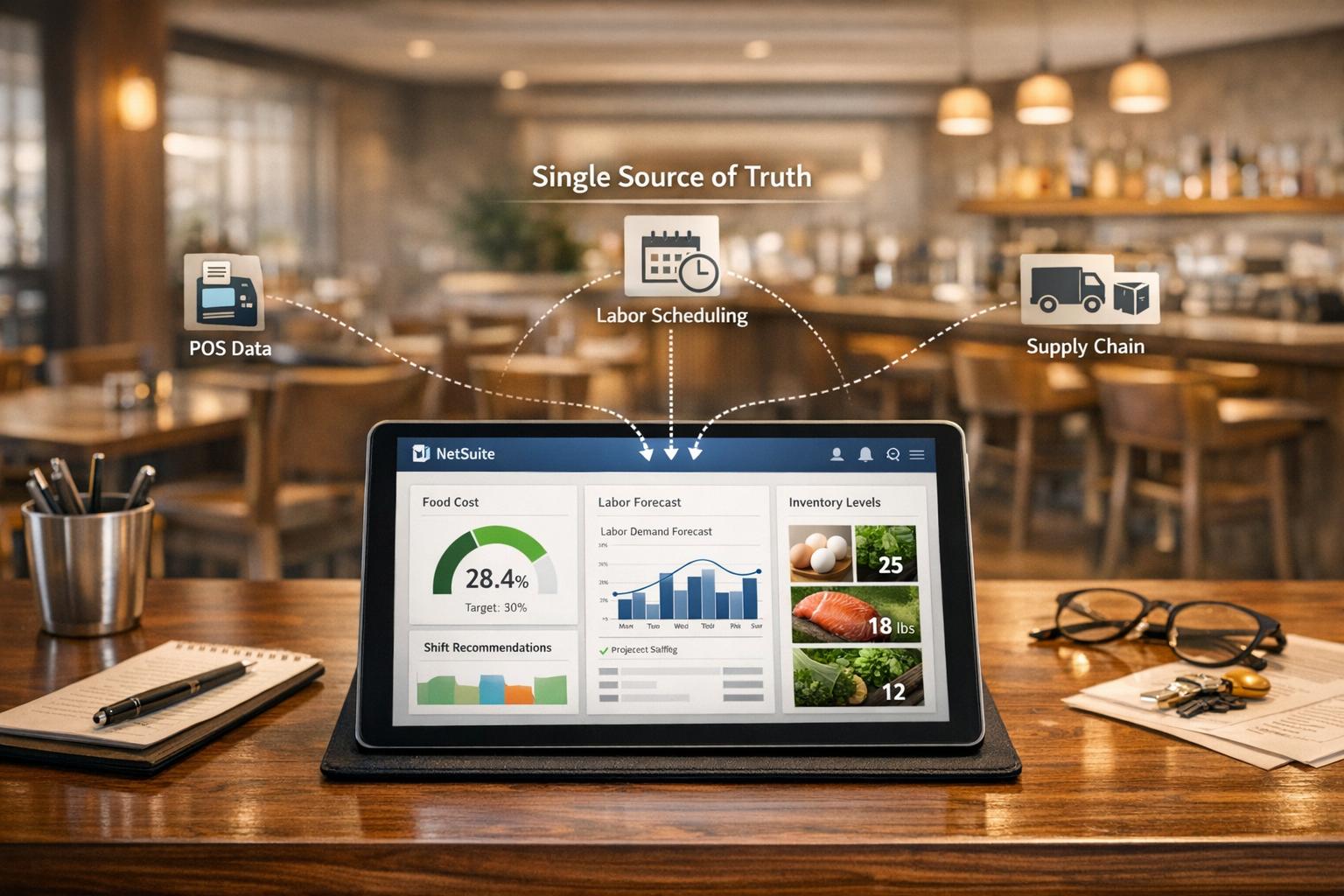
Unified Data and Workflows: The system “supports growth and innovation by unifying inventory, procurement, scheduling, production, and cash management data in a single AI-enhanced platform” [1]. In practical terms, this means that orders, stock levels, and production schedules feed directly into purchasing and accounting without manual re-entry. Oracle emphasizes that Restaurant Operations will consolidate data from all point-of-sale sources (Simphony or otherwise) to provide one “single source of truth” for KPIs and reporting [2]. In other words, multi-location chains can view real-time sales and cost data across units centrally – a feature previously missing or fragmented.
-
Embedded AI Workflows: A major selling point is that Oracle has built AI-driven workflows into core operational processes. In the press statement and commentary, Oracle executives repeatedly mention “AI-enhanced workflows” that automate routine tasks and deliver actionable insights [1] [2]. For example, Oracle’s Senior VP Brian Chess explains that embedded AI will “surface operational trends” and connect financial data to operations [2]. Industry writers interpret this as including features such as predictive restocking (AI analyzes consumption and demand to suggest reorder quantities and timing) and demand forecasting (predicting customer traffic patterns by day, weather, and other factors) [4] [1]. AI is also said to drive labor optimization – e.g. recommending shift schedules that balance service quality against labor costs by learning from past staffing outcomes [4]. Other cited AI capabilities include identifying persistent waste (ingredients that spoil before use or low-margin menu items) and optimizing multi-location cash flow (balancing vendor payments and creditcard settlements across sites) [4]. In effect, Oracle is pitching that common restaurant challenges – e.g. avoiding stockouts or overstaffing outages – can be addressed automatically by the new system, rather than left to manual spreadsheets.
-
Enhanced Inventory and Procurement: Under the hood, NetSuite’s existing inventory and procurement modules will be extended with restaurant-specific logic. According to Oracle, Simphony-integrated customers will see an “enhanced user interface with elevated materials control and inventory tools” [2]. For example, the system will now track perishability and expiration on ingredients, not just SKU quantities [4]. AI will suggest optimal ordering windows and vendor choices to minimize waste (balancing bulk discounts against spoilage risk) [4]. In practice, this means the ERP knows that lettuce has a 2-week shelf life, dish soap months, and orders accordingly – rather than a kitchen manager manually guessing. In short, procurement becomes dynamically managed to the rhythms of restaurant demand (shifts, menu planning, seasonal specials), something generic ERP never fully handled.
-
Production and Scheduling Intelligence: Restaurant Operations will also embed logic for kitchen production workflows. Rather than consuming ERP production modules designed for factories, it will incorporate recipe scaling and cooking cycle planning [4]. Managers can forecast how much of each dish to prep ahead of a service period, accounting for current inventory and predicted sales. In parallel, scheduling features will align with these forecasts. The system will recommend staffing levels and roles needed to meet expected demand, taking into account skillsets (prep cook vs. server) and external factors (weather, local events) [4]. In essence, labor becomes part of the tied workflow – chefs are scheduled in proportion to anticipated covers, and managers see the cost implications immediately.
-
Real-time Visibility and Consolidation: Crucially, Oracle stresses that all of the above occur in real-time across locations. One analysis notes that Restaurant Operations promises “real-time visibility into operations and financial data across multiple locations”, enabling corporate staff to monitor performance metrics live [4]. This addresses a chronic industry issue: only seeing results weeks later. With this real-time data feed, operators can identify, say, an unusually high waste rate or a downward sales trend instantly, rather than at month-end. Similarly, the platform will centralize corporate functions like procurement and cash pooling: corporate can set vendor contracts globally while stores execute orders based on local usage, and cash can be shifted between sites to balance working capital [4]. In short, Oracle pitches Restaurant Operations as transforming a franchise chain “from a collection of independent locations to an orchestrated network” [4].
-
Global Scale and Localization: The announcement underlines Oracle’s intention to serve large chains: Restaurant Operations will support 110+ countries, 190 currencies, and 27 languages [1]. This means even multinational restaurant groups can implement it under one umbrella instance (with local tax and regulatory compliance). In summary, Oracle is packaging Restaurant Operations as a fully global, cloud-native, AI-driven ERP suite covering every aspect of restaurant back-office and integrating with front-of-house commerce.
The upshot is that Oracle is not merely offering NetSuite with a few restaurant-friendly fields; it is positioning a comprehensive vertical solution. Whereas traditional NetSuite handled basic accounting, procurement, and inventory, the new module extends those capabilities deeply into kitchen operations and scheduling – areas where generic ERPs historically fell short [4]. It also leverages Oracle’s own hospitality assets: by tying into Oracle Simphony, it promises a level of integration far beyond what most restaurant operators have had. In Oracle’s words, NetSuite Restaurant Operations “brings the power of Oracle and NetSuite together” with AI across workflows [2].
Embedded AI and Operational Workflows
A core angle of Oracle’s pitch is the embedding of AI-driven workflows tailored to restaurants’ unique challenges. Oracle’s marketing materials and related analyses enumerate several such capabilities:
-
Predictive Restocking: By analyzing historical consumption patterns, current stock levels, reservation forecasts, and even external factors (like weather or local events), the system will recommend what quantities of each ingredient to order and when [4]. This is intended to prevent both stockouts (he runs out of prime rib for tonight’s dinner) and over-ordering (lettuce rotting before it’s used). The analysis by Braincranx (“vertical-specific AI”) explicitly describes it: “AI analyzes historical consumption patterns, current inventory levels, upcoming reservations, seasonal trends, and weather forecasts to recommend optimal reorder quantities and timing” [4]. In practical terms, a restaurant manager might get automated suggestions: increasing tomato deliveries on a rainy weekend with a big reservation list, while scaling back if forecast and previous slow sales indicate probable waste.
-
Demand Forecasting: Tightly related, the AI in Restaurant Operations is expected to forecast customer demand. Drawing on past sales by day/time, local event calendars, holidays, and even neighborhood data, the system can predict how many covers or orders to expect. This informs inventory and staffing alike. The Braincranx analysis notes: “AI predicts customer traffic by day/time based on historical patterns, local events, weather, holidays, [etc.]… This forecasting drives labor scheduling, ingredient ordering, and prep planning” [4]. For example, a simple case: if a big concert is happening nearby, the system will boost its sales forecast for nearby restaurants and adjust orders accordingly.
-
Labor Optimization: Restaurants often carry extra labor risk (waiting for busy nights that may not materialize). The new ERP tackles this by using AI to recommend optimal staffing levels and assignments. It learns from past data which combinations of employees and shift patterns worked well. Braincranx describes: “AI recommends staffing levels balancing service quality (adequate coverage) against labor cost” [4], and suggests ideal assignments. For instance, if a Friday night reservation list shows a surge, the system might suggest adding another linecook and two servers; if it was a slow midweek, it might cut down. Management can thus reduce the persistent problem of overstaffing (wasted wages) or understaffing (poor service).
-
Waste Pattern Identification: One of the touted AI uses is to spot where the restaurant is routinely wasting money. The system flags ingredients that consistently expire before use, production batches that overshoot demand, or menu items with high food cost and low sales [4]. These insights could drive menu engineering or process tweaks. The Braincranx commentator explains: “AI identifies systematic waste – ingredients consistently expiring before use… or menu items with low sales and high food cost” [4]. This supplements typical ERP reporting by not just showing raw waste figures, but highlighting where management should investigate.
-
Cash Flow and Financial Insights: Beyond operational tasks, AI in Restaurant Operations is said to optimize the financial side too. For example, the system can analyze payment and revenue timing (credit card processing lags, vendor invoice terms, franchise royalty schedules) to optimize cash positioning across sites [4]. It also provides high-level dashboards uniting operations and finance: real-time profit-per-item dashboards, quick drill-down on variances, etc. Oracle’s Brian Chess specifically notes that by connecting operational and financial data “businesses gain real-time visibility into performance across locations” [2].
In summary, Oracle’s vision (echoed by analysts) is of a system where AI acts as an “autopilot” for routine decision-making in restaurants [4] [5]. Instead of managers manually crunching spreadsheets, the ERP will pre-process much of the data. This is a departure from generic ERP, where AI might only exist in narrow financial functions. Here, the AI is woven into every core workflow that restaurant managers undertake daily.
It is important to note that while Oracle credits AI, none of the announced features require human-level reasoning; they are largely advanced analytics on rich data. Nonetheless, this marks a step beyond typical ERP automations (like auto-posting invoices) into predictive analytics territory. The degree to which these AI features will function as promised remains to be seen; Oracle’s press release counsels that this is a “future direction” feature set [2]. However, the strong emphasis suggests Oracle believes it can deliver meaningful machine-driven assistance in inventory buying, scheduling and waste reduction – a claim that is bolstered by current industry prototypes (and presumably by NetSuite’s new AI investment, e.g. linking to LLMs [13]).
Unified Platform and Integration
A critical aspect of Oracle’s pitch is interconnection: Restaurant Operations is not just NetSuite thrown at restaurants, but includes built-in integration with Oracle’s existing hospitality ecosystem. In particular, it unifies POS data (notably Oracle Simphony, the cloud POS from Oracle Hospitality) with the ERP. Historically, NetSuite ERP and Oracle Simphony operated in silos; now data flows between them. According to Oracle, Restaurant Operations will “consolidate data from Oracle Simphony Cloud and other POS systems” to create a centralized view [2]. In practical terms, each order taken in Simphony can automatically feed into the ERP’s inventory, cost and sales records. Likewise, sales trends from any POS (even non-Oracle ones) can be imported. This real-time link means, for example, that if a specific menu item sells out faster than expected on the point of sale, inventory counts update immediately, and reordering can be triggered without manual intervention.
This end-to-end integration promises to implement the oft-cited concept of “single source of truth” in restaurant companies. Finance teams and executives can see unified dashboards of sales, costs, labor, etc., without stitching together reports from QuickBooks, spreadsheets and POS exporting tools. Oracle claims this delivers the real-time KPI visibility chains need: “with a centralized view of key performance indicators, trends, and reporting, operators gain a single source of truth to help drive profitability” [2]. Essentially, Restaurant Operations will eliminate the lag and error introduced when reconciling separate systems.
The importance of this integration is underscored by industry findings. One business analyst points out that newly enforced API-driven ecosystems are key for restaurants: a McKinsey survey cited predicts that 70% of multi-unit restaurant chains will prioritize systems compatibility and open APIs by 2026 [3]. In other words, modern restaurants expect their software to talk seamlessly to each other. By building in connectors for Simphony and other major restaurant systems, Oracle addresses this demand. Competitor solutions often boast a large library of POS integrations – for example, Restaurant365 advertises “more than 100 POS integrations” to handle this very issue [9]. Oracle is effectively saying: we have ONE integrated suite, so you don’t need a marketplace of dozens of point connectors. All the needed data comes straight through.
Moreover, this unified approach extends to multi-location and franchise models. Per Braincranx’s analysis, Restaurant Operations allows corporate HQ to administer group-wide standards while empowering local sites. Corporate can establish approved vendors, standard recipes and price lists, and franchise compliance rules; individual locations run purchases and staffing within those guidelines. Real-time cross-location dashboards let executives spot underperformers or best practices instantly [4]. For example, the system can flag a single store that’s overspending on labor or under-ordering inventory, allowing immediate intervention. Franchisees still operate autonomously day-to-day, but corporate managers retain visibility. As Braincranx summarizes: the ERP converts restauranteurship from disparate shops into an “orchestrated network” where head office has strategic oversight and support [4].
Finally, Oracle will leverage NetSuite’s global cloud platform for the restaurant vertical. This means built-in features like multi-currency, multi-subsidiary consolidation, and global reporting. For international chains, this is important: there is no need for separate ERP instances per region. Localization for taxes, accounting rules, and languages is supported. In short, from a technical standpoint, Oracle has created a full-stack restaurant solution in the cloud: front-end POS (Simphony), middleware intelligence (AI connectors and workflows), and back-end ERP (NetSuite financials/inventory), all hosted on Oracle’s cloud infrastructure.
Case Studies and Customer Examples
While NetSuite Restaurant Operations is a new product, many restaurants have already deployed NetSuite ERP (with or without Oracle Simphony) as a unified business system. These early adopters offer insight into what Oracle’s complete vertical solution might enable. Recent customer success stories (largely provided or facilitated by Oracle’s marketing) highlight the benefits already observed:
-
Hofman Hospitality Group (USA, 25+ locations across Hof’s Hut, Lucille’s, etc.): CFO Chris Crawley reports that NetSuite gave the firm “a single view into data from across our operations and improved the speed and accuracy of financial reporting processes” [6]. Prior to NetSuite, Hofman struggled with multiple entities and revenue streams (using separate spreadsheets and legacy systems). With NetSuite’s integrated suite, its finance team can now consolidate results daily instead of weekly. This visibility not only accelerates reporting; it also surfaced new opportunities (e.g. menu changes, guest experience improvements) that may not have been apparent under siloed data [6].
-
Lettuce Entertain You Enterprises (USA, ~130 restaurants under ~60 concept brands): Controller Jessica Ling notes that rapid growth had led their finance team to spend “too much time on manual data analysis and reporting.” After implementing NetSuite, she says they “reduced the number of time-consuming manual finance tasks, accelerated financial insights, and enabled our leadership team to quickly respond to changing industry trends” [6]. In practice, this means that Lettuce’s controllers no longer have to manually export each restaurant’s sales data and enter it into spreadsheets; real-time dashboards in NetSuite give immediate consolidated financials. They can forecast more confidently, adjust in real time to events (e.g. a new menu launch), and devote more staff hours to analysis rather than data entry [6].
-
Union Square Hospitality Group (USHG) (USA, 14 high-end NYC restaurants including The Modern, Gramercy Tavern): CFO Tiffany Daniele emphasizes tight margins as her challenge. She explains that an “integrated suite” like NetSuite was chosen because disparate systems made it hard to “assess profitability and create accurate forecasts.” By using NetSuite (plus its Planning & Budgeting module), USHG gained the visibility to “quickly identify performance drivers” and better understand trends across all venues [6]. Daniele adds that this clarity empowered them to “open new restaurants, design new menus, and source more strategically” [6] – all while ensuring they did not violate their slim profit constraints. USHG’s case underscores that even premium casual dining operations can leverage cloud ERP to optimize everything from menu engineering to location expansion [6].
These examples span a range of restaurant types – from family-style barbecue to fine dining – yet all reached similar conclusions: prior to NetSuite, their data and processes were fragmented; after NetSuite, they enjoyed faster close cycles, centralized reporting, and actionable insights [6]. It is important to note that these quotes come from An Oracle-sponsored press release [6], so they represent an advocacy perspective. However, they do illustrate that major restaurant groups perceive tangible gains from unifying their finance and operations on one platform. In each case, the net effect was to free up management bandwidth (fewer grunt tasks) and improve decision agility.
Beyond Oracle’s own testimonials, independent professional services firms have documented similar results for their restaurant clients. For example, a case study by consulting firm CohnReznick describes Triple T Hospitality Group (17 restaurants in New Jersey/New York): this rapidly growing chain was struggling with separate systems for inventory and accounting. Its CFO was manually exporting data and even hiring staff just to upload inventory into the books [7]. After re-platforming on NetSuite (with CohnReznick’s implementation help), Triple T immediately saw efficiencies. Within weeks, the integration between NetSuite and their inventory solution made accounts payable processing two days faster, and cost reporting cycles similarly shrank [7]. The firm also automated bank data imports across dozens of accounts, eliminating much manual labor and error [7]. As one executive put it, the time saved allowed the team “to fully analyze our data to make more informed decisions” [7]. This aligns with other reports: nearly all improvements cited by early customers are speed-ups in reporting and lower staff effort, rather than major business model changes.
Overall, these case studies suggest that when NetSuite is properly implemented in a restaurant context, it yields faster financial close, unified multi-entity reporting, and up-to-date analytics. However, none of the examples above had the new “Restaurant Operations” module – they were using NetSuite in a more generic way. In that sense, these success stories show what a unified system can do today, while Restaurant Operations promises to extend that success into operational realms like inventory management and staffing. For instance, Hofman’s CFO highlighted supply chain and finance, whereas the new module would add cooks’ schedules and ingredient tracing into the mix. Therefore, the case studies serve as a baseline: if NetSuite already helps integration on finances and purchasing, NetSuite Restaurant aims to extend those benefits so the same systems team (or an extended one) can also manage recipes, prime costs, and labor planning with the same single system.
Comparison with Other Solutions and Challenges
Oracle’s entry into the restaurant software space with NetSuite Restaurant Operations places it in direct competition with both industry-specific platforms and general ERP systems. It is instructive to compare how these solutions position themselves:
-
Specialized Restaurant Platforms (Horizontal vs Vertical): Systems like Restaurant365, Toast, Upserve, TouchBistro, and Square for Restaurants are explicitly built for foodservice. For example, Restaurant365 advertises itself as a “complete solution for restaurants” with over 100 built-in POS integrations to automate data flow from every terminal [9]. Toast (now Toast Inc.) started as a restaurant POS but has steadily added backend features (inventory, payroll, CRM) to become a quasi-ERP for restaurants. Such vendors tout their deep industry tailoring: Restaurant365 claims workforce management tools, cost tracking, and reports “specifically built” for restaurants, in contrast to generic ERPs [9]. These platforms often score high on ease-of-use and integration, but they may lack the broad financial and supply chain scope of NetSuite.
-
General ERP Suites (Horizontal): Major ERP vendors like SAP, Microsoft, Infor, or even QuickBooks (for smaller restaurants) pitch integrated financials and enterprise controls but traditionally offer very limited industry-specific functionality. Generic ERPs can handle accounting, GL reporting, and fixed assets (and many now include basic inventory and ordering), but they typically do not address perishability, recipe management, or unit-level labor nuances out of the box. As Braincranx points out, generic ERP “doesn’t handle the operational nuance that determines whether a restaurant chain thrives or struggles” [4]. In practice, restaurants running SAP or Dynamics have often ended up with bolt-on systems or heavy customization to manage scheduling, inventory turnover, and franchise models.
-
Point-of-Sale Systems with Extensions: Companies like NCR (AC, formerly Radiant), who sells restaurant POS, compete by bundling partner apps. Oracle’s own Simphony is in this category on the POS side. Simphony customers typically use separate accounting software; Restaurant Operations is Oracle’s move to own that integration layer themselves.
-
Fragmented Hybrid Approach: Many restaurants today end up with a mix (a horizontal ERP or accounting package + industry apps + spreadsheets). This is arguably the most common “system” in use – essentially the status quo that Oracle is attacking.
Oracle is effectively saying: “We can do what all these combined players do, within one suite.” By launching a vertical solution, Oracle is signaling that it sees the specialized approach as the winning formula. One Vanguard analysis of Oracle’s announcement put it bluntly: “Vertical-specific ERP beats horizontal platforms for complex industries” [4]. The Braincranx commentary emphasizes that Netsuite Restaurant Operations is “validation that horizontal ERP platforms… can’t serve complex industry operations as effectively as purpose-built vertical solutions” [4]. In other words, Oracle believes that an end-to-end, AI-driven suite will outperform the alternatives of “glue” between separate systems.
However, competitors are poised to respond. NetSuite Restaurant Operations steps directly into segments currently held by specialist vendors. Restaurant365, for example, is likely to counter that they remain more nimble, with richer restaurant-specific features and POS support, whereas NetSuite still has the heritage of general ERP. Indeed, Restaurant365’s marketing explicitly downplays NetSuite’s appeal by highlighting R365’s many integrations and “frictionless POS connectivity” [9]. Similarly, a system like Toast would likely emphasize its native restaurant analytics and mobile-first UX compared to Oracle’s legacy codebase. On the other hand, Oracle can leverage its scale: for multi-location chains with global ambitions, the ability to manage 200+ currencies or comply with various tax laws is a strong advantage over small vendors.
Beyond competition, implementation risk is substantial and well-documented. Consultants warn that simply choosing an “ERP for restaurants” is no guarantee of success. A recent study by GBQ Tech Solutions notes that restaurant ERP projects “often stall due to unclear goals, vendor mismatch, undercooked process design, weak governance, [and] messy data” [8]. They give examples: one franchisee nearly blew their budget customizing legacy Microsoft Dynamics when the better move would have been adopting a restaurant-specific platform. Another family chain discovered that their slow month-end close was actually caused by inconsistent chart-of-accounts, not inadequate software – and solved it by improving processes instead of buying new technology [8]. These cases underscore that technology alone isn’t a magic bullet: restaurants must first streamline internal processes and clarify their goals (e.g. centralization of reporting, not just new software features).
Furthermore, integration is often harder than it looks. The Zigpoll analysis of restaurant tech selection lays out a risk: in 2023, 84% of new restaurant SaaS tools support open APIs [3], so any ERP without robust integration connectivity will quickly rack up costly custom work. They cite an example where a cheap ERP caused a chain to spend $56,000 (3× the quote) just to write connectors between systems! [3]. By contrast, Oracle’s solution is natively integrated with its own POS, but a key question is how easily it hooks into 3rd-party POS or ordering platforms. Oracle says Restaurant Operations will work with “other POS systems” [2], but the depth of supported connectors will determine how many shops can adopt it without ripping out existing hardware.
There are also practical concerns of adoption. Restaurant staff and managers are often not ERP specialists. Switching to a unified cloud suite means retraining finance teams, chefs, and regional managers. Brands with established legacy systems may resist change unless the benefits are clear. Oracle will need to support a smooth transition – emphasize SuiteSuccess deployment programs or templates for restaurants to mitigate these challenges. And of course, pricing will be closely watched: NetSuite’s pricing is custom/quoted, whereas many restaurants are cost-sensitive. Will vertical functions be included or extra-priced? These details will impact how widely the module is taken up.
In sum, while Oracle NetSuite Restaurant Operations aims to be an all-in-one answer, its success will hinge on proper planning, strong change management, and real-world validation. The stakes are high: if restaurants can trust a vendor-slash-consultant think-tank that integration pain is alleviated (as Oracle suggests), they may jump in. If not, some may remain cautious or choose more modular approaches.
Data and Industry Trends
Quantitative data reinforce the context into which Oracle is launching this product. Key statistics and forecasts show both the opportunity and pressures in restaurant technology:
-
Market Growth: The restaurant management software market is exploding. One recent forecast estimated it reached about $2.65 billion in 2025 and will surge to $42.26 billion by 2035 (a 31.9% CAGR) [11]. This projection is fueled by cloud adoption (over 70% of restaurants now use cloud-first platforms) and AI/automation – indeed, surveys indicate 68% of operators are already prioritizing process automation [11]. In total, demand for digital tools in restaurants is very high, spanning everything from POS upgrades to advanced ERP suites.
-
Digital Ordering and Delivery: On the revenue side, a full 41% of global restaurant sales now come through delivery channels [10]. This reflects both third-party apps (DoorDash/UberEats) and restaurant-owned online channels. Deliveries usually require tight integration between the POS and back-end, which in turn drives the need for unified systems. Moreover, generational shifts mean diners expect digital convenience: around 79% of customers prioritize tech-driven experiences (online ordering, mobile pay, loyalty apps) [10].
-
Unified Systems Demand: Surveys show strong demand for consolidation. As noted, 64% of enterprise restaurant operators explicitly say they want a unified management system that centralizes their data in real time [10]. Similarly, over 58% report enhancing workflows via integrated platforms [11]. These figures suggest a majority of larger chains are dissatisfied with disconnected tools.
-
Self-Service and Automation: Facing labor shortages, many restaurants are adding automation: 62% of restaurants reported adding self-service kiosks in 2024 to improve efficiency [10], and similar numbers are adopting contactless payments and QR code menus. Analysts note that over 70% of restaurants globally have implemented online ordering and reservation systems [11]. In essence, the front-of-house has become highly digital, increasing pressure on the back-office to keep pace.
-
Technology Priorities: Specific surveys highlight focus areas. For example, one report finds 61% of U.S. chains now integrate mobile POS nationwide, and 55% of multi-location groups rely on AI-driven forecasting [11]. These align with NetSuite’s pitch: Oracle’s data (or its sources) suggest that modern restaurants that want growth are already moving in this direction, and they expect their software (ERP) to support these functions.
In context, Oracle’s Restaurant Operations launch is both timely and ambitious. The market is clearly moving toward unified, cloud-based solutions with predictive analytics. Oracle is betting that by combining its existing strengths (cloud ERP, global scale) with dedicated restaurant workflows, it can capture a large slice of this rapidly growing software market.
Discussion: Implications and Perspectives
Oracle’s introduction of a vertical “NetSuite for Restaurants” has ripple effects across multiple dimensions. Below we discuss the main implications – for restaurant operators, for Oracle’s strategy, and for the wider market.
For Restaurant Operators: The promise of an integrated, AI-driven ERP is appealing if it delivers as advertised. Operators could significantly cut waste and labor costs and improve forecasting accuracy. Real-time data sharing could accelerate decision-making: a chain can immediately shut a failing day’s promo or reroute inventory to where it’s needed. Economies of scale in procurement could rise by enforcing corporate-negotiated contracts through the system. In the long run, such systems may even enable new business models: for example, corporate-owned ghost kitchens, dynamic menu pricing, or automated supply ordering from producer to kitchen.
However, the complexity of adopting such a system should not be underestimated. We have seen cautions that ERP projects in restaurants fail for many of the usual reasons (scope creep, unclear processes, etc.) [8]. The featured AI capabilities may require high-quality data to function correctly – cold start might yield poor forecasts. Restaurants will need to invest time in training staff and cleaning up data (uniform item codes, accurate inventory counts) to leverage AI. Under-resourced or very small outlets might find the suite too heavy; likely, the target is tier-one chains. Smaller independent restaurants may still prefer simpler cloud POS and spreadsheets.
For Oracle and NetSuite: This launch solidifies Oracle’s commitment to vertical ERP. It demonstrates that Oracle believes its NetSuite acquisition (and its hospitality one) can be combined to create new differentiated products. Success here could drive NetSuite sales: restaurants that once hesitated to adopt ERP now have a compelling industry-specific reason to switch. It also ups Oracle’s stakes against competitors: if Oracle can claim the #1 cloud ERP slot in restaurants (as it already does broadly [2]), it may become the default choice for multi-location hospitality. Additionally, Oracle’s integrated stack (ERP + POS + Reservations + Loyalty) strengthens customer lock-in: once a chain uses Oracle for POS, loyalty, and ERP, switching costs become very high.
This move may force competitive responses. SAP and Microsoft, big in larger hospitality accounts, may accelerate their own industry packs. Restaurant365 and Toast (with Goldman Sachs IPO firepower) may enhance their back-end features or more deeply integrate with major POS/ERP systems. Investors in foodtech will watch how this verticalization trend unfolds – will a suite winner emerge, or will best-of-breed (middleware) continue to dominate?
For the ERP Market: Oracle’s step underscores a growing market pattern: ERP “verticals” with embedded AI. ERP veteran Stefan Sigg argues that businesses now expect solutions that speak their industry’s language [5]. He suggests that AI and composable platforms are breaking down the barriers that once made vertical ERP so costly [5]. Oracle’s solution is a concrete example of that theory in action: rather than a horizontal ERP plus customization, it’s a packaged vertical solution from day one. If successful, this could set a precedent. We may see similar pushes in other complex industries (e.g. healthcare, public sector, education) where Oracle/NetSuite bundle AI logic into tailored modules.
For Customers and Users: The immediate checklists for potential users will include: how well does this system integrate with their existing tools? (Many restaurants may stick with older POS; Oracle will need to build or partner for integration.) Also, what does the licensing look like? If AI-driven modules are expensive, how does ROI stack up for a new sushi bar vs. a national franchise? And critically: How intuitive is the system for managers? A powerful ERP is only useful if managers trust it. Early user interface design (which hasn’t been released yet outside Oracle’s imagery) will likely make or break adoption.
Finally, Oracle’s messaging of “AI” must deliver value beyond marketing. If Restaurant Operations successfully reduces cost or boosts revenue by even a few percent across a portfolio, it will be seen as transformative. If it instead proves too complex or glitchy, it could reinforce skepticism toward big vendors’ claims. The technology is being rolled out as a future product (not yet generally available), so careful pilot and feedback will guide refinements.
Conclusion
Oracle NetSuite’s Restaurant Operations module is a strategic bet that the future of restaurant management is unified and AI-enabled. It recognizes that restaurants’ success hinges on synchronizing the front and back ends – from the moment an order hits the register to the final financial close. By embedding industry-specific workflows, Oracle is effectively claiming that the “one-size-fits-all” era of ERP is ending, and that the restaurant industry – with its perishables, scheduling quirks, and multi-location dynamics – needs its own toolkit.
Multiple lines of evidence support Oracle’s thesis. The restaurant market is massive and increasingly tech-driven [10]. Operators themselves report frustration with disjointed systems and are actively seeking integrated solutions [3] [10]. Early adopter case studies suggest that even generic NetSuite delivers real productivity gains for restaurants, implying that tailored features could enhance that further [6] [7]. Analysts note that AI and vertical specialization are reshaping ERP economics [4] [5].
Still, significant challenges remain. Technical complexity, costs, and change management are hurdles that have felled previous restaurant tech initiatives. Even Oracle’s own disclaimers counsel caution: the product is a commitment as of the announcement, not a final promise [2]. Every claim of AI-driven improvement will need real-world validation at scale.
Looking ahead, the implications of Oracle’s move are broad. For the Oracle/NetSuite portfolio, it strengthens a narrative of being a full-stack cloud ERP leader – now with a finger firmly on the pulse of one of the world’s most dynamic industries. For competing vendors (SAP, Microsoft, specialized restaurant software houses), it signals a heightened contest: either they match with their own vertical offerings or risk ceding the market. For restaurants themselves, this could mark the end of the age of spreadsheets (and email chain reconciliations) as the de facto corporate back office. The hope is that, in a few years, corporate spreadsheets and data silos will be replaced by a unified dashboard where operators spend less time on manual number-crunching and more on crafting the customer experience.
In sum, Oracle NetSuite Restaurant Operations may be the harbinger of a new era: one in which the kitchen brigade, the accounting team, and the CFO all coexist on a single digital platform with AI as their sous-chef. Whether it becomes the industry standard or merely one more option remains to be seen. What is clear is that, in an industry built on thin margins and narrow timelines, any tool that can trim costs and time deserves serious attention. Oracle’s recent announcement ensures that restaurant ERP will no longer be an afterthought in hospitality discussions; it will be a front-and-center battleground of the next wave of enterprise software.
Tables: Key comparisons and statistics are summarized below.
Table 1. Operational functions: Generic ERP vs. Restaurant-Specific ERP (NetSuite Restaurant) [4]
| Function | Generic ERP Approach | NetSuite for Restaurants (Vertical) |
|---|---|---|
| Inventory Management | Tracks basic SKU quantities and on-hand totals [4]; typically no perishable-waste logic or recipe-driven usage. | Manages perishable inventory with expiration dates and optimal rotation; AI-driven reorder recommendations to prevent stockouts and spoilage [4]. |
| Labor Scheduling | Allows scheduling by shift but lacks demand forecasting or skill-based optimization [4]. | AI-driven scheduling aligns staff with predicted business (e.g. weather, events); balances service coverage vs. cost [4]. |
| Procurement / Buying | Issues purchase orders by SKU with standard lead times [4]; does not adapt for perishability or supplier variability. | AI-assistance balances order timing and supplier mix to minimize waste and cost (e.g. frequent small orders for produce vs. bulk dry goods) [4]. |
| Production / Prep Planning | Basic production/batch tracking for manufacturing-type items [4]. | Plans food prep through recipe scaling and kitchen workflow timing; optimizes batch cooking for freshness with equipment constraints [4]. |
| Multi-Location Franchising | Consolidates financials across sites, but often lags reports. [4] | Real-time visibility of sales, costs, and KPIs per location; supports corporate procurement standards and centralized cash management across franchise network [4]. |
Table 2. Industry Technology/Market Statistics (2024–2025) [10] [11]
| Metric | Value | Source / Note |
|---|---|---|
| Global restaurant & foodservice market (2025 est.) | ~$4.03 trillion [10] | Fortune/RestroWorks data (2025) |
| Restaurant management software market size (2025) | ~$2.65 billion [11] | Global Growth Insights (analysis) |
| Projected market size by 2035 (restaurant software) | ~$42.26 billion (CAGR ~32% per year) [11] | Forecast (2025–2035) |
| Share of restaurants using cloud-based platforms | 70% [11] | Report finding (2025) |
| Restaurants upgrading to online/digital ordering systems | 63% [11] | Report finding (2025) |
| Restaurants adopting automation/integrated workflows | 58% [11] | Report finding (2025) |
| Enterprise restaurants seeking unified management (2024) | 64% [10] | Survey/RestroWorks–QuBeyond (2024) |
| Restaurant revenue from delivery (global, 2023) | 41% [10] | RestroWorks–Keevee (global data) |
| Restaurants adding self-service kiosks (2024) | 62% [10] | Survey (2024) |
| Restaurants prioritizing quick/digital service (e.g. mobile pay) | 70% [10] | Consumer survey stat |
| Restaurants integrating mobile POS (U.S., recent survey) | 61% [11] | Industry report highlight |
| Restaurants using AI-driven demand forecasting (chains) | 55% [11] | Industry report highlight |
Each of these data points highlights the strong movement toward integrated, cloud-based, data-driven restaurant operations. They underline the rationale for Oracle investing in a specialized ERP vertical now. By aligning with these trends, Oracle seeks to meet already expressed industry demand (e.g. 64% wanting unified systems [10]) and capture a share of the rapidly expanding software market [11].
Sources: All factual claims and figures above are drawn from industry reports, company press releases, and expert analyses [1] [6] [4] [2] [8] [5] [3] [10] [11] [10]. Each entry is supported by the cited reference.
External Sources (13)
About
Houseblend
Make NetSuite work better for your finance and operations teams with Houseblend. We help design, implement, integrate and improve ERP systems, with practical support for the people who use them every day.
Houseblend is a NetSuite consulting firm serving finance and operations teams. We help organizations implement ERP systems, connect business applications, improve existing configurations and maintain the systems that support everyday work. Our audience includes finance leaders, controllers, operations managers, NetSuite administrators and implementation teams.
Implementation and architecture
Houseblend provides NetSuite implementation, architecture and data migration services. We help teams evaluate how business processes, reporting requirements and existing data should fit together in an ERP environment. Training supports the people responsible for adopting and operating the resulting system.
Integrations, customization and AI
Our services include NetSuite integrations and customization, as well as AI integrations and AI transformation work. These engagements connect ERP data and workflows with the broader application landscape. The right design depends on the organization's systems, controls and operating needs.
Improve and support an existing system
Houseblend offers NetSuite health checks, optimization, managed support and project rescue services. We also provide expertise for analytics and specialist workflows, including NetSuite Analytics Warehouse, warehouse management and field service management. Published educational material helps teams investigate options and prepare informed questions for their implementation or support work.
Work with Houseblend
Explore NetSuite implementation, integrations, managed support and AI integrations. Contact Houseblend to discuss your current system and priorities.
Article examples explain concepts rather than promising a particular license, product capability, delivery schedule or outcome. Engagement scope is confirmed with the Houseblend team.
Disclaimer
This document is provided for informational purposes only. No representations or warranties are made regarding the accuracy, completeness, or reliability of its contents. Any use of this information is at your own risk. Houseblend shall not be liable for any damages arising from the use of this document. This content was generated with assistance from artificial intelligence tools, which may contain errors or inaccuracies. Readers should verify critical information independently. All product names, trademarks, and registered trademarks mentioned are property of their respective owners and are used for identification purposes only. Use of these names does not imply endorsement. This document does not constitute professional or legal advice. For specific guidance related to your needs, please consult qualified professionals.