Houseblend Article
NetSuite SuiteBilling: Usage-Based Billing Configuration
Inside this article
Executive Summary
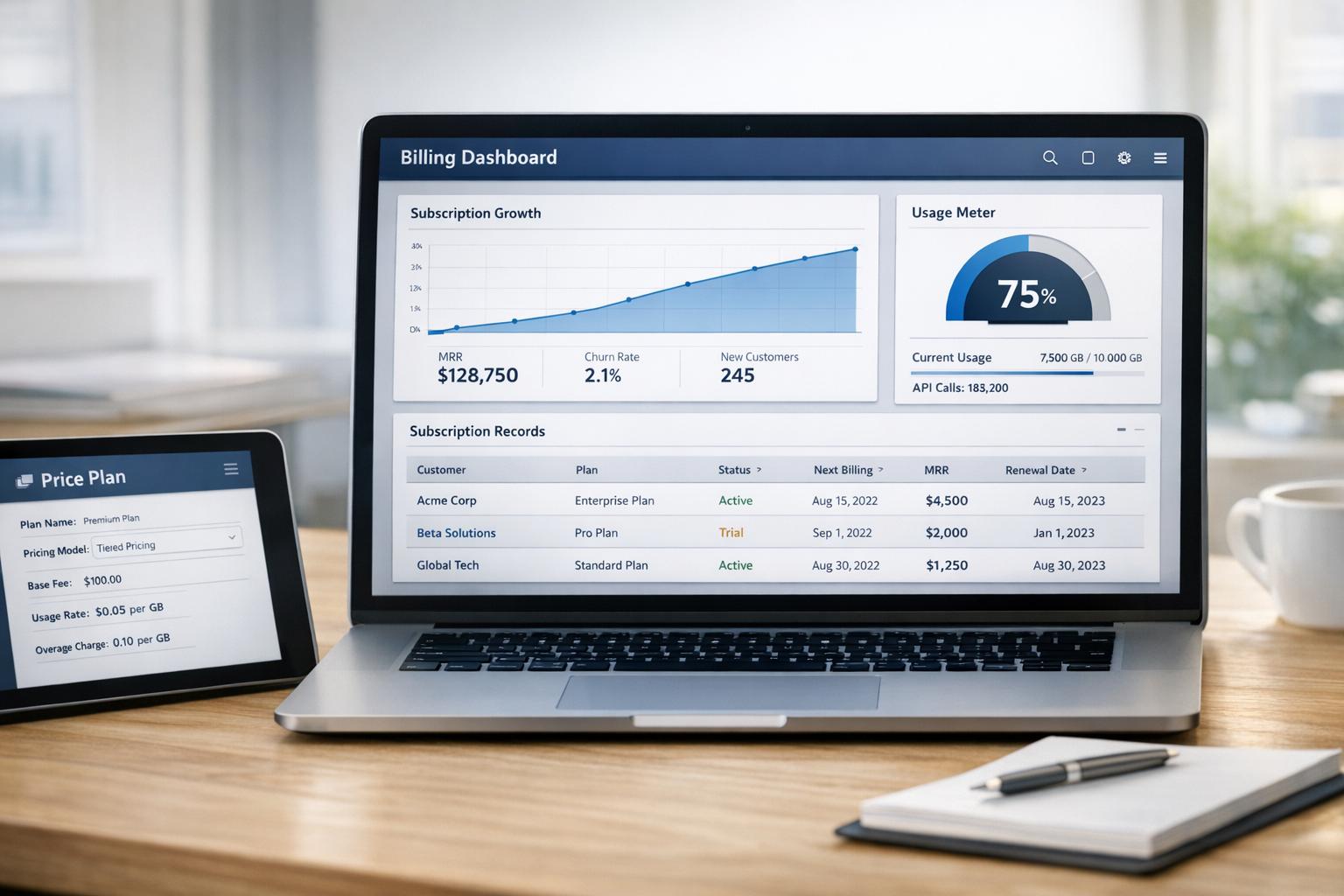
Usage-based billing (UBB), also known as consumption-based billing, has become a prominent model in the modern subscription economy. Instead of constant flat fees, customers pay in proportion to their actual usage of a service or resource (e.g. data, minutes, compute). This model drives transparency and can align service cost with customer value (Source: abaxus.software). Oracle NetSuite’s SuiteBilling is an integrated billing module within NetSuite ERP that supports usage-based and hybrid subscription billing models. SuiteBilling enables businesses to define usage meters, import or capture usage data, and automate the rating and invoicing of consumption charges all within the NetSuite platform [1] [2]. Its native integration with NetSuite means that billing, accounting, and revenue recognition are unified, simplifying audit and reconciliation.
This report provides a comprehensive examination of NetSuite’s SuiteBilling usage-based billing capabilities, focusing on metering and configuration. We first review the growth of usage-based models in industry and the design of the SuiteBilling system. We then detail how to configure SuiteBilling for metered charges: enabling features, creating item and price plan records, and loading usage data (via UI, CSV import, or API). We explain how SuiteBilling processes usage records through “billing operations” to generate invoices. Key system objects (billing accounts, subscriptions, usage records, etc.) are defined, and best practices are highlighted. We contrast SuiteBilling’s abilities with dedicated third-party billing platforms (e.g. Zuora, Chargebee), noting trade-offs in flexibility, scale, and integration. Throughout, authoritative sources – including Oracle documentation, industry analyses, and expert writings – support the discussion. The report concludes with practical implications and future directions, such as advances in AI-driven billing and the continuing evolution of consumption economies (Source: abaxus.software).
Introduction and Background
The Shift to Usage-Based Billing
In the past decade, many industries have moved from one-time sales to recurring and consumption-based models. Zuora popularized the term “Subscription Economy” in the 2010s to describe how companies increasingly monetize via subscriptions and usage fees. SaaS, media, telecom, and even traditionally one-time-sale sectors (like automotive and consumer goods) now embrace billed-on-consumption models [3]. Companies offer pay-as-you-go or tiered usage pricing so that customers “pay for what they actually consume” (Source: abaxus.software). This alignment can build trust and reduce churn: for example, research suggests companies using consumption pricing see 23% higher customer lifetime value compared to flat models, as customers perceive greater fairness (Source: abaxus.software). Across SaaS, an industry report found 61% of companies were testing usage-based pricing, with 38% reporting significant revenue gains after doing so (Source: abaxus.software). Notably, heavy-usage businesses like Snowflake and Stripe exemplify the model’s success: Snowflake’s credit-based billing helped it achieve ~135% net revenue retention (Source: abaxus.software), and Stripe’s per-transaction pricing supports billions in annual volume and simple cost transparency (Source: abaxus.software).
This trend reflects broader market pressures. Customers increasingly demand flexible, transparent pricing; surveys report that 84% of enterprise customers want agility in billing terms (Source: abaxus.software). According to Zuora’s Subscription Economy Index, many buyers experience “subscription fatigue” under rigid plans, and transparent value-based pricing is a key vendor-selection factor (Source: abaxus.software). In short, the traditional one-size-fits-all subscription tiers often misalign cost and value, hurting both user satisfaction and vendor revenue. Usage-based billing addresses this by billing in arrears based on real metrics (e.g. API calls, data usage, hours, machine minutes), eliminating overage disputes and encouraging “pay-for-value” relationships (Source: abaxus.software).
Meanwhile, platforms for managing complex billing have proliferated. Gartner and Forrester note that advanced billing now centers on cloud-based, API-driven systems. Global market analyses project the subscription billing management market (including usage billing functionality) growing from roughly $4.5 billion in 2022 to around $7.4 billion by 2028. This reflects not only more recurring revenue models but also digital finance transformations (ERP adoption, automation) driving demand for integrated solutions. NetSuite, as a leading cloud ERP with thousands of customers worldwide, has accordingly invested in native subscription billing (SuiteBilling) to keep pace with these trends.
NetSuite SuiteBilling Overview
NetSuite SuiteBilling was introduced (announced in 2016) as Oracle’s answer to heterogeneous billing needs—subscription, usage, or hybrid.Designed from the ground up within NetSuite ERP, SuiteBilling provides end-to-end revenue automation from quote/order through invoicing and revenue recognition. Being fully native, it leverages NetSuite’s data (customers, items, GL accounts) so that no external billing database is required. This tight integration simplifies bookkeeping and ensures a single source of truth.
SuiteBilling extends NetSuite’s data model with several new record types and concepts (some key definitions in Table 1). For example, a Billing Account groups the billing information (billing schedule, addresses, currency) for a customer or sub-customer [1]. A Subscription Plan is a template of items (services or non-inventory products) to be sold on subscription, including price book assignments and renewal terms [1]. Each Subscription is then an instance of such a plan for a given customer, with specific start dates and quantities [1]. Subscriptions contain one or more Subscription Lines – each line corresponds to an item (e.g. a service tier, or usage object) and its quantity. To handle usage billing, SuiteBilling introduces Usage Record objects, which capture actual consumption against a subscription line (units of time, data, etc.) [1] [2]. Other constructs include Billing Operations (routine that runs rating and invoicing automatically [1]), Price Books (collections of price plans for items) and Price Plans (tiered or volume pricing per item) [1]. Whenever a subscription is changed (e.g. upgrade/downgrade), a Change Order record is used to move the subscription’s effective date and re-calculate charges [1] [4].
SuiteBilling supports multiple pricing models in one system: flat (fixed recurring) fees, tiered/volume pricing, and metered (usage) pricing [1]. For usage-based lines, customers can commit to a base amount (the Commit Plus Overage model) with overage billed on a per-unit basis [5]. Tiered pricing (e.g. volume thresholds) and promotional discounts are accommodated. All invoicing (both recurring and usage charges) feeds into NetSuite’s Advanced Revenue Management (ARM) compliance engine for ASC 606/IFRS 15 revenue recognition. In summary, SuiteBilling aims to fully automate invoicing and revenue schedules for subscription and usage products—without leaving NetSuite. (Table 1 lists key SuiteBilling records.)
| SuiteBilling Record / Object | Description |
|---|---|
| Billing Account | Customer/subcustomer billing profile: holds bill-to and ship-to addresses, billing schedule, currency, and related schedule info [1]. |
| Billing Operation | Process that automates rating (calculating charges) and invoicing for subscriptions. Executed via *Transactions > Billing > Process Billing Operations* [1]. |
| Subscription Plan | Template of items/services sold together on subscription. Includes default renewal terms, associated Price Book(s), and other settings [1]. |
| Price Book | Defines pricing for a collection of items/services in a subscription. A subscription plan can reference multiple price books (for different currencies or channels) [1]. |
| Price Plan | Pertains to an individual item in a Price Book. Sets pricing details (flat fee, tier breaks, volume discounts, included usage, multipliers) for that item [1] [6]. |
| Subscription | An active contract for a customer. Specifies start/end dates and contains one or more Subscription Lines based on a plan. Each subscription belongs to one billing account [1]. |
| Subscription Line | One line of the subscription, representing a specific item/service with quantity. A line may be of type Recurring (fixed fee), Usage, or Commit+Overage, affecting how charges are calculated [7] [5]. |
| Usage Record | Entry capturing actual consumption for a Usage-type subscription line. Includes the quantity used and date; used in rating runs to generate usage charges [7] [2]. |
| Change Order | Document used to amend a subscription (e.g. add/remove items, change quantities, extend term). It updates the Subscription/Subscription Lines and triggers new rating calculations [1] [4]. |
Table 1. Key SuiteBilling objects and their roles in usage-based subscription billing.
SuiteBilling Configuration and Metering
To implement usage-based billing in NetSuite, administrators must enable SuiteBilling features and then configure billing products, plans, and usage collection. The steps include provisioning SuiteBilling features, creating subscription items and price plans, and setting up mechanisms to record usage data. The following subsections detail these steps.
Enabling SuiteBilling Features
NetSuite’s SuiteBilling functionality is modular and must be activated in your account. An Administrator should navigate to Setup > Company > Enable Features, then the Transactions subtab. In the Billing section, the following boxes must be checked: Billing Accounts, Billing Operations, Charge-Based Billing, Subscription Billing, and Advanced Subscription Billing [8]. (The Advanced Billing option is also commonly enabled for more billing flexibility [8].) The Charge-Based Billing feature must be on to enable all subscription line item pricing details [8]. Optionally, enable Time-Based Pricing if you plan to use ramp or trial pricing intervals [8]. Once these are turned on, the new menu items (Transactions > Billing > Process Billing Operations, etc.) and Setup preferences appear.
SuiteBilling also relies on proper account permissions. The Billing Operations function (for running the rating/invoicing process) typically requires access via either the Administrator or Accounts Receivable Clerk role [9]. The Billing Specialist role can be granted permission to create usage records (even without full accounting permissions) [7]. System users who will manage subscriptions should have roles that include access to the Billing menu.
After enabling features, some accounting preferences should be reviewed. For example, on Setup > Accounting > Accounting Preferences, administrators can require or allow Classes, Departments, and Locations on subscription records as needed (SuiteBilling supplies optional advertising in the “Class, Department and Location” fields for revenue reporting [4]). Under Setup > Accounting > Invoicing Preferences, the Subscription Management subtab appears. Here you can set preferences like auto-activating subscriptions upon sales order approval and how off-cycle (mid-term) change orders generate credit memos [4]. Another important global preference, “Create Delta Charges for Changes to Invoiced Service Periods”, if enabled, will cause NetSuite to generate adjustment charges when a change order alters an already invoiced period [4]. These are optional settings but can streamline usage billing workflows (especially proration of mid-cycle usage).
In summary, enabling SuiteBilling requires checking the relevant boxes in Enable Features and adjusting a few optional preferences. Once complete, the environment is prepared for creating subscription items, price plans, and usage schedules within NetSuite (without needing external billing systems).
Creating Subscription Items and Price Plans
Defining Subscription Items
Before subscriptions can be built, the underlying Item records must be created in NetSuite. Subscription items must be either non-inventory items or service items; other types (inventory parts, assemblies) are not allowed in subscription plans [10]. To create a subscription item, go to Lists > Accounting > Items > New and select Non-Inventory Item (Mark “For Sale” or “For Resale”) or Service Item (For Sale/Resale) [10]. Key details:
- Item Name/Number: Enter a unique identifier for the subscription item.
- Classification Fields: If using Oracle OneWorld, you may set Class, Department, and Location (these can be used for revenue segmentation) [4].
- Preferences subtab: Uncheck Can Be Fulfilled/Received. By default, non-inventory items are marked as fulfillable; you must clear this box so the item is treated purely as a billing service [10]. (Service items default to not fulfillable.) This ensures no inventory transactions or demand are triggered when the subscription is sold.
On the Accounting subtab of the item, specify the appropriate income and COGS accounts if needed, and select a Tax Schedule if applicable [10]. Save the item. Repeat for each distinct subscription component you will sell (e.g. “Cloud Storage Service”, “API Usage”, “Support Package”, etc.). For usage-based services, it is common to create two related items: one item representing the committed quota (often a service item with a flat fee) and one item representing the usage meter.
After items are defined, they can be added to Subscription Plans (see below). Each item will have a corresponding Price Plan within a Price Book that specifies its rates (see next section).
Price Books and Price Plans
A Price Book in SuiteBilling organizes one or more Price Plans, each of which defines the pricing strategy for an item over time. Think of a price book as a pricing menu (e.g. “Standard Plan – Monthly Billing”); within it, each item has an entry (price plan) that sets its recurring price, tiers, discounts, and usage rates [6].
To create a price book, first define a Subscription Plan (Setup > Subscriptions > Subscription Plans) if you wish to use one. (Alternatively, subscriptions can be created standalone and items added ad hoc.) After saving a subscription plan record, click its Price Books subtab and select New Price Book. Give it a name (e.g. “USD Standard Pricing”) and currency. In the Price Book Lines tab, click New on each item to add it. This opens a Price Plan entry for that item.
On the Price Plan entry:
- Start/End dates (Interval): Define the charging interval (Day, Week, Month, Year) and the start of that interval [6]. For example, “Interval = Month” and “Start On = 1” means monthly charges start month 1 relative to the subscription start date [6].
- Price/Quantity: Enter the base pricing. If the item is recurring, enter a fixed amount for the interval; if it is usage-based, the structure differs (see below).
- Charge Frequency & Repeat: For recurring items, set how often to bill (e.g. Monthly, Weekly) and repetition (every 1 month, etc.) [6].
- Prorate By: Choose Month or Day if you want charges prorated for partial periods [6].
- Discount: If including a default discount, enter percentage or flat here [6].
- Included Quantity Multiplier: For usage items, this optional field multiplies any included usage. For example, if a plan includes 100 units and the multiplier is 5, the effective included usage becomes 500 (e.g. for 5 users in one plan) [7] [6]. (See Example below.)
- Usage-Related Fields: If the item is usage-based, you may specify tiers, minimums, etc. For Commit+Overage models, one typically sets a minimum (commit) amount in the price plan and then usage (overage) events are billed additionally [5]. (SuiteBilling’s standard UI for price plans allows setting a Minimum and tiered Volume prices for usage items.)
For clarity, consider this example: A price book “Gold Plan – USD” includes four items: a one-time setup charge, a flat monthly fee, a usage allowance item, and a commit+overage usage item. The flat fee might be $100/month. The commit+overage item might have a commit quantity of 100 units ($10 per unit) with overage $12 per unit beyond 100. On the price plan for the usage item, you could set Included Amount = 100 and define an overage rate for “Usage” billing units. The Commit Plus Overage model allows the system to apply the first 100 units at $10, then $12 for each extra unit consumed [5]. If “Charge Commit On Usage” is enabled on the line, the $10×100 commitment can be billed at the end of the period instead of upfront [5].
In short, SuiteBilling’s price books and plans combine flat fees and usage schemes. Each subscription line gets all its pricing from a price plan. One can have multiple price books per plan (e.g. different currencies or partner-specific pricing). The UI guides creation, but key fields (interval, prices, tiers, multipliers) must be populated properly for accurate rating. Once all items have price plans in the relevant price book, save the price book. These definitions tell NetSuite how to compute recurring and usage charges for any subscription that uses them.
Recording and Importing Usage Data
SuiteBilling’s handling of metered billing hinges on the Usage Record. This record stores measured consumption against a subscription line and is the basis for usage charges. Usage can be captured in three main ways: manual entry, CSV import, or via API integration.
Manual entry (UI): Users with the Billing Specialist role (or above) can go to Transactions > Subscriptions > Create Usage [7]. On the usage record form, optionally select the customer, item, and subscription plan. Then choose the specific Subscription and Subscription Line (the item line) being used. Enter the Quantity (units consumed) and Usage Date. Save the record. This creates a usage entry that will later be picked up by a billing operation. After a rating run, anything in excess of any included commitment generates an overage charge. (If the subscription line has an included quota, usage up to that amount generates no extra charge but is still recorded.) Notably, NetSuite bills usage in arrears [7], meaning usage must actually occur before invoicing; flat fees and one-time charges are prepaid, but usage is postpaid.
CSV Import: For high-volume or automated use cases, SuiteBilling provides a CSV import for usage. Under Setup > Import/Export > Import Tasks > Import CSV Records, choose Transactions type and Usage record. The CSV file must include certain columns (External ID if used, Subscription, Subscription Line, Subscription Plan, Item, Quantity, Usage Date) [11]. The example format is:
External ID | Subscription | Subscription Line | Subscription Plan | Item | Quantity | Usage Date
USG001      | MySubGoldPlan |     7             |  Gold Plan       |  DataItem |  150     | 2026-03-15
...
After upload, NetSuite creates usage records accordingly. This is useful when collecting usage (e.g. sensor readings, API calls) in an external system or logfile, then batch-loading them into NetSuite. The CSV import is available when SuiteBilling is enabled and requires an existing subscription to attach usage to [11].
REST API / Integrations: Oracle NetSuite exposes the Usage record via its SuiteTalk REST Web Services API [2]. This allows programmatic creation of usage entries from external systems. For example, a middleware could POST JSON like:
POST /services/rest/record/v1/usage
{
  "usageQuantity": 33,
  "usageDate": "2024-07-14",
  "customer": 5,
  "subscriptionPlan": 8,
  "usageSubscription": 208,
  "usageSubscriptionLine": 235,
  "memo": "Meter reading"
}
This would create 33 units of usage on the given subscription line dated July 14, 2024 [2]. To use this API, SuiteBilling features must be enabled and the Subscription, Plan, and Line must exist [2]. This pathway is ideal for real-time or high-volume usage ingestion (e.g. automated metering systems).
In all cases, once usage records are in the system, they accumulate on the subscription line. Note that any usage within the committed amount does not generate a charge but is tracked. However, after a billing (rating) run, overage charges appear only for usage beyond the commitment [7]. Also, usage records cannot be deleted once invoiced – they can only be voided if entered erroneously [7]. This reinforces the need for accurate usage data inputs.
Billing Operations and Invoicing
With subscription definitions and usage data in place, SuiteBilling requires executing the Billing Operations to convert usage into revenue. Under Transactions > Billing (or Billing > Billing Operations for AR roles) one can Process Billing Operations [9]. This process consists of several parts: a Rating run and an Invoice (Bill) run. When invoked, NetSuite first calculates usage charges by applying the price plan rates to the accumulated usage records. It then creates draft invoices (billing schedules) for all due charges (recurring, usage overages, etc.) and posts them to the customer.
Importantly, the documentation notes that when Billing Operations runs, “rating runs and credit memo runs happen before invoicing billable customers” [9]. In practice, an Accounts Payable or AR clerk can schedule Billing Operations (daily, monthly, etc.) to automate billing. For usage-based items, since charges are in arrears, a usage record dated within the billing period will be included in that run. The system will calculate the total charges for usage and create the appropriate invoice lines. If off-cycle usage needs invoicing (for example, mid-month), one can run Billing Operations manually as needed.
After rating, the resulting charges are converted into NetSuite invoices (Sales Invoices). These invoices flow through NetSuite’s standard A/R collection and accounting. Because SuiteBilling ties directly into Advanced Revenue Management, each invoice line can simultaneously generate the necessary deferred revenue schedules for ASC 606 compliance.
Change Orders and Usage
Charges from usage are generally straightforward, but SuiteBilling’s change order mechanism also interacts with usage. If a subscription is amended (e.g. adding services or altering commitment mid-term), a Change Order record is saved. This may require proration of charges or retroactive adjustments. Notably, SuiteBilling can be configured to create delta charges for already-invoiced periods when a change order modifies past usage entitlement [4]. If the “Create Delta Charges” preference is enabled [4], any change that alters the invoiced total (e.g. increasing a commitment after usage has been billed) will generate an adjustment invoice line automatically. This ensures usage billing remains accurate even with mid-cycle plan changes.
Example Flow
As an illustrative flow: a company has a subscription with a usage line (“API Calls”) set at 10,000 calls per month (commit) and a $0.01 per-call overage. Each month, when 12,000 calls occurred, the CSV import loads a usage record of 12,000 calls on that subscription line on the bill date. On Process Billing Operations, the system rates 10,000 calls as included (no extra), then applies 2,000×$0.01 = $20 of overage, and invoices accordingly. The invoice then feeds NetSuite’s accounting, recording $20 revenue (and corresponding deferred revenue schedule).
Data Analysis and Reporting
NetSuite provides several ways to analyze subscription and usage data. Standard SuiteBilling includes reports and saved searches for metrics like MRR (Monthly Recurring Revenue), churn, and usage summary. For deeper analytics, NetSuite offers a Subscription Metrics SuiteApp (NetSuite-Side) that dashboards ARR, MRR, churn, retention, and bookings [12]. Usage records become part of these analyses once rated: e.g. a report can show total consumption by service or average usage per subscriber. Financial reporting combines usage revenue with recurring fees on invoices.
In practice, many organizations set up custom Saved Searches or Excel/BI exports to break down usage trends (e.g. daily usage volumes, top users). Because SuiteBilling is native, usage and billing data live in the same database as CRM and GL data, enabling cross-module reporting. The fully integrated data stream eliminates reconciliation errors – a major benefit that automation advocates note when choosing embedded billing solutions [13]. For example, one study found manual billing errors cause 20–40% revenue leakage in complex environments [13]; an automated, ERP-embedded system can mitigate such leakage by providing clean end-to-end data flows.
Practical Case Examples
Hypothetical scenarios illustrate SuiteBilling in action:
-
Cloud Service Provider: A telecom/IT services firm sells cloud storage by the gigabyte. They set up a subscription plan with a 100 GB/month commit plus overage at $0.10/GB. Each customer’s storage agent sends daily CSV usage of consumption. NetSuite imports the data; monthly billing operations invoice commit and overage smoothly. Using SuiteBilling keeps all AR in NetSuite, so finance tracks exactly how usage (GB) drove each invoice line.
-
SaaS Platform: A software company offers 24/7 premium support charging by incident hours. In SuiteBilling, they create a “Support Hours” usage item with included 10 hours/month and $50/hour overage. As support cases are closed, the support team enters usage records for hours spent (possibly via SuiteScript integration). NetSuite’s rating turns those hours into invoice charges, and finance benefits from built-in ASC 606 schedules.
-
Media Streaming Service: The company bills advertisers per view. Each video view is a unit. They load view counts nightly (CSV import) into NetSuite usage records, then invoice media buyers at month-end. Different price plans allow tiered pricing (e.g. $0.05 per view up to 100,000 views, then $0.03 beyond). Usage records and pricing logic reside entirely within SuiteBilling.
While published case studies of SuiteBilling specifically are limited, these examples show typical patterns from industries adapting usage billing. Many NetSuite customers (especially in high-tech and utilities sectors) use SuiteBilling for models like pay-per-minute, data usage, API calls, or service hours. SuiteWorks Tech and Zone & Co, for instance, have documented client successes where automated usage billing reduced manual effort by orders of magnitude (from hours of spreadsheet work to seconds of processing) [14] [15]. (See Appendix for summarized outcomes from SuiteBilling implementations in practice.)
Comparison: SuiteBilling vs. Third-Party Billing Platforms
Businesses often debate using NetSuite’s built-in SuiteBilling versus integrating a specialized external billing system (such as Zuora, ChargeBee, Maxio, etc.). Each approach has strengths and limitations. Table 2 compares SuiteBilling’s attributes against general third-party billing platform characteristics for usage-based models, as noted by industry experts [16].
| Aspect | SuiteBilling (NetSuite ERP) | Standalone Billing Platform (e.g. Zuora, Chargebee) |
|---|---|---|
| Integration | Native to NetSuite ERP – uses the same customer, item, and financial data. No separate system to sync. Integrated revenue recognition (ARM) is built in. | Typically external; integration required. Data sync (invoices, subscription status) via API or connector. Decoupled from GL and ERP, requiring reconciliation layers. |
| Supported Pricing Models | Supports flat, tiered, and basic usage models. Can combine recurring and usage in one invoice. Commit+overage and volume tiers work, but complex usage arrangements need manual setup. | Designed for all subscription models, including complex usage mediation (e.g. multi-tiered usage, volume thresholds, bundled usage across services) with advanced billing logic built-in [16]. |
| Usage Data Handling | Requires usage to be pre-processed before entry. SuiteBilling does not mediate raw usage – the data must arrive in billing-ready units [16] [5]. (No built-in ETL for usage.) | Many provide built-in usage mediation engines: they can ingest raw data from various sources, normalize units, and automatically rate usages [16] [12]. |
| Change Orders & Flexibility | Change Orders in SuiteBilling are sequential actions (each order alters one aspect). Complex mid-term modifications (multiple services changed) often require multiple change orders or manual adjustments [6]. | Mature platforms often support complex contract amendments (product bundling changes, automated proration, multi-line adjustments) more natively, with wizards and automation. Less manual intervention is needed. |
| Scale & Performance | Scales within NetSuite; built for moderate usage volumes. Very large usage imports (thousands/day) may require careful design (batching, monitoring) to avoid performance lags [16]. NetSuite governance may limit script-based operations. | Architected for heavy volume (enterprise-scale). Many use microservices or big-data pipelines to handle millions of usage events per day. Generally better performance with high-frequency usage rating [16]. |
| Multi-Entity/Global | Supports OneWorld subsidiaries; however, one subscription = one billing account. Cannot natively invoice a single subscription across multiple subsidiaries or currencies. (Multi-subsidiary global billing often requires workarounds.) | Many third parties have built-in support for multi-subsidiary billing, multi-entity consolidations, and complex accounting. Often easier to bill centralized while reporting to subsidiaries. |
| Revenue Recognition | Seamlessly integrated with NetSuite’s ARM module, automatically generating ASC606/IFRS15 schedules as part of the ERP’s financials. No separate mapping needed. | Standalone systems may have their own rev-rec modules or connectors. At minimum, must export schedules/invoices to ERP for GL posting; some advanced platforms provide built-in compliance tools. |
| Cost & Maintenance | Included in NetSuite licensing (no extra platform fees). No middleware needed. Maintenance is part of NetSuite support. However, complex customization (scripts or SuiteApps) may be needed to fill gaps. | Requires separate subscription costs and possibly integration tools. Vendors often provide support. Upgrades of ERP and billing system are independent, adding coord overhead. |
| Customer Self-Service / Portals | Limited native self-service UI for customers in SuiteBilling. Some portals can be built, but not as rich as dedicated systems. | Many third-party solutions include customer self-service portals for subscription management, usage tracking in real-time, and payment methods. |
| Overall Fit | Best for small-to-midsize companies with relatively straightforward subscription and usage needs (flat, tiered, moderate consumption). Simpler implementations and maintenance. Keeps billing and accounting tightly coupled in one platform. | Best for large or complex businesses with heavy usage billing, intricate pricing models, multi-entity structures, or extensive customer self-service needs. Provides deep billing functionality at the cost of integration overhead [16]. |
Table 2. Comparison of SuiteBilling (NetSuite) versus standalone subscription billing platforms for usage-based billing.
As shown, SuiteBilling’s strength lies in its seamless NetSuite integration: single system, unified reporting, no dual data entry. It handles flat/tiered/usage pricing and ties directly into Oracle ARM. For straightforward consumption models (“bill all usage once a month at a unit price”), it can be quite effective. Limitations surface when billing logic becomes very complex. Industry practitioners note that SuiteBilling “does not transform raw data internally” [16] – meaning any advanced usage processing must be done upfront (via ETL or custom code). There is no built-in usage mediation or rating engine beyond what you define in price plans. Contract changes and consolidations can also require manual workarounds. In contrast, specialized platforms like Zuora or BillingPlatform contain sophisticated usage engines and are battle-tested for high-volume or multi-layered usage scenarios [16].
In practice, many companies adopt a hybrid best-of-breed approach: use a third-party system for subscription/usage billing logic (taking advantage of its flexibility), but sync the resulting invoices into NetSuite for financials and revenue recognition. Others who prioritize speed and unified data prefer SuiteBilling and supplement it only when needed. Ultimately, the choice hinges on factors like expected transaction volume, pricing complexity, IT resources, and total cost of ownership.
Current Status and Future Directions
SuiteBilling continues to evolve in line with market demands. Oracle has announced significant investments in AI across its cloud suite – including NetSuite – which are likely to impact billing processes. For example, in 2025 Oracle introduced an AI Marketplace for SuiteApps, enabling partners to embed machine learning into workflows. Future billing automation may include AI-driven usage forecasting, anomaly detection in consumption data, and automated pricing recommendations. In parallel, compliance and global business trends shape features: enhanced reporting (VAT/tax on usage), support for new accounting standards (e.g. insurance IFRS 17), and deeper integration with CRM/CPQ (for automated quote-to-cash) are on the roadmap.
At the same time, the overall subscription billing market is growing. Research forecasts indicate continued high double-digit CAGR in subscription/usage billing software over the next 5–10 years. SuiteBilling’s embedded model has appeal in this expansion: it lowers the barrier for NetSuite customers to adopt advanced billing without setting up separate systems. However, as companies expand internationally and add complex products, we expect a trend toward implementing specialized billing platforms connected back to NetSuite. Hybrid models, where NetSuite handles back-end accounting and third parties handle the heavy lifting of usage rating, are likely to remain common for large enterprises.
Still, advancements are shrinking the gap. Partners have built SuiteApps (e.g. ZoneBilling, SuiteWorks) that extend SuiteBilling’s metering and subscription capabilities while keeping data in NetSuite [14] [15]. NetSuite’s own development has improved APIs (REST for usage records [2]) and user interface. If Oracle continues to invest (for example, by developing internal usage mediation or enhancing Billing Operations), SuiteBilling may capture even more use cases natively.
Conclusion
NetSuite’s SuiteBilling provides a comprehensive, if opinionated, solution for usage-based billing within the NetSuite ecosystem. Its native integration streamlines operations for companies with moderate subscription models, eliminating the need for external data synchronization. Billing administrators can define metered items, configure pricing plans, import consumption data, and run automated billing, all within NetSuite. The system supports common usage pricing constructs such as included allowances, tiered rates, and commit-plus-overage agreements [5]. Moreover, SuiteBilling’s tight link to the ERP’s accounting engine ensures ASC 606-compliant revenue recognition is automatic.
However, SuiteBilling is not a silver bullet. It expects pre-processed usage data and can require workarounds for intricate billing logic [16]. High-volume usage scenarios or frequent complex subscription changes may stretch its design. As such, organizations must evaluate their needs: for straightforward usage billing (e.g. single-unit meters, monthly cycles), SuiteBilling can handle it well and avoid extra costs. For enterprise-grade metering (hundreds of parameters, IoT-scale volumes, multi-entity aggregates), a dedicated billing platform or a specialized SuiteApp often becomes necessary [16].
In any case, the trend toward consumption-based models is clear and likely irreversible. Companies pursuing growth will continue to adopt tools and practices to bill clients on usage, leveraging technology to turn detailed meter data into revenue. SuiteBilling equips NetSuite users with many of these capabilities today, and ongoing enhancements (from the vendor and partners) promise greater flexibility and intelligence in the future. Organizations using SuiteBilling should stay abreast of new features (e.g. advanced metering SuiteApps, AI tools) and maintain data integration discipline so that usage metering seamlessly feeds into billing and finance.
In summary, SuiteBilling’s usage-based billing features represent a powerful option for NetSuite-based businesses. By following the configuration guidelines above and understanding SuiteBilling’s strengths and limits, companies can effectively automate metered billing and integrate usage data into their subscription revenue streams – turning raw consumption figures into accurate, auditable invoices.
References
- Oracle NetSuite SuiteBilling Documentation [17] [1] [7] [2] [11] [9] [5] [10].
- Manasa (SuiteWorks Tech, Sr. NetSuite Solution Architect), “Usage-Based Billing in NetSuite” (SuiteWorks Tech blog, Nov. 26, 2025) [14]; “How NetSuite Subscription Billing Simplifies Usage-Based Invoicing” (SuiteWorks Tech blog, Aug. 15, 2025) [15].
- HouseBlend (NetSuite consultants), “NetSuite SuiteBilling vs Third-Party: Comparison & Guide” (2025).
- Zone & Co (NetSuite ISV), “NetSuite SuiteBilling: A guide” (2023) [16].
- Abaxus (industry analysis blog), “SaaS Pricing Revolution: Usage-Based Billing Software Takes Over” (June 3, 2025) (Source: abaxus.software).
- NetSuite Community and others, SuiteBilling articles and forums (2023–2025), various posts on terms, setup, and use cases.
- (Additional secondary sources on subscription billing trends and practices (Source: abaxus.software)).
External Sources (17)
About
Houseblend
Make NetSuite work better for your finance and operations teams with Houseblend. We help design, implement, integrate and improve ERP systems, with practical support for the people who use them every day.
Houseblend is a NetSuite consulting firm serving finance and operations teams. We help organizations implement ERP systems, connect business applications, improve existing configurations and maintain the systems that support everyday work. Our audience includes finance leaders, controllers, operations managers, NetSuite administrators and implementation teams.
Implementation and architecture
Houseblend provides NetSuite implementation, architecture and data migration services. We help teams evaluate how business processes, reporting requirements and existing data should fit together in an ERP environment. Training supports the people responsible for adopting and operating the resulting system.
Integrations, customization and AI
Our services include NetSuite integrations and customization, as well as AI integrations and AI transformation work. These engagements connect ERP data and workflows with the broader application landscape. The right design depends on the organization's systems, controls and operating needs.
Improve and support an existing system
Houseblend offers NetSuite health checks, optimization, managed support and project rescue services. We also provide expertise for analytics and specialist workflows, including NetSuite Analytics Warehouse, warehouse management and field service management. Published educational material helps teams investigate options and prepare informed questions for their implementation or support work.
Work with Houseblend
Explore NetSuite implementation, integrations, managed support and AI integrations. Contact Houseblend to discuss your current system and priorities.
Article examples explain concepts rather than promising a particular license, product capability, delivery schedule or outcome. Engagement scope is confirmed with the Houseblend team.
Disclaimer
This document is provided for informational purposes only. No representations or warranties are made regarding the accuracy, completeness, or reliability of its contents. Any use of this information is at your own risk. Houseblend shall not be liable for any damages arising from the use of this document. This content was generated with assistance from artificial intelligence tools, which may contain errors or inaccuracies. Readers should verify critical information independently. All product names, trademarks, and registered trademarks mentioned are property of their respective owners and are used for identification purposes only. Use of these names does not imply endorsement. This document does not constitute professional or legal advice. For specific guidance related to your needs, please consult qualified professionals.