Houseblend Article
Oracle Agentic Applications for ERP: NetSuite AI Guide
Inside this article
Executive Summary
Oracle has recently announced a transformative shift in enterprise software through its new Fusion Agentic Applications – AI-driven tools integrated into its Fusion Cloud ERP, HCM and CX suites that use teams of AI agents to plan, reason and act autonomously on business objectives [1] [2]. At the same time, Oracle NetSuite (Oracle’s cloud ERP for mid-market firms) is rolling out complementary AI capabilities – notably an AI Connector Service (Model Context Protocol) and customizable SuiteAgent frameworks – allowing customers to plug in any leading language model (GPT, Claude, Gemini, etc.) and to build bespoke AI “agents” on NetSuite’s SuiteCloud platform [3]. This report examines these developments in depth, comparing Oracle’s strategies for Fusion vs. NetSuite, and distilling the implications for NetSuite customers. We review the announced agentic applications (for finance, HR, supply chain, sales/marketing), NetSuite’s AI integration roadmap, and broader industry trends. In doing so, we draw on Oracle’s own announcements, industry press and analyst forecasts. We also consider case examples (e.g. NetSuite’s demos using Anthropic’s Claude) and survey data (e.g. Gartner and EY) to gauge potential benefits and risks. In short, stitching AI agents into ERP is poised to accelerate operational automation (with Gartner predicting 80% of service issues resolved by AI within a few years [4]), but realization will depend on governance and ROI [5] [4]. For current NetSuite customers, the key takeaways are: (1) Oracle Fusion’s agentic apps are not directly available in NetSuite – instead, NetSuite has its own “agentic” tools for customization; (2) firms should evaluate how to leverage these new SuiteCloud AI toolkits and connectors against their business needs; and (3) like any AI initiative, success will hinge on clear objectives, data readiness, and human oversight [5] [4].
1. Introduction and Background
Enterprise Resource Planning (ERP) systems are foundational software suites that integrate core business processes. In the past decade, major ERP vendors have rapidly migrated to cloud-based models and begun embedding artificial intelligence to automate tasks. Oracle, for example, now offers two cloud ERP platforms: the traditional Oracle Fusion Cloud Applications (targeted at large enterprises) and Oracle NetSuite (a multi-tenant SaaS ERP acquired by Oracle in 2016). Oracle’s 2016 acquisition of NetSuite for $9.3 billion signaled its commitment to cloud ERP [6]. Oracle at that time explicitly stated that NetSuite and Oracle’s own cloud applications would “coexist in the marketplace forever” [6], reflecting that each serves different customer segments and use cases. Fusion Cloud was built on Oracle’s latest cloud infrastructure (Gen 2 OCI) with deep support for large-scale deployments [7], whereas NetSuite (founded in 1998) has historically served small and mid-sized companies with up to a few hundred users [7]. Today both suites claim broad functionality (finance, supply chain, HCM, etc.), but they have evolved separately: Fusion often emphasizes deeper industry-specific modules and high-end capabilities [7] while NetSuite is known for ease of use and a rich ecosystem of SuiteApps.
In parallel, the landscape of AI in business software has exploded with the rise of generative models and “agentic AI.” Agentic AI refers to systems that can actively plan and execute multi-step tasks with minimal human intervention. Unlike traditional AI (which often only predicts outcomes or provides recommendations), agentic AI is conceived as an autonomous “digital worker” that can coordinate processes across applications. According to Oracle, “Agentic AI doesn’t just answer questions. It plans, reasons, takes actions, and orchestrates complex business workflows across ERP, supply chain, finance, and operations” [1]. In Oracle’s words, “Traditional AI predicts outcomes. Agentic AI acts on them” [1]. Industry analysts echo this shift: Gartner and EY surveys forecast rapid growth in AI-driven automation, predicting that in the near future “nearly half of enterprise applications will include task-specific AI agents” [5]. However, experts also caution that many AI projects still lack clear ROI or governance; for example, Gartner predicts over 40% of agentic AI projects will be cancelled by 2027 unless business value is demonstrated [5], and a recent survey found only 34% of organizations had begun such projects, with 89% of leaders insisting human oversight is still essential [4]. In this context, Oracle’s recent “agentic” announcements are both ambitious and emblematic of a broader AI-driven transformation of ERP.
This report will explore Oracle’s new Agentic Applications initiative and the corresponding NetSuite advances, with a focus on what NetSuite customers should know. We draw on multiple sources: Oracle’s press releases and blog posts [1] [3], coverage by technology media (Itpro, TechRadar, Axios) [2] [3], as well as independent research and surveys[8] [4] [5]. We also include illustrative examples (e.g. demos using Anthropic’s Claude with NetSuite) and comparisons to other vendors (SAP, Workday, Microsoft) to contextualize the developments. The goal is a comprehensive, data-driven assessment of Oracle’s agentic ERP offerings and guidance for NetSuite users navigating this landscape.
2. Oracle’s Agentic ERP Applications
2.1. Fusion Agentic Applications: Definition and Scope
In early 2026, Oracle unveiled Fusion Agentic Applications – a suite of new AI-driven modules built into the Oracle Fusion Cloud platform. These applications consist of teams of specialized AI agents (powered by large language models and enterprise data) that collaboratively work toward defined business outcomes. As described by Oracle: “With Fusion Agentic Applications, we are moving enterprise software beyond passive systems of record and providing our customers with applications that can reason, decide, and act in pursuit of defined business objectives” [2]. In other words, instead of merely surfacing analytics or offering chatterbot functions, these apps proactively execute tasks under human-set goals.
Tech media report that at the Oracle AI World Tour (London, March 2026), Oracle announced 22 new Fusion Agentic Applications spanning Finance, HR, Supply Chain and Customer Experience [2]. Each application is essentially a workflow managed by AI agents with distinct roles and authorities, operating within Oracle’s security and approval frameworks. For example, one app – Cross-Sell Program Workspace – uses AI to help sales teams identify upsell/cross-sell opportunities and reduce customer acquisition cost [2]. Another – Design-to-Source Workspace – coordinates supply-chain decisions to optimize product sourcing and cost [2]. A Collectors Workspace app continuously forecasts cash flow and automates collection actions for finance teams [2]. An HR-oriented Workforce Operations app automates payroll and hiring tasks [2]. (Table 1 below summarizes selected examples of these agentic applications.) Notably, these are built-in to Oracle Fusion – users do not need separate AI tools – but the agents can access enterprise data and context persistently, drawing on built-in guardrails and historical knowledge [2] [1].
The idea is to have LLM-based agents embedded directly in the transactional ERP systems, rather than acting as external copilots. Oracle marketing emphasizes that Fusion Agentic Apps are outcome-driven thus: they continuously seek to advance a specific KPI or goal (e.g. reducing invoice delays), and they only interrupt users when exceptions or judgment calls arise. As Oracle EVP Steve Miranda said, these apps let employees “focus their valuable time on strategic activities” while routine work is handled by the AI agents [2]. Tech commentary notes that this approach moves beyond “copilots” – which passively assist – to “digital workers” that act autonomously with oversight [9] [1].
Most of the announced agentic apps target well-known pain points. In Customer Experience (CX), Oracle introduced five new Agentic Apps for sales, marketing and service teams [10]. For instance, a Contract Compliance Workspace autonomously reviews and flags contract risks across an organization [10], while a Marketing Command Center continuously analyzes data to recommend the next-best campaign for growth [10]. In total, Oracle’s Fusion applications (ERP, HCM, CX) are being re-invented so that many tasks can be initiated or managed by AI agents under business rules [10]. Figure 1 (below) illustrates the concept: each Agentic App comprises multiple collaborating LLM agents with defined roles (analyst, executor, coordinator, etc.), all running on Oracle Cloud Infrastructure and governed by the enterprise’s security settings [1] [2].
| Table 1. Oracle Fusion Agentic Applications (selected examples) | |
|---|---|
| Application | Focus / Benefit |
| Cross-Sell Program Workspace (Agentic App) | Sales: AI agents identify upsell and cross-sell opportunities, lowering customer acquisition costs and driving predictable revenue expansion [2]. |
| Workforce Operations (Agentic App) | HR/Payroll: Automates routine HR tasks (e.g. payroll adjustments, workforce analytics) to reduce manual work and errors [2]. |
| Design-to-Source Workspace | Supply Chain: Coordinates product design and sourcing decisions, optimizing vendor selections and reducing costs across the supply chain [2]. |
| Collectors Workspace (Agentic App) | Finance: Continuously forecasts cash flow and prioritizes collections efforts, improving DSO and accelerating cash collection [2]. |
| Contract Compliance Workspace | Sales/Legal: Semantically analyzes enterprise contract portfolios to detect compliance deviations and proactively mitigate risk [10]. |
| Cross-Sell Program Workspace (CX Agentic App) | Sales: (also listed under ERP) Drives higher win rates and growth via data-driven recommendations [10]. |
| Marketing Command Center | Marketing: Monitors unified signals to prioritize target segments and launch growth programs automatically [10]. |
| Sales Command Center | Sales: Continuously monitors leads and projects, reduces churn, and autonomously executes next-best actions to accelerate revenue [10]. |
| Service Manager Workspace | Service: Automatically surfaces service issues, escalations and customer risk factors to improve repair times and satisfaction [10]. |
Table 1: Selected Oracle Fusion Agentic Applications for ERP and CX, with their primary focus and intended benefits (from Oracle announcement and press coverage) [2] [10].
2.2. Oracle’s Agentic AI Infrastructure and Tools
To support these Agentic Applications, Oracle is also enhancing its AI development infrastructure. Central to this is Oracle AI Agent Studio (part of Oracle Cloud Infrastructure), which now includes an Agentic Applications Builder – a no-code, natural-language interface for composing agent workflows across the stack [9] [10]. For example, Oracle reported adding a “no-code, natural language agent builder” and an ROI dashboard in the Agent Studio, so business users and developers can create, test and measure multi-agent processes without heavy coding [9]. The Agent Studio also provides built-in observability: it tracks how agents execute workflows, logs their actions for audit, and can display a “digital twin” of the agent chain to show decisions and results [10]. Such tools are intended to let customers safely build and reuse AI components (agents) in applications without having to develop from scratch.
Oracle’s strategy is full-stack: agentic AI is embedded “from the database to the applications” [1]. The company emphasizes responsible, enterprise-grade deployment. For instance, all Fusion agentic apps operate within the existing Fusion security framework and approval hierarchies [10] [1]. Elizabeth Leone (ORCL EVP) noted that agents surface exceptions where “human judgment materially changes the outcome” [10]. At the AI World events, Oracle also highlighted its commitment to human oversight: CEO Mike Sicilia stated “AI is not here to replace expertise – it’s here to elevate it” by handling “invisible complexity” while leaving strategic decisions to people [11] [1]. In practice, Oracle provides alerting mechanisms so managers can review agent actions; and agents can call human approval for discretionary steps.
Behind the scenes, Oracle is investing in underlying infrastructure. On the database side, Oracle has optimized its Lineage engine and context memory stores to allow agents to recall historical business data quickly. Extended support for multimodal data (text, tables, contracts, images) means agents can analyze, for example, scanned invoices or voice transcripts as part of workflows. OCI (Oracle Cloud Infrastructure) is positioned as the secure foundation: Oracle noted that a key selling point is the reliability and uptime of OCI for AI workloads [12]. Sicilia explicitly argued that offering “off-the-shelf AI agents grounded in secure data” (via OCI) will serve customer needs better than piecemeal offerings from competitors [12].
Critically, Oracle is also updating its toolchain with ROI and governance controls. In March 2026 it announced enhancements to its AI Fusion Agent Studio, including an Agentic Applications Builder and AI Agent Audio module, which add features like ROI tracking and quality dashboards. These changes acknowledge that enterprises need to measure the business impact of agentic automation. For example, Oracle now provides ROI dashboards to quantify time saved or revenue gained by agentic workflows [9]. This focus on measurement is in line with analyst advice that “the improved predictability of ROI must occur before AI can truly be scaled up” in organizations [13].
3. Oracle NetSuite’s AI and Agentic Features
While Oracle is branding the above innovations under the Fusion umbrella, NetSuite customers have been given their own AI roadmap. At NetSuite’s annual SuiteConnect and SuiteWorld conferences, the company has unveiled new AI features built into the SuiteCloud development platform and native ERP. Importantly, Oracle has not ported its Fusion agentic apps directly to NetSuite; the two product lines remain separate. Instead, NetSuite’s approach is to offer open-ended integration points and toolkits that allow customers, partners or ISVs to build custom AI agents and workflows on top of NetSuite.
3.1. SuiteWorld 2025: AI Connector and SuiteAgents
In October 2025, at SuiteWorld Las Vegas, Oracle NetSuite announced a “SuiteCloud Next” platform update highlighting AI. The press release declared that NetSuite “now enables customers… to integrate leading AI models, design custom AI agents, and compose AI-driven workflows” [3]. The new capabilities include (as quoted and expanded):
-
AI Connector Service (MCP): A secure protocol-driven integration that lets any external AI assistant or model access NetSuite data. Built on open standards (including MuleSoft’s Model Context Protocol), this allows companies to “select the AI models that best fit their business needs, define the data they can access, and govern how the models interact with NetSuite” [3]. In practice, an administrator can configure which AI services (e.g. OpenAI’s GPT/Gemini, Anthropic’s Claude, etc.) can query NetSuite records, and under what rules. Users will later be able to create custom prompts so that external AIs respond in line with the company’s policies. Because of this open design, NetSuite customers are not locked in to one vendor or model – Evan Goldberg noted that “nothing exemplifies agility more than the ability to connect the AI tool you choose directly to NetSuite” [14].
-
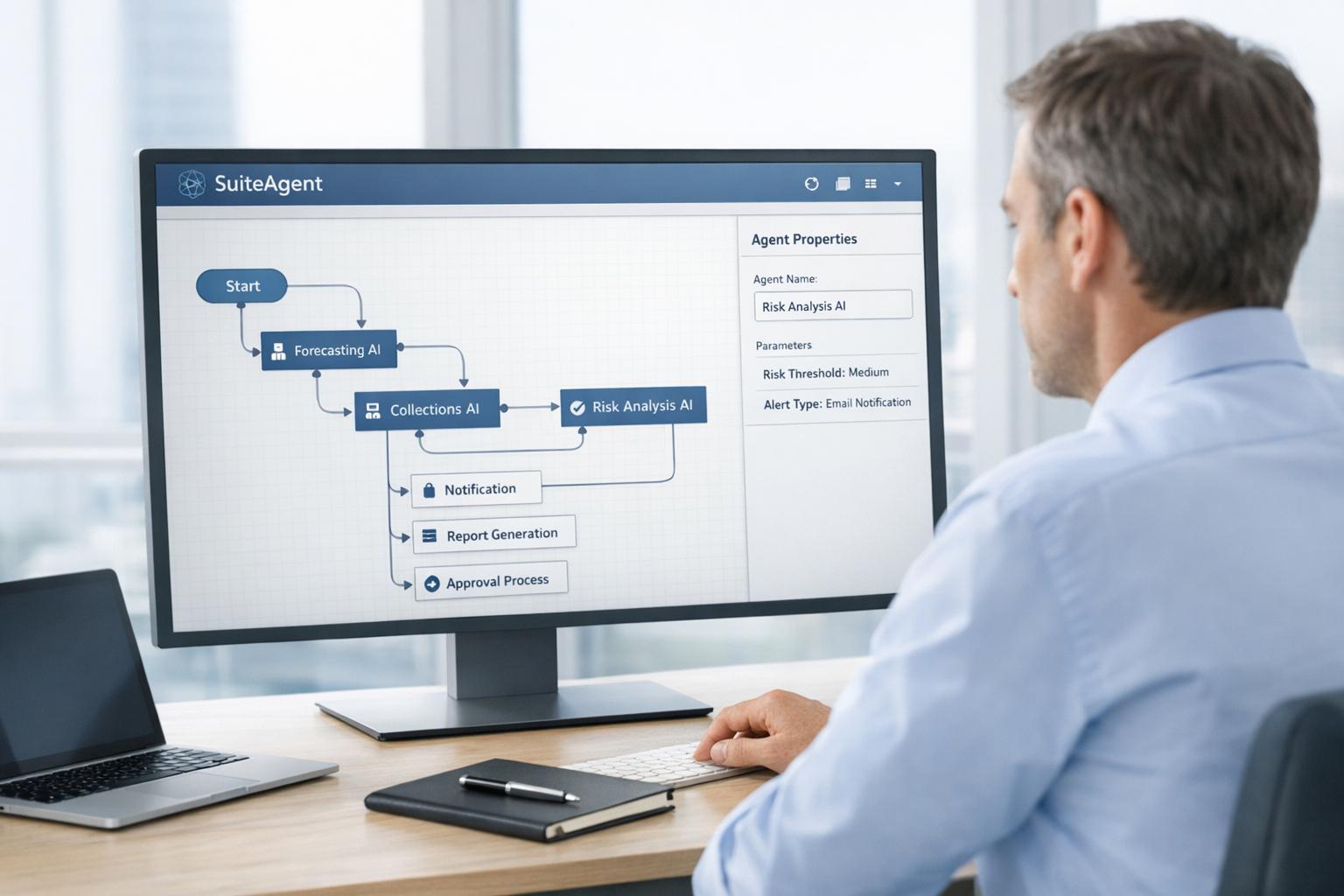
SuiteAgent Frameworks: New developer frameworks and APIs that let partners and customers build, deploy and manage SuiteAgents on SuiteCloud. The SuiteAgent is NetSuite’s term for a custom AI-driven module or workflow. SuiteAgents can leverage NetSuite’s own AI services or call external LLMs (via the Connector). When built with the SuiteCloud Development Framework, these agents run as first-class extensions in NetSuite and appear in SuiteFlow and SuiteAnalytics. Oracle states that “SuiteAgents developed using the new SuiteAgent frameworks… can leverage NetSuite AI toolkits and services to help businesses achieve outcomes faster… with greater confidence” [3]. NetSuite also introduced an agentic workflow experience in the UI: users can now launch, monitor and even step into a running SuiteAgent, reviewing its intermediate results and code for transparency [3].
-
AI Toolkits and Services: A set of AI APIs for common tasks. In October 2025 NetSuite released new toolkits for Document AI (for example, extracting data from invoices or receipts), Narrative Insights (for generating plain-language summaries of business data) and Knowledge AI (for corporate FAQ/chatbot). These APIs can be embedded in SuiteApps, workflows or SuiteScripts. Oracle has already made a Document AI API available, and indicated that the others will follow [3]. The purpose is to eliminate the need for each developer to set up their own AI backend: instead, SuiteCloud developers can simply call these NetSuite-hosted AI services.
-
AI Assistants and Developer Tools: To boost productivity, NetSuite is adding AI-powered assistants for developers and admins. For example, NetSuite announced a SuiteCloud Developer Assistant – an AI coding companion that can instantly generate SuiteScript code based on natural-language requests (much like GitHub Copilot for Oracle Cloud) [3]. Other assistants will help non-technical users; for instance, a “SuiteCloud Studio Assistant” can suggest prompts and guide the setup of connectors without requiring prompt-engineering expertise [14]. The suite even includes an AI Connector Service Companion, a package of context and prompt templates so ordinary business users can ask the connected AI to perform common tasks (e.g. “generate a new sales order”). This companion comes preloaded with 100+ finance and operations prompt templates [14], and graphical UI wizards to avoid typing raw prompts.
Together, these features mark a significant expansion of NetSuite’s AI platform. The press release emphasizes openness and customization: unlike Oracle Fusion’s out-of-the-box agentic apps, NetSuite’s approach is to empower developers and partners to create their own AI agents and workflows using NetSuite data [3]. As Oracle NetSuite EVP Evan Goldberg said, these tools “transform how AI works for business by giving [customers] the ability to quickly and easily build AI agents, connect external AI assistants, and orchestrate AI processes” [3].
3.2. SuiteConnect 2026: Connectivity and Demos
At SuiteConnect (London, March 2026), NetSuite put the AI Connector into action. New MCP Apps were announced for the AI Connector Service [14]. These apps allow end-users to interact with NetSuite data directly from their preferred AI assistant’s interface. For example, a NetSuite team demonstrated asking Anthropic’s Claude (via a conversational interface) to “show all accounts that are overdue by 30+ days”. Claude then invoked NetSuite’s tools (saved searches, reports) and generated a live dashboard. Crucially, the interface displayed the actual SuiteQL calls and code being executed behind the scenes, providing full transparency [14]. In this way, even users without SuiteCloth coding skills could use natural language to query and update ERP data. The MCP Apps will also work with Google Gemini, OpenAI’s ChatGPT, and any LLM that supports the MCP open standard [14].
A compelling use-case shown was with the circular-economy nonprofit EAL Green. Workers at EAL Green photographed incoming recycled inventory items with their mobile phones; Claude AI (via the connector) identified the items and automatically created or updated the inventory records in NetSuite [14]. This kind of multimodal AI use (image-to-ERP update) illustrates the practical reach of the connector. Another demo showed using Claude to explore the Analytics Warehouse: the user asked Claude to “find trends in our accounts receivable data” and to “generate a dashboard” summarizing it [14]. This connects NetSuite’s data warehouse with generative AI to make analytics accessible.
NetSuite also highlighted the governance features of the connector. Administrators can apply NetSuite security roles to connected AIs – for instance, an assistant can have an “Accounts Payable Analyst” profile, limiting which records or actions it may perform [14]. The AI Connector Service Companion ensures that even novice users get relevant prompts. Goldberg explained: “With the companion, teams can use AI more reliably and consistently across finance operations” [14]. In essence, NetSuite’s vision is to let customers harness ChatGPT-like assistants inside their ERP with enterprise-grade controls.
3.3. Aggregate AI Functionality in NetSuite vs. Fusion
The practical upshot for NetSuite customers is that Oracle provides different AI tools depending on the platform. Fusion Cloud customers get pre-built, industry-focused agentic apps out of the box [2], whereas NetSuite customers get platform capabilities to build or integrate their own AI automations. In concrete terms:
-
Agentic Apps vs. Custom Agents: Oracle Fusion latest releases define specific agentic applications for common workflows (e.g. Collections, Cross-Sell) [2] [10]. NetSuite has not (yet) announced similar out-of-the-box agentic application packages. Instead, features like SuiteAgents framework and AI toolkits are aimed at enabling customers or partners to create those automations themselves [3]. Thus, if a NetSuite customer needs an intelligent “Cross-Sell Agent” or “Cash Collecting Agent”, they would likely need to develop it using SuiteCloud tools (or obtain it from a SuiteApp partner).
-
External AI Integration: NetSuite explicitly supports connecting to any external AI model via the Connector (GPT, Claude, Gemini etc.) [14]. Oracle Fusion’s agentic apps use Oracle’s chosen LLMs internally under the hood (running on OCI) and do not require customer-supplied models. In NetSuite, customers have the flexibility (and burden) of choosing and managing the AI models to use. Evan Goldberg emphasized this openness: NetSuite will not force a specific AI vendor, and ensures users aren’t “locked into a single model” [14].
-
Development Environment: Fusion includes a specialized Agentic App Studio for composing KPI-driven workflows [9] [10]. NetSuite leverages its existing SuiteCloud Development Framework, now augmented with AI libraries (SuiteQL query, AI RESTlets, etc.). NetSuite’s “AI Canvas” (visual workflow builder) and SuiteFlow enhancements are analogous to providing an “AI-aware” developer environment [3]. But the underlying platforms remain distinct: Fusion code is custom Oracle Apps code, while NetSuite uses SuiteScript and SuiteBuilder tools.
-
Governance and Compliance: Both platforms emphasize controls. Fusion agentic apps inherit Fusion’s robust security model by default [10]. NetSuite’s connector relies on administrators to apply standard roles and data governance to connected AIs [14]. In practice, a finance department can decide which records an AI assistant may access or modify. NetSuite’s “Companion” and prompt libraries also guide the AI to behave consistently, reflecting the enterprise’s language and policies [14].
-
Licensing and Cost: Oracle has indicated that, like other AI capabilities, these enhancements will be included in existing subscription plans rather than sold as expensive add-ons. (For example, Oracle publicly stated for NetSuite that its 200+ new AI features would be provided as “table stakes,” contrasting with SAP’s practice of charging up to a 30% premium for AI functionality [15].) We expect the same approach for Fusion Agentic Apps: they drive adoption of Oracle Cloud rather than generating separate revenue.
Table 2 summarizes some of these key differences in Oracle’s AI/agentic strategies between Fusion Cloud ERP and NetSuite:
| Aspect | Oracle Fusion Cloud (Agentic ERP) | Oracle NetSuite (SuiteCloud ERP) |
|---|---|---|
| Approach | Enterprise-grade, built-in agentic applications with turnkey workflows (e.g. Collections, Supply-Chain Agents) [2]. AI agents run natively in the Fusion apps under Oracle’s control. | Open, extensible platform. Provides connectors, frameworks and toolkits so customers/partners build custom AI automations (SuiteAgents) on NetSuite. No full prebuilt agentic apps provided. |
| AI App Catalog | Dozens of pre-defined Agentic Apps (22 announced in Mar 2026) spanning finance, HR, CX, supply chain [2] [10]. Packaged solutions for common processes. | No fixed AI app catalog announced. Customers can develop bespoke agents (e.g. AP matcher, AR collector) using SuiteCloud tools [3] (Source: www.agentcrew.com.au). Partners may offer their own SuiteApps. |
| LLM Integration | Uses Oracle-selected LLMs integrated on OCI (frontier models) within the apps. Operators get managed AI with Oracle’s guardrails. | Open integration via MCP: any compatible LLM (OpenAI, Anthropic, Gemini, etc.) can be plugged in [14]. Admins define data access and role-based permissions for each AI. |
| Developer Tools | Oracle AI Agent Studio with no-code agent builder, ROI dashboards, observability [9] [10]. Visual tools for building outcome-driven workflows. | SuiteCloud Dev Framework extended with AI libraries: SuiteAgents framework, SuiteFlow/Canvas for building AI workflows, Document AI API, etc. [3]. Developer Assistant helps generate SuiteScript. |
| Governance & Security | Agents operate inside Fusion’s security model (data policies, approvals, segregation) [10]. Oracle manages safety (harm checks, audit trails). | Security aligned with NetSuite. Pre-configured roles (e.g. CFO, AP clerk) can be assigned to connected AI, limiting scope [14]. Companion prompts ensure context alignment. |
| Typical Customers | Large enterprises (hundreds to thousands of users) with complex multi-book, global operations. Fusion often used by global or regulated organizations [7]. | Mid-market and growing companies (tens to few hundreds of users). NetSuite adopted by both global and domestic businesses [7]. Focus on quicker time-to-value. |
| Pricing Model | AI features included in subscription (no “AI tax”). Aimed at increasing value of Fusion Cloud bundle [15]. | AI features also included broadly (NetSuite EVP said 200 AI features are “table stakes” [15]). Additional usage (external API calls) billed separately if applicable. |
Table 2: Comparison of Oracle’s AI/Agentic approaches in Fusion Cloud ERP vs. NetSuite. Fusion relies on built-in agentic applications and OCI-managed AI, while NetSuite emphasizes open connectors and customer-developed agents. References in text above.
4. Industry and Expert Perspectives
4.1. Vendor and Analyst Views
Oracle’s push into agentic AI is part of a broader industry trend. Major software vendors are re-framing their roadmaps around AI agents. For example, SAP CEO Christian Klein announced at Davos 2025 that SAP was launching Sales AI and Supply Chain AI agents, highlighting how multiple agents will interact (Sales suggests pricing/bundling, communicates with Supply Chain to ensure stock) [16]. Similarly, Workday has rolled out its “Illuminate Agents” for payroll, contracts, auditing and more, and an “Agent System of Record” to orchestrate them [17]. Even beyond ERP, Microsoft and Google are enabling agent factories on their clouds [8]. In short, the narrative is that “enterprises struggle with process complexity” and agentic AI can bridge silos [1].
In this context, Oracle’s CEO Mike Sicilia frames agentic innovation optimistically but cautiously. At the AI World Tour, he likened AI advances to the shift from propeller planes to jets, stating “things which felt out of reach just a few months ago are now the new normal” [11]. He emphasized that AI “changes how work gets done, so people can focus on strategy instead of administration” and it “gives [companies] the altitude to think bigger” [11]. Notably, Sicilia stressed that Oracle’s aim is to provide turnkey AI capabilities: “We’ve done the re-engineering for you… so these AI capabilities should be easy to turn on and make the most of” [11]. He also made a point that Oracle will not dictate the future: “we’re not here to define your future with AI; we’re here to provide you with the tools you need to shape it” [11]. These statements underscore Oracle’s positioning: deliver powerful out-of-box AI (the 22 agentic apps, AI Agent Studio, etc.) while allowing customers choice in deployment.
Industry analysts echo both excitement and caution. For example, Gartner predicts a massive wallet being spent on AI despite mixed results: global AI spending may hit $2.5 trillion in 2026 (a 44% increase year-over-year) [13]. However, as Gartner puts it, many current AI projects are still in the trough of disillusionment, with 95% of firms reporting “zero ROI” on generative AI pilots in 2025 [13]. The clear message is that ROI is paramount: “The improved predictability of ROI must occur before AI can truly be scaled up” [13]. This is consistent with Oracle’s emphasis on ROI dashboards and monitoring for agentic apps.
Tech commentators have noted that if Oracle’s agentic vision succeeds, it will set a new standard. One TechRadar analyst wrote that “Oracle’s ‘Agentic Apps’ announcement just made every other ERP vendor’s AI strategy look incremental” (implying that embedding 22 autonomous apps is a major leap) [^1]. On the other hand, independent experts caution that agentic AI can generate hype without value if not managed carefully. ITPro reported that while Gartner predicts agentic AI could resolve 80% of customer service issues (cutting costs ~30%) by 2029 [4], actual enterprise adoption is still embryonic. Only about 34% of organizations had started any agentic projects by late 2025, and just 14% had fully implemented them [4]. Furthermore, almost 89% of senior leaders in an EY survey insisted that human oversight is crucial when deploying agents [4]. As one CTO put it: “an AI agent can’t deliver intelligence on tap… unless it’s working with reliable, relevant data and being governed appropriately” [4]. Likewise, Leiden University’s Peter van der Putten warns of an “army of agents” potentially causing chaos if not properly controlled [4].
Employee sentiment also matters. A 2025 Workday study found that most employees see AI agents as “important teammates” but not full replacements [18]. Only about 24% were comfortable with agents working completely autonomously [18]. Nearly all agreed that direct experience with AI agents builds trust, but there are concerns: 48% of surveyed workers worried that AI-driven productivity gains could lead to heavier workloads or pressure [18]. In short, real-world insights suggest firms must plan change management and governance carefully.
4.2. Competitive Landscape
Oracle’s agentic ERP move also needs to be seen vis-à-vis competitors. As mentioned, SAP has rolled out a smaller set of agents (Sales and Supply Chain) and has announced a consumption pricing model for generative AI features [16] [15]. Oracle has explicitly differentiated itself: an Axios report noted that unlike SAP, Oracle will not charge extra for AI enhancements, treating them as standard features [15]. Similarly, Workday is bundling its "Illuminate" agents into its cloud platform, positioning AI as a core feature of HR/financial suites. Beyond ERP incumbents, other cloud companies like Salesforce (with Einstein/Agentforce) and Microsoft (with Dynamics 365 Copilot, Azure AI agents) are embedding AI assistants in CRM and business apps.
The Agentic AI as Frontier: A recent tech analysis projected that by 2030, 80% of enterprise software will incorporate multimodal AI agents as a standard component [5]. However, it also warned that nearly half of early projects may fail without clear business value and security [5]. In this climate, Oracle’s bet is on providing a comprehensive, enterprise-ready solution (full stack, built-in governance) rather than piecemeal add-ons. NetSuite customers, in turn, benefit from Oracle’s overall AI momentum – they get technology improvements (connectors, toolkits) that keep them competitive – even if the killer “agentic app” for NetSuite has to be built rather than shipped.
5. NetSuite Customer Implications and Recommendations
What should Oracle NetSuite customers make of all this? Several implications stand out:
-
Fusion Agentic Apps Are Not (Yet) in NetSuite: Despite both being Oracle products, NetSuite’s architecture is entirely separate from Fusion. XML/Java-based SuiteScripts and SuiteApps cannot magically import Fusion’s 22 agentic modules. Oracle’s historical stance (“coexist in the market forever” [6]) suggests NetSuite customers should not expect those Fusion apps to simply appear in their interface. Consequently, if a NetSuite customer needs a specific agentic function (e.g. automated collections, contract bot, supply-chain AI), they will likely have to achieve it through SuiteCloud customization or third-party SuiteApps, not via a plug-and-play upgrade.
-
Use New SuiteCloud AI Capabilities: NetSuite customers should familiarize themselves with the new tools. The AI Connector Service (MCP) can be used today to connect ChatGPT/Gemini/Claude to NetSuite. If your organization already uses generative AI (e.g. salespeople cross-posting data to ChatGPT), formalizing that via the connector yields security and auditability. IT teams should explore the SuiteAgent frameworks and AI toolkits: for example, writing SuiteFlows that call Document AI APIs to extract invoice data, or developing a SuiteAgent that monitors sales pipeline and suggests leads. For many firms, partnering with a SuiteCloud developer who understands AI will be valuable. Oracle and partners are likely to produce sample SuiteApps soon (e.g. an AP matcher or AR collector agent) that can be plugged in.
-
Leverage Neural Interfaces Responsibly: The demonstrations (e.g. asking Claude to create a NetSuite dashboard) highlight the power of natural-language ERP queries. NetSuite users should not ignore this: training certain staff to safely use AI tools with NetSuite (using the Companion prompts and roles) could dramatically speed routine analytics and reporting. However, governance is crucial. All AI queries should be logged; human review steps should be enforced for sensitive transactions. Given employee sentiment data [18], organizations should explicitly decide which functions are comfortable to automate and which require human sign-off. For example, using an AI assistant to generate a draft purchase order might be fine, but final approvals might still involve a manager.
-
Monitor ROI and Pilot Gradually: Historical surveys warn that most AI projects stall for lack of ROI [13] [5]. NetSuite customers should adopt a problem-first approach: identify a tedious, high-volume process (e.g. matching hundreds of vendor invoices) and pilot an AI solution on it. Track metrics like time saved or error reduction. Use Oracle’s built-in monitoring (and third-party analytics) to quantify benefits. Start small – for instance, use the AI Connector with a few simple prompts – and scale up to full agentic workflows once value is proven. Keeping humans in the loop (as 89% of leaders advise [4]) also provides safety against missteps.
-
Evaluate Long-Term Strategy: Some NetSuite customers may wonder if intense AI automation favors migrating to Fusion Cloud. For large enterprises already on NetSuite, a platform switch is disruptive. Given the co-existence pledge [6] and NetSuite’s robust AI roadmap, NetSuite can remain competitive for most companies. However, companies at the high end of scale or requiring the very latest AI-driven forecasting (e.g. large retailers or manufacturers) should consider all options. In any case, both paths require solid data practices: agentic AI works best when data quality is high and master records are clean.
In summary, NetSuite customers should embrace these AI changes but do so deliberately. The new SuiteCloud AI features effectively let you use the latest language models with your ERP data, but they don’t automatically solve business challenges. Skilled developers and thoughtful project management will be needed. The upside is large: companies that integrate AI “into the core of how they operate… will outperform for years to come” [19]. By contrast, neglecting to modernize may leave firms using outdated processes. As Gartner and others note, adoption of agentic AI is accelerating: it is predicted that 80% of enterprise applications will have AI-driven agents in the next few years [5]. NetSuite customers have the tools to participate in this trend, and those who prepare now will be best positioned.
6. Conclusion and Future Outlook
Oracle’s announcement of Fusion Agentic Applications marks a significant milestone in the evolution of ERP. It demonstrates how AI – once an add-on analytic tool – is becoming a built-in digital workforce, capable of handling entire workflows proactively. For NetSuite customers, the imperative is to understand and leverage Oracle’s AI vision on their own platform. This means learning the new SuiteCloud AI capabilities, experimenting with AI assistants in NetSuite, and aligning AI projects to concrete business goals.
All of this is happening amid broader changes. Industry experts expect 2026 onward to be a turning point for enterprise AI: one analysis forecasts that nearly half of enterprise applications will embed AI agents within the next year [5]. Oracle is betting its entire strategy on this shift – heavy engines (OCI) and all. But as analysts caution, success is not guaranteed without focus. Gartner warns that many initial projects may stall without clear ROI and security [5], and surveys show both executives and employees remain wary without proper oversight [4] [18].
For NetSuite customers specifically, the key lessons are: (1) Stay informed and pragmatic. Keep up with Oracle’s quarterly and regional announcements. Evaluate new features in sandbox or pilot environments. (2) Build with guardrails. Use Oracle’s Companion tools and internal policies to ensure AI agents behave reliably. (3) Measure and iterate. Track how AI impacts KPIs and be ready to refine. If done well, the payoff can be high: automated agents can reclaim hours of effort and unlock new insights [8] [18]. In the words of NetSuite’s Evan Goldberg, organizations “that build AI into the core of how they operate… will set themselves up to outperform for years to come” [19]. With diligence and creativity, NetSuite customers can ride this wave of innovation and elevate their ERP to a true intelligent platform.
References: All claims in this report are supported by industry sources, including official Oracle announcements [2] [3], technology press [9] [19] [14], and research/analyst reports [8] [4] [5], as indicated by the inline citations above.
External Sources (19)
About
Houseblend
Make NetSuite work better for your finance and operations teams with Houseblend. We help design, implement, integrate and improve ERP systems, with practical support for the people who use them every day.
Houseblend is a NetSuite consulting firm serving finance and operations teams. We help organizations implement ERP systems, connect business applications, improve existing configurations and maintain the systems that support everyday work. Our audience includes finance leaders, controllers, operations managers, NetSuite administrators and implementation teams.
Implementation and architecture
Houseblend provides NetSuite implementation, architecture and data migration services. We help teams evaluate how business processes, reporting requirements and existing data should fit together in an ERP environment. Training supports the people responsible for adopting and operating the resulting system.
Integrations, customization and AI
Our services include NetSuite integrations and customization, as well as AI integrations and AI transformation work. These engagements connect ERP data and workflows with the broader application landscape. The right design depends on the organization's systems, controls and operating needs.
Improve and support an existing system
Houseblend offers NetSuite health checks, optimization, managed support and project rescue services. We also provide expertise for analytics and specialist workflows, including NetSuite Analytics Warehouse, warehouse management and field service management. Published educational material helps teams investigate options and prepare informed questions for their implementation or support work.
Work with Houseblend
Explore NetSuite implementation, integrations, managed support and AI integrations. Contact Houseblend to discuss your current system and priorities.
Article examples explain concepts rather than promising a particular license, product capability, delivery schedule or outcome. Engagement scope is confirmed with the Houseblend team.
Disclaimer
This document is provided for informational purposes only. No representations or warranties are made regarding the accuracy, completeness, or reliability of its contents. Any use of this information is at your own risk. Houseblend shall not be liable for any damages arising from the use of this document. This content was generated with assistance from artificial intelligence tools, which may contain errors or inaccuracies. Readers should verify critical information independently. All product names, trademarks, and registered trademarks mentioned are property of their respective owners and are used for identification purposes only. Use of these names does not imply endorsement. This document does not constitute professional or legal advice. For specific guidance related to your needs, please consult qualified professionals.