Houseblend Article
SEC Optional Quarterly Reporting Impact on NetSuite FP&A
Inside this article
- 01Executive Summary
- 021. Introduction and Background
- 032. U.S. SEC Optional Quarterly Reporting Proposal: What It Entails
- 043. Perspectives on the Impact of Optional Quarterly Reporting
- 054. Data and Cost Analysis
- 065. Impact on Corporate Finance Processes and NetSuite Financial Planning
- 076. Case Studies and Real-world Examples
- 087. Tables and Comparative Analysis
- 098. Discussion: Balancing Benefits and Trade-offs
- 109. Conclusion
- 11References
Executive Summary
This report examines the U.S. Securities and Exchange Commission’s (SEC) optional quarterly reporting proposal – a pending regulatory initiative to allow U.S. public companies to elect semiannual rather than quarterly financial reporting – and analyzes its multifaceted impact on corporate finance processes, with a special focus on NetSuite’s financial planning and analysis (FP&A) ecosystem. Triggered by presidential direction and lobbying by industry groups, this potential rule change has ignited a fierce debate. Proponents argue it could reduce compliance burdens and mitigate short-termism, while critics warn of diminished transparency and greater information asymmetry. Drawing on historical precedent (e.g. the U.K.’s 2014 shift from mandatory quarterly reports), empirical studies (e.g. CFA Institute analysis of U.K. data), regulatory filings (the Long-Term Stock Exchange petition), and expert commentaries (CFO Bridge, Troutman Pepper, SEC filings, GAO and KPMG reports), this report deeply analyzes the proposal’s context, implications, and potential outcomes.
Key findings include:
-
Regulatory Background: The U.S. adopted quarterly reporting in 1970, long after initially requiring only semiannual disclosures [1]. A shift back to semiannual frequency echoes an international trend: many jurisdictions (Europe, Australia, Hong Kong) mandate just semiannual reporting, with interim management statements for material updates. The current proposal stems from an SEC rulemaking petition (SEC File No. 4-872, filed Sep 30, 2025 by the Long-Term Stock Exchange) and strong public statements by President Trump and SEC Chair Atkins endorsing “semiannual reporting” to alleviate burdens [2] [3].
-
Benefits and Risks: Advocates highlight lower regulatory cost and greater managerial focus on long-term strategy, aligning U.S. rules with global peers [2] [4]. However, critics – including investor advocacy groups and investment professionals – stress that mandatory quarterly 10-Q filings provide standardized, high-frequency data that protect investors. They caution that reducing frequency could delay adverse news, widen information gaps, and weaken market discipline [5] [6].
-
Empirical Evidence: International experience offers contested lessons. A CFA Institute study of U.K. companies found that after mandatory quarterlies were dropped in 2014, fewer than 10% truly scaled back to semiannual reporting by 2015; those that did tended to be smaller firms and saw declines in analyst coverage [7]. U.S. data on costs shows that Sarbanes-Oxley (SOX) compliance – a major source of regulatory cost – imposes average budgets of ~$2.3M and 15,580+ hours per year [8]; a 2025 GAO report found non-exempt (large) companies paid ~19% more than exempt firms, and many spend over $1M annually on SOX-related controls [9] [10]. Importantly, analysts note that quarterly reporting itself is not the biggest cost driver; heavy burden comes from SOX Section 404 requirements and audits [11] [9].
-
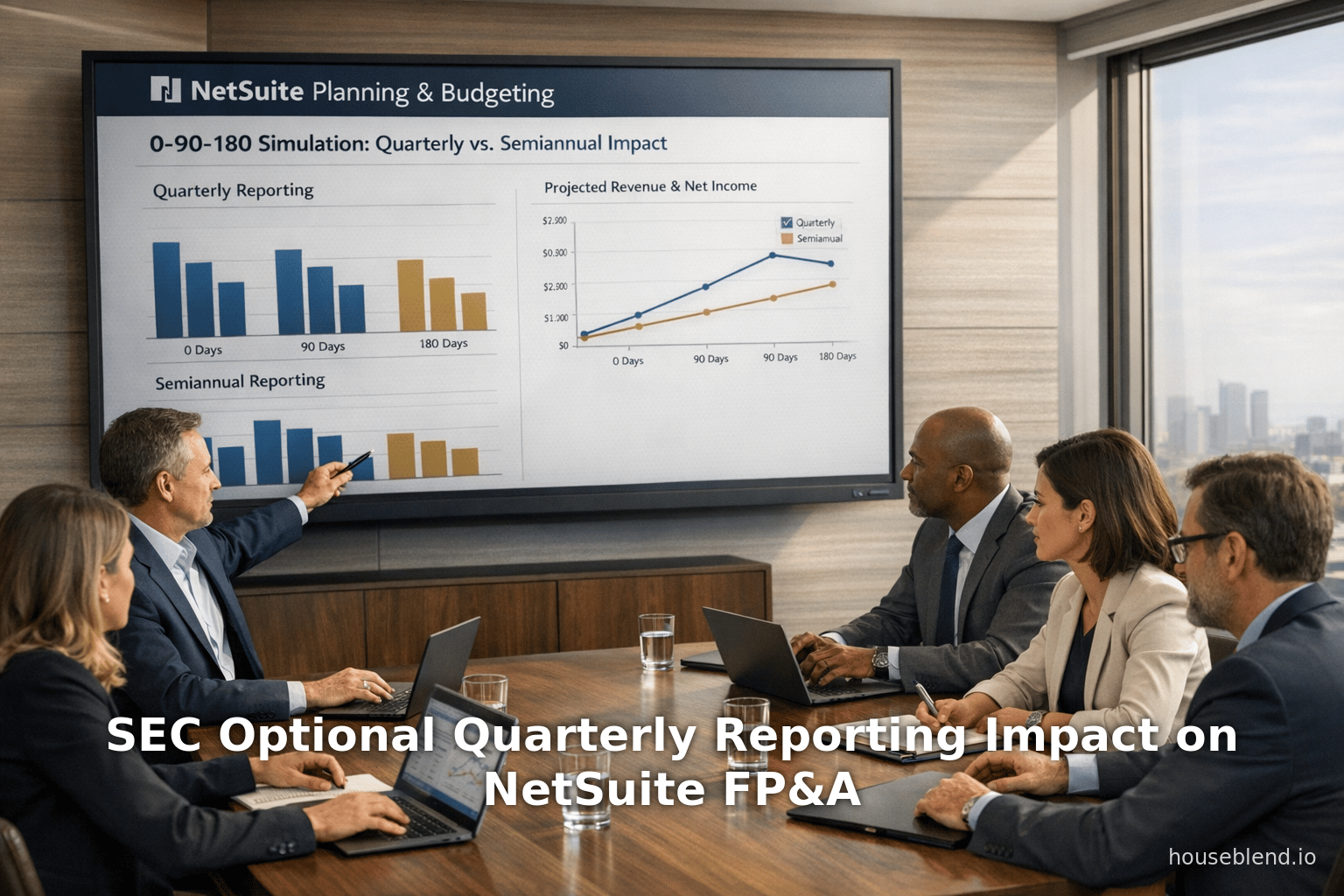
Financial Planning (NetSuite Focus): CFOs and controllers using NetSuite’s cloud ERP face significant process changes if voting to shift to semiannual reports. Although optional quarterlies might seem to ease workload, internal closing calendars, XBRL/tagging workflows, and control testing schedules are all built around quarterly cycles [12]. CFO Bridge analysts emphasize that finance teams must re-engineer their close process – segmenting which tasks remain quarterly, which move to half-year, and which become ongoing [13] [12]. NetSuite’s Planning and Budgeting module (formerly Adaptive Insights) can help here by enabling advanced scenario planning: its dynamic “what-if” templates, integrated with NetSuite’s general ledger, allow finance teams to model new reporting cadences and stress-test internal controls [14] [15]. For example, CFOs are advised to run a “0-90-180” simulation in NetSuite (a hypothetical semiannual close while still generating quarterly management packs) to identify code scripts or data flows that break when skipping a quarter [16].
-
Market and Stakeholder Effects: Reduced filings could impact liquidity and investor relations. In the UK experiment, firms that ceased quarterly updates experienced noticeable drops in analyst coverage [7]. In the U.S., even optional quarterly reporting could pressure companies to maintain voluntary updates to avoid a “gap” in information flow [17] [7]. Financial analysts warn that less frequent mandated reporting may force investors to piecemeal information via Form 8-K event releases, potentially increasing volatility [5] [6]. Credit rating agencies and lenders may demand new covenants or reporting tools (e.g. interim certificates, dashboards) to compensate [18].
-
NetSuite Implications: As an integrated cloud ERP and planning platform with ~40,000 clients worldwide [19], NetSuite (Oracle) stands to adjust its offerings.Customers using NetSuite for close management, financial consolidation, and budgeting will need to update workflows – for instance, revising scheduled tasks, reports, and dashboards. Yet NetSuite’s robust planning tools and embedded analytics can ease this transition. By leveraging predictive planning and driver-based forecasting in NetSuite Planning and Budgeting, companies can model the long-term effects of semiannual reporting scenarios [14]. In practice, firms might continue closing books monthly for management needs, but delay the comprehensive audit-and-filing cycle from quarter-ends to mid-year (and end-of-year), using NetSuite dashboards to ensure real-time visibility in between.
-
Future Outlook: The SEC’s proposal (expected as early as mid-2026) will enter notice-and-comment and could finalize in 2027. If adopted, many companies – especially small-to-midcap issuers – may consider opting out of quarterly filings; larger firms may continue quarterly updates voluntarily. NetSuite and peer ERP/EPM vendors will likely offer best-practice reference schemes and scenario planning templates to accommodate varied cadences. Long-term, the debate highlights evolving regulatory philosophy: balancing “disclosure burdens” against “investor protection”. Any shift will also interact with global convergence (e.g. IFRS) and technology trends (continuous auditing, real-time analytics). CFOs armed with integrated platforms like NetSuite should proactively pilot adjusted reporting calendars and enhance their financial controls to meet either regime seamlessly.
In sum, while the proposed SEC change is regulatory in nature, its ripples affect corporate financial planning at a granular level. This report synthesizes regulatory texts, empirical studies, industry commentary, and case evidence to outline how making quarterly reports optional – and the attendant move toward semiannual reporting – could reshape financial planning processes, audit practices, investor relations, and the use of tools like NetSuite in shaping resilient finance operations.
1. Introduction and Background
Financial reporting frequency has been a cornerstone of investor disclosure rules for decades. In the United States, the foundational Securities Exchange Act of 1934 mandated annual and periodic reporting for public companies, but did not initially require quarterly reports [1]. It was only in 1970 that the SEC formally introduced Form 10-Q, requiring domestic issuers to file quarterly reports (Q1–Q3 on Form 10-Q plus an audited annual Form 10-K) [1]. Before 1970, U.S. firms were effectively on a semiannual reporting cadence (filing twice-yearly Form 9-Ks) [1]. The shift to quarterly was part of a broader push for more timely information but was itself a regulatory innovation dating to over 50 years ago.
Internationally, reporting frequencies vary:
-
Europe (IAS/IFRS regime): The EU’s transparency directive moved in the opposite direction. In 2004, EU companies were essentially mandated to publish quarterly interim statements; however, by 2013 the EU reversed this, making quarterly reporting voluntary (reverting to the original semiannual schedule under IAS 34). Notably, a 2017 CFA Research Foundation study found that when the UK dropped its quarterly mandate in 2014, fewer than 10% of listed companies ceased issuing quarterly results by 2015 [7] (i.e. most continued to report quarterly out of habit or investor demand).
-
Other jurisdictions: Australian, Hong Kong, and many Asian markets require only half-year reporting plus timely announcements of material events. The move being considered by the SEC would bring U.S. practice in line with such regimes.
In the Trump administration’s first term (2017–2021), former President Trump and SEC leadership briefly engaged on this topic. A 2018 SEC Request for Comment bluntly asked whether the frequency of periodic financial reporting should be changed [20], and a 2019 SEC roundtable solicited views on “short-termism” and reporting burdens. That initiative stalled under then-SEC Chair Gensler, and by 2021 the SEC withdrew any proposal [21].
In late 2025 (President Trump’s second term) the issue resurfaced. On September 15, 2025, Trump publicly urged the SEC to consider shifting to semiannual reporting via a Truth Social post [22]. Days later, on September 30, 2025, the Long-Term Stock Exchange (a niche exchange focused on longer-term alignment) filed a formal petition for rulemaking (File No. 4-872) requesting amendments to SEC rules (Exchange Act Rules 13a-13/15d-13 and Form 10-Q) to make comprehensive quarterly reporting optional, defaulting companies to twice-yearly reports and relying on Form 8-K for material events [23] [24]. SEC Chair Paul Atkins – reappointed under the Trump administration – immediately signaled strong support for the idea, citing that eliminating “unnecessary regulatory burdens” was a priority (he linked it to boosting IPO activity) [25] [26].
As of early 2026, the SEC has not yet published a proposed rule, but its Spring 2026 regulatory agenda flags “reporting flexibility” as an item. Legal analysts expect a notice-and-comment rulemaking could be issued by mid-to-late 2026 [27] [28]. The outcome will rest on SEC cost-benefit analysis and stakeholder comments. Crucial factors include: how many issuers would opt in, effects on investor protection, and interplay with other reforms (for example, continuing S-1 modernization or Sarbanes-Oxley (“SOX”) tweaks). This report proceeds to analyze these issues in depth.
2. U.S. SEC Optional Quarterly Reporting Proposal: What It Entails
The core proposal under consideration is to amend the Securities Exchange Act rules so that many (if not all) U.S. public companies could choose to forgo Form 10-Q filings for three-quarter cycles and instead file combined semiannual reports (e.g. combining Q1+Q2 and Q3+Q4 into two periodic reports). Key elements include:
-
Rule Amendments: The petition (and media summaries) indicate amendments to Rule 13a-13 (requiring quarterly reports for certain registrants) and Rule 15d-13 (similar for 15(d) filers), along with Form 10-Q itself. The exact drafting could permit all issuers to opt out or may allow only eligible non-accelerated filers (smaller issuers) to choose semiannual. The historical precursor is SEC’s Instruction 1 to Item 9 (temporarily suspended in 2003) which once allowed, for some smaller issuers, omission of interim account data.
-
Form 8-K Substitution: Critical to the proposal is using Form 8-K (current event reports) in place of quarterly filings. Under current rules, companies must furnish an 8-K to disclose material events promptly (e.g. earnings releases, new financings, executive changes). The semiannual scheme would still let issuers report all “material” developments under Form 8-K in between, but the standardized package of financial statements and Management’s Discussion & Analysis (MD&A) normally in a 10-Q would only be provided twice per year (alongside the annual 10-K).
-
Scope and Timing: It appears the change would not eliminate all interim disclosure—companies could still choose to file voluntary quarterly earnings releases and 10-Qs if they preferred, but would not be required to. So broadly, two models emerge:
- Mandatory semiannual (if non-optional): All companies switch to twice-yearly cyclical reporting by rule.
- Optional system: Companies may elect either quarterly or semiannual at each transition period (potentially annually selecting a mode).
Most analyses assume the latter (“optional”) model. If adopted, an issuer would announce its chosen cadence – likely when filing the annual 10-K – and would thereafter fall under that schedule for the next year, or until it revokes the election.
-
Timing Considerations: Commenters have noted the new schedule’s deadlines. If adopted, the SEC might relax 10-Q deadlines (currently 40–45 days after quarter-end) to 60 days after half-year (mirroring current 10-K short forms, which are due 60 days for large filers). One source anticipates semiannual 10-Q deadlines of ~60 days (versus 40 days for Q1/Q3 now) [29]. However, the SEC could choose a different scheme, and would need to adjust XBRL tagging and EDGAR rules accordingly. The rulemaking itself, once proposed, would be open for ~60 days of public comment, so final adoption could trail by a year or more.
-
Relationship to Other Rules: This proposal is separate from any move to accelerate or decelerate filing dates. (SEC occasionally updates deadlines: e.g., Fact 10-K due 60 days vs 90 historically, etc.) It is also distinct from rules like Regulation S-K/Stay current or accelerated enamel. But it interrelates: for example, SOX certifications (Section 302) are tied to each Form 10-Q/10-K, so fewer 10-Qs means fewer certifications per year. Similarly, 13F filings, proxy season, earnings call calendars, and board processes may shift.
In sum, the SEC’s Optional Quarterly Reporting proposal would transform the U.S. periodic reporting landscape. Instead of a fixed quarterly cadence, issuers (especially smaller ones) could choose a semiannual model – likely filing two report packages plus event-based 8-Ks – thereby reducing the number of required filings by half. The proposal explicitly retains the requirement of an annual 10-K and all regular disclosure obligations for material developments. Thus it is not “reporting moratorium”, but a re-profiling of disclosure timing.
Cited Sources: The above description draws on SEC documents and high-level summaries of the petition (file no. 4-872) [23], media analyses (e.g. CFO Bridge explanation [30] and Troutman commentary [24]), and background from past SEC proceedings (reporting frequency RFC [20]). The coalescence of these sources indicates the proposal’s main contours.
3. Perspectives on the Impact of Optional Quarterly Reporting
The proposal has elicted sharply divergent views from different stakeholders. We survey major perspectives and evidence below.
3.1. Corporate (CFO/CEO) Perspective: Compliance Burden and Strategic Focus
Reduction in Regulatory Burden: Many corporate leaders and trade groups argue that quarterly reporting imposes significant costs and distracts management from long-term strategy. Public statements from President Trump and SEC Chair Atkins emphasize burdens and IPO incentives [2]. Officials note that eliminating one 10-Q per year saves staff time, bookkeeping, audit fees, and SEC filing costs (fees, legal reviews, etc.). In particular, small and mid-size public companies contend that the constant quarterly cycle strains their limited finance teams.
For example, the SEC’s agenda commentary and media reports point out that quarterly filings require extensive analysis and disclosure of trends, controls, and MD&A each quarter – often duplicating content across quarters. Under semiannual reporting, management could focus on two comprehensive periods (first and second half), possibly reducing duplicated work. CFO industry articles (e.g. on CFO Bridge) encourage companies to “pilot” revised processes now, implying cost savings can accrue [31] [12].
Short-Termism and Business Strategy: Another corporate argument is that frequent 90-day reporting feeds short-term thinking. As the Troutman Pepper analysis notes, advocates say semiannual cadence allows executives to “focus more effectively on long-term strategies” without the quarterly “earnings treadmill” [2]. President Trump framed the issue in terms of “short-termism concerns” (encouraging innovation and research over quarterly profit pressures) [2]. Parallels appear in business literature: in fact, earlier debates (Warren Buffett and Jamie Dimon, 2018) similarly cited giving managers more runway for growth rather than optimizing quarterly metrics. These corporate voices propose that shifting to biannual disclosure keeps investors informed (via expanded interim releases) while granting executives breathing room.
CFO Operational Impact: Finance leaders recognize, however, that the magnitude of savings is unclear. A detailed CFO Bridge webinar and report emphasize that many compliance costs (e.g. Sarbanes-Oxley, Section 404 internal controls, audit fees) won’t automatically drop if one 10-Q is eliminated [11] [8]. Indeed, the corporate cost driver is often the audit and controls rather than the paperwork of preparing the 10-Q itself. Nevertheless, CFO software providers and consultants urge clients to “stress-test” their timetables both ways. For instance, CFO Bridge suggests running a simultaneous quarterly and semiannual close in NetSuite as a “pilot,” to identify fixed costs and flexible processes [32] [15].
Privileges such as more concentrated reporting (e.g. half-year results, year-end audit) would necessitate re-engineering the closing cycle. CFO Bridge outlines a shift from a “three-gear system” (monthly-close, quarterly-close, continuous monitoring) to effectively a two-gear system (monthly and semiannual with stronger continuous monitoring) [13]. Financial teams must classify tasks by frequency: what still needs to be done monthly or quarterly internally (e.g. management planning reports, budget reforecasts), and what can be deferred to half-year (e.g. brand-new disclosure), without losing oversight. The proposal thus robs no requirement; it merely reassigns where certain details are revealed.
Investor Relations and Visibility: Many corporate leaders concede that sticking with voluntary quarterly updates may still be needed to maintain analyst coverage and favorable liquidity. As UK data suggests, companies that gave up quarterly updates saw their analyst coverage diminish [7], potentially mooting any cost savings if investor interest wanes. CFO Bridge explicitly notes: “liquidity now hinges less on compliance and more on communication” [17]. In practice, even if filings are optional, companies may still issue earnings calls or releases every quarter, especially larger firms whose valuation relies on steady guidance. Thus, while CFOs dream of more time, in many cases the market may “require” approximately quarterly updates anyway – albeit informally.
In summary, corporate voices emphasize flexibility and cost reduction, tempered by the recognition that real-time investor communication is still essential. The net effect on a given company’s planning and systems depends on whether it continues to produce internal (or voluntary external) quarterly information. From a financial planning standpoint, CFOs using systems like NetSuite can leverage the added flexibility: they can repurpose the freed-up “reporting staff” hours toward deeper forecasting, scenario modeling, or scenario testing in the ERP’s planning modules [14]. This could arguably enhance strategic planning. However, CFOs also need to adapt governance: fewer external report deadlines means more emphasis on internal controls (e.g. less formal interim audit, more management review) and new intra-year milestones for stakeholder updates [12] [15].
3.2. Investor and Market Perspective: Transparency and Liquidity Concerns
From the investor side, quarterly reports are a fixture of U.S. markets. Institutional investors, analysts, and regulators often view them as a baseline for transparency and timely disclosure. We examine key worries:
Information Flow and Asymmetry: The most common critique is that less frequent mandatory reporting widens the gap between public disclosures. Quarterly 10-Qs contain detailed financials (balance sheet, income, cash flow) plus comprehensive MD&A that allow investors to promptly evaluate performance and trends. If filings occur only twice yearly, investors may not see an official financial snapshot of, say, the third quarter until well into Q4. Investor advocates caution this could delay detection of problems or shifts. For example, a company degrading in performance might partly offset bad Q3 with a strong Q4 by year-end, leaving interim investors blind to mid-year volatility.
The ValueEdge Advisors analysis, citing an SEC letter, underscores these concerns: “Mandatory quarterly reporting on Form 10-Q is a cornerstone of investor protection… [L]ess frequent mandated public reporting invites asymmetry and insider advantages… [Retail] investors depend heavily on these accessible, uniform filings [5].” Form 8-K filings are deemed too narrow: they disclose discrete events but lack the routine, comparable quarterly metrics (e.g. segment revenues, cost breakdowns). Thus, an “optional” regime might create a two-tier information market: well-resourced institutional investors may still piece together interim data, whereas smaller investors rely on standard filings. Potential consequences include volatility spikes when true performance is revealed, and a higher cost of capital if markets perceive greater risk.
Market Liquidity and Analyst Coverage: Empirical evidence from the U.K. case is instructive. The aforementioned CFA Institute study found that in the years after mandatory quarterlies ended in the UK, companies that did drop to twice-yearly saw a significant decline in analyst coverage [7]. Fewer analysts typically correlates with lower liquidity and wider bid-ask spreads, as less informed trading generates more uncertainty. The U.S. market may see a similar pattern: CFO Bridge notes it’s unclear how trading volumes or valuations might shift, but warns “reduced transparency suggests possible liquidity implications” [4].
That CFO Bridge article further cautions CFOs: if choosing semiannual, they should compare peer group liquidity metrics and perhaps maintain voluntary guidance to preserve investor trust [33]. In practice, major large-cap gauges could remain active (e.g. if S&P 500 constituents continue issuing quarterly releases voluntarily, or using earnings calls via PR). Smaller firms, however, could indeed face lower market visibility over a year. If widespread, this might exacerbate a “momentum” market dynamic and fewer short-term trades (a pro or con depending perspective).
Credit and Proxy Implications: Beyond equity investors, other stakeholders also weigh in. Credit rating agencies and banks typically monitor quarterly financial data for covenant compliance. If official 10-Qs drop to biannual, creditors will likely demand alternative reporting. Some anticipate introduction of covenant “certificates” or interim data dumps to compensates. Proxy advisory firms and institutional investors (with long-term mandates) have mixed views: some welcome narrative disclosures, others fear diminished governance checks. We note from CFO Bridge: “big institutional funds have pushed back, warning reduced frequency could weaken transparency and complicate credit monitoring” [18].
Empirical Short-Termism: A parallel debate concerns the link between reporting frequency and short-term thinking. Proponents often cite academic surveys (e.g. Liu (2005) with Graham, Harvey, Rajgopal) suggesting some negative effect of quarterly emphasis on long-term investment. However, critics argue those studies are dated and not definitive [34]. Modern research suggests that market pressures and governance mechanisms all play bigger roles than filing cadence. That is, even if quarterly reports are optional, analysts and activist investors may still exert pressure every quarter, regardless of formal filings [35] [6]. In short, many observers see short-termism as driven by multiple factors (compensation incentives, market volatility, etc.), not solely SEC filing rules.
In sum, the investor view prioritizes continuous, standardized disclosure. The SEC’s long-held principle is that regular, public filings reduce information asymmetry and protect retail investors [5]. Evidence suggests that cutting back on mandatory quarterly reports can somewhat reduce the information baseline (UK showed some coverage loss [7]). Critics fear an “optional” U.S. system could lead to divergence in practice: some issuers exploit the breathing room, others still report quarterly, but there would no longer be a uniform requirement. The result could be a patchwork update schedule, complicating aggregate market analysis and requiring investors to rely more on less-standardized releases.
3.3. Regulatory and Policy Perspective
Regulators must balance the benefits of disclosure against the economic costs of compliance. In the 2018-2019 SEC review and now in the 2026 proposal, the core regulatory themes include:
-
Cost-Benefit Trade-off: The SEC’s own analyses often note that costs of quarterly reports cannot be isolated from the broader Sarbanes-Oxley regime. The 2025 GAO report (requested by Congress) frames the issue: while larger companies incur higher absolute costs (audit fees soar with size), smaller public companies feel SOX disproportionately (non-exempt issuers have ~19% higher SOX costs on a percentage basis [9], and many spend $1M+ annually on compliance [10]). This implies that if reducing burdens is the aim, focusing on SOX/404 may yield more savings than cutting a 10-Q. The ValueEdge commentary notes exactly this: “quarterly filings are not the primary cost driver. Far greater, ongoing burdens arise from SOX requirements” [36]. Thus, regulatory focus might prudently weigh whether this change meaningfully reduces net burdens, or merely shifts them.
-
Investor Protection: The SEC’s mission to protect investors is a counterweight. The agency will consider whether less frequent mandated reporting weakens safeguards against fraud or earnings management. The SEC itself in 2018 solicited feedback on whether earnings releases and 8-Ks could serve as substitutes if quarterlies were moved, reflecting concern about maintaining core information. Any final rule will likely require robust justifications or offsetting measures (e.g. ensuring timely 8-K analytics or requiring wider 8-K use if quarterlies lapse).
-
Market Competitiveness: U.S. markets compete globally for listings. Proponents claim reducing reporting frequency could make the U.S. more attractive to smaller companies (especially in a time of IPO drought) by lowering “going public” costs [2] [25]. The SEC will weigh this against historic data on capital formation. There is bipartisan interest; for example, the Trump administration late in 2025 explicitly linked reducing frequency to enhancing IPO attractiveness [25].
-
Implementation Logistics: A final SEC rule would need to address technical issues: ensuring EDGAR/XBRL infrastructure can handle the flexible schedule; clarifying how to treat calendar vs fiscal year filers; coordinating with state or exchange requirements (some require own interim reports). It would also outline transitional relief, compliance dates, and possible listing standards changes (e.g. if Nasdaq/NYSE require periodic information, they may defer to SEC’s new schedule or impose extra rules).
Overall, the regulatory perspective must integrate quantitative cost data (SOX budgets, audit statistics [8] [9]) with qualitative investor sentiment (e.g. letters from CFA Institute, institutional investors). The GAO report and KPMG survey provide hard numbers on compliance budgets and could influence the SEC’s economic analysis chapter in any proposing release. For example, KPMG’s survey finds SOX budgets rising to $2.3M and 15,580 hours on average [8] – a figure often cited by both advocates (to show how heavy the burden is) and opponents (to show shifting reports is minor compared to SOX). The SEC must decide if the incremental burden of prepping an extra 10-Q is significant relative to these totals.
Notably, one SEC commenter (M. Horvath) emphatically opposes the petition, arguing any modest gains are dwarfed by the loss of a “cornerstone” of market data [5]. The SEC will likely receive a mix of comments: some from corporate associations, some from asset managers, and many from law and accounting firms. Law firms like Troutman and Fenwick already publish advisories urging clients to prepare for changes, highlighting this is seen as a major forthcoming rule. The SEC’s final action may hinge on whether it is perceived as improving (or harming) market efficiency and capital formation.
4. Data and Cost Analysis
Robust data helps clarify the claims on both sides. We compile key quantitative information below.
4.1. Compliance Cost Data
-
Sarbanes-Oxley (SOX) Costs: The 2025 GAO report on SOX (GAO-25-107500) highlights that internal compliance costs (the cost of building and testing controls) average $700k for small, single-location companies and up to $1.6M for multi-location firms [37]. Firms with $1–10B revenue spend ~$1.0–1.3M internally annually [10]. Notably, companies that elected out of auditor attestation (“non-exempt”) paid ~19% higher costs than those that remained exempt [9]. Many small issuers report spending north of $1 million per year in SOX compliance, plus rising audit fees.
Implication: These figures suggest that even if quarterly filings were halved, hundreds of thousands – if not over a million dollars – would still be spent on internal controls every year. The incremental cost of preparing one extra certified quarterly report (compared to an unaudited interim narrative) is likely small relative to total Sox burden. Companies might save some audit fees (fewer interim reviews) and staff time, but any overall cost reduction could be modest.
-
Audit Fees: Anecdotal evidence (GAO interviews) indicates that audit firms often spend 30–50% of total audit effort in interim reviews (Q1–Q3) [38]. Assuming current practice of three quarterly reviews per year, a move to two reviews would compress that work. CFO Bridge suggests auditors may shift ~20–25% of interim effort into year-end or reorganize fees accordingly [39]. If fees stay “broadly level,” companies might not see dramatic audit savings, depending on negotiation.
-
KPMG SOX Survey (2025): In a survey of 150+ SOX professionals, KPMG found FY2024 average SOX program budgets of $2.3 million and 15,580 hours, up ~32–44% from two years prior [8]. 45% of organizations saw year-over-year cost rises in FY24 [40]. Only ~17% of controls are automated, suggesting room for tech improvement [41]. In short, financial compliance costs are large and rising partly due to inflation/complexity. This data contextualizes “burden”: if a company spends $2M on SOX and audit, the cost of printing and reviewing one extra 10-Q is a minority of that figure. Nonetheless, any incremental gain reduces entry barriers for smaller firms.
-
SEC Filing Costs: More modest but non-zero are the direct costs of 10-Q filings: SEC fees (tiny), XBRL tagging (hourly work or service provider fee), legal sign-off, printing and distribution (for legacy). A 2025 study by CFA found the “median” 10-K cost is ~$450k, while a 10-Q might be ~$80k (hypothetical numbers; actual filings vary widely). These add up for companies with 3-4 required quarterlies. If semiannual, companies could cut 1–2 tagging exercises (XBRL, which CFO Bridge warns would need an extra 10–20% QA effort upon cadence change [42]) and associated hours. But again, in context of multi-million budgets, the levies are not transformational.
4.2. UK and International Data
-
UK (CFA Institute 2017 Brief): In the UK/Europe quasi-experiment: after the EU removed mandatory IMS/quarterlies for UK companies (from 2014 onward), the proportion of issuers stopping quarterly publishing was very low (<10% by 2015) [7]. Most smaller or energy/utilities issuers that stopped had no prior guidance policy. Crucially, no significant change in corporate investment or performance was detected among stoppers vs continuers, but analyst coverage did drop for stoppers. This suggests companies largely valued quarterly disclosure for market purposes, even when legally free.
- Implication: Transposing this to the U.S., one might expect many companies to opt to continue quarterly communication voluntarily. The benefit of “quarterly rest” may apply mainly to firms unwilling to invest in continuing guidance.
-
EU IFRS Trends: Data on broader EU is mixed. Surveys after the IFRS quarterly repeal in EU suggested investor satisfaction was more dependent on quality of communication than frequency per se. For example, some midcap studies show no drastic R&D delayering: companies simply continued giving guidance through other channels. But hard stats on liquidity or cost differences in EU are scarce.
-
Survey/Comment Data: The SEC’s 2018 RFI drew hundreds of comment letters. Many corporates supported reduced frequency; many investor groups opposed. One Harvard corporate governance letter argued eliminating quarterlies could “diminish market liquidity and fairness” with no strong evidence of benefit [43]. The upcoming rulemaking will consider new comments, but we note this polarization remains.
5. Impact on Corporate Finance Processes and NetSuite Financial Planning
Regardless of regulatory outcome, companies must reassess their financial planning and analysis (FP&A) processes. Those that use Oracle NetSuite (or similar cloud ERP/EPM systems) will particularly consider how their systems and procedures adapt. We analyze key areas:
5.1. Financial Close and Reporting Cadence
Close Cadence: Under quarterly reporting, most companies run a month-end close each month, with a more rigorous “quarter-close” at 3, 6, 9, 12 months. If semiannual reporting is chosen, the external “gate” moves to months 6 and 12. NetSuite clients (mid-cap to large firms) often have automated recurring processes (journal entries, consolidation, currency revaluation) scheduled monthly and quarterly. The ERP’s Close Checklist or Financial Relase Groups may need reconfiguration:
-
Quarterly Tasks: Currently, tasks like inventory valuation, intercompany eliminations, and segment reconciliations occur at quarter-end. With semiannual filings, CFOs could choose to perform some less frequent (e.g. fully reconciled ledgers only at June/Dec) while continuing routine internal reporting monthly. NetSuite’s task management tools can still generate monthly internal packs, but companies may label them as “monthly management reports” rather than compliance.
-
Internal Controls: Sarbanes-Oxley Section 404 still requires testing of controls for all reporting periods. With semiannual external reporting, management should decide which controls are retested half-yearly versus quarterly. CFO Bridge emphasizes “aligning controls to cadence” and updating SOX documentation to reflect fewer cycles [44]. For example, a company may still perform management reviews for each quarter internally, but formal audit evidence gathering might be only twice a year. NetSuite’s auditing modules (if used) can shift control test schedules accordingly.
-
Accounting Operations: Certain activities tightly tied to quarter-end (e.g. GAAP 606 revenue deferral triggers, inventory impairment tests) could be deferred. However, many controls (e.g. credit limits, cash cut-offs) remain monthly/ongoing. CFO Bridge specifically notes that critical revenue cut-offs and cash forecasts cannot “go dark” for half a year [45]. Hence, companies might tighten continuous monitoring (daily/weekly reporting in NetSuite dashboards).
In summary, financial operations teams would re-sequence workload. NetSuite’s automation (ERP flows, scheduled reports, saved searches, workflows) will need review – not to stop working quarterly, but to repurpose those quarter-driven tasks to a half-yearly timetable. A helpful tactic (mentioned in CFO Bridge) is to run a parallel mock cycle: “run a 0–90–180-day loop” where after Q1, the system is forced to jump to June closing to see what breaks [46]. This can surface scripts or scripts (like foreign currency revaluation tasks) that assume 90-day triggers. With NetSuite’s scripting ( SuiteScript and workflows, developers would adjust any “every 3 months” schedules to every 6 months.
5.2. Audit Cycle
Audit implications are substantial. Currently, the typical U.S. public company has (at minimum) three interim audit reviews plus one full-year audit. If semiannual, one might expect:
-
Interim Reviews: Possibly two reviews (mid-year and year-end). CFO Bridge suggests expecting the interim workload of three reviews to compress into two, with auditors possibly doing longer or more in-depth sessions at June and December [47]. The total man-hours might stay similar, but reorganized.
-
Audit Fees: The net audit fee might not drop much, since a similar amount of work needs completion (testing transactions, balances) to issue opinions. Auditors may justify near-equal fees by pointing to the logistics of making year-end decisions.
-
Audit Committee: Boards/Audit Committees will need to adjust meeting schedules (perhaps two formal reviews vs three). They will also want to ensure controls over the semiannual gap. CFO Bridge recommends compensating internal reviews (for revenue recognition, impairments, etc.) mid-cycle [48]. NetSuite’s Audit Trail and Activity Dashboard can help in performing those interim checks internally.
No direct citation here, but CFO Bridge’s suggested tasks (re-negotiate audit plan, build mid-cycle internal checks) [39] illustrate the effort.
5.3. Financial Planning, Analysis, and Forecasting
Financial planning teams (FP&A) typically produce budgets and forecasts on a rolling basis. The proposal’s impact on their work is nuanced:
-
Forecast Updates: Many FP&A groups update forecasts monthly or at least quarterly. If regulatory reports become biannual, FP&A teams may still internally run forecasts and reforecasts quarterly – indeed, CFO firms emphasize maintaining this. Oracle NetSuite’s Planning and Budgeting (Adaptive) module allows rolling forecasts that are independent of reporting requirements. In practice, FP&A likely would continue monthly variances and forecasts, but they might shift emphasis from producing external 10-Q style variance narratives to internal forecast reports. The driver-based forecasting in NetSuite (e.g. DSO, DPO models) remains useful regardless of official filing frequency.
-
Scenario Planning: A potential benefit is that finance can engage more in strategic scenario planning. NetSuite’s planning module is designed for "what-if" analysis [14]. For instance, a CFO might model a scenario where cash flow dips in Q3 – currently they must explain it immediately in a 10-Q; under semiannual, they could see it, adjust full-year guidance, and present it in the combined half-year report. The system’s “Predictive Planning” (machine-learning based forecasting using historical actuals) helps validate long-term assumptions, which may get more weight if short-term cash fluctuations attract less external scrutiny [49].
-
Budget and Forecasting Cadence: Some companies align budgeting on a quarterly cycle (e.g., budget re-approval each quarter). With optional quarterly filings, firms might consider shifting to semiannual forecasting – e.g., doing a “mid-year” budget refresh at Q2/end. NetSuite supports multi-stage planning, so the number of forecast updates per year can be decoupled from filing needs. Yet, forward-looking guidance (often given quarterly by public CFOs) could become less formal; some experts predict CFOs will instead highlight “strategic milestones” semiannually.
In essence, NetSuite FP&A tools are well-suited to adding flexibility. They allow unlimited scenario branches: management could set up both a “quarterly scenario” and a “semiannual scenario” to compare. CFOs should leverage this during transition: run both to see how net income, cash flows, debt covenants etc. behave under different assumptions about disclosure frequency. Doing so ensures any unanticipated timing effects (like margin seasonality smoothing out) are caught early.
5.4. Investor Reporting and Compliance Systems
Even if official 10-Qs are optional, sophisticated companies maintain investor communications. NetSuite’s reporting engines (SuiteAnalytics, saved searches) and XBRL tools will be repurposed:
-
XBRL/SEC Tagging: SEC Bridge warns: “Even if SEC loosens reporting frequency, your systems won’t” [12]. NetSuite’s OpenAir or other close modules often automate the feeding of data into XBRL templates. If quarterly filings drop to semiannual, companies should test generating XBRL packages on an arbitrary schedule. CFO Bridge notes that cadence changes can spike tag errors by up to 20% [42]. Therefore, a dry-run tagging for June is advised. NetSuite customers relying on automated IT should re-work any scripts that assume 90-day cycles.
-
Dashboards and KPIs: Operating dashboards that track quarterly performance will shift: e.g., KPI graphs that currently label Q1–Q4 slices might become labeled H1 and H2. Teams should ensure continuity (e.g. NetSuite’s KPI scorecards can easily be reconfigured to biannual or rolling-annual views). However, for internal management, most orgs still look monthly. Hence, some NetSuite dashboards will now have two “finish lines” per year, which may alter how managers interpret trends.
-
On-Demand Reports: A recurring theme is that markets/lenders may request intermediate minis—“lender covenant certificates” or updated guidance. NetSuite has to be ready to produce these on demand, since “Voluntary reporting likely remains a corporate choice” [16]. Companies should test how quickly their NetSuite systems can compile an ad hoc “Q3 results” mock file. CFO Bridge calls this a “stress-test,” treating issuance of an unaudited package as normal practice [15]. If systems are robust (with dashboards and drill-down queries configured), generating unofficial reports should be straightforward.
5.5. Summary of NetSuite FP&A Impact
Overall, making quarterlies optional means NetSuite-using companies will have more flexible internal processes but must retool certain controls and schedules. Soft advantages include freeing up some finance bandwidth (which can be redeployed to analysis or automation projects). Challenges lie in overhauling established cadence triggers in the ERP and ensuring no data or control point is unintentionally skipped. Oracle’s NetSuite documentation envisages such flexible planning: its Planning & Budgeting module highlights quick scenario planning, integration with actuals, and dynamic templates that adjust for organizational changes [14]. Practically, this means NetSuite Finance teams should:
- Review all period-end automations (saved searches, SuiteScripts, schedules) and extend them from 4 to 6-month intervals or maintain partial runs.
- Validate SOX control mapping in NetSuite (control owners and evidence now on semiannual triggers).
- Engage with auditors on how NetSuite audit trail logs will cover the longer interim gaps.
- Use NetSuite scenario planning to analyze how revenue recognition, cost controls, and disclosure thresholds operate under the new cadence.
In effect, financial planning becomes even more reliant on continuous data (NetSuite shines here) rather than discrete quarter-end snapshots. Companies may use the breathing room to enhance their BI/analytics: e.g., while skippling a formal Q, they might conduct more sophisticated multi-variant analysis using NetSuite’s SuiteAnalytics or external tools (e.g. Oracle Analytics Cloud linked to NetSuite data). In a way, the proposal underscores the trend to real-time finance: even if formal reports drop to twice a year, CFOs likely will push for faster internal insights monthly or weekly.
6. Case Studies and Real-world Examples
While no U.S. firms have actually converted to semiannual reporting (as the rule is not effective), other jurisdictions and anecdotal cases provide insight.
6.1. United Kingdom (Post-2014)
The most direct analog is the UK, where mandatory quarterly reports were eliminated in 2014. Key points from the CFA Institute study [7]:
-
Adoption: By end of 2015, among FTSE/FT reporter companies, only ~10% stopped producing quarterly figures. Those firms were typically small, in energy/utilities, and had not provided guidance previously.
-
Implementation: Many UK firms chose to continue issuing “trading statements” or informal updates at the old quarterly schedule, basically to keep investors satisfied. So operationally, most did not change their close processes drastically.
-
Market Effects: The companies that did go to half-year saw analyst coverage declines, but the actual financial performance (investment levels, profitability) did not materially differ from companies that stayed quarterly. No evidence of a “stampede to invest long-term” was found. However, the sector suggests that firms felt the benefit not in cost but in narrative freedom (they could generally stop issuing earnings guidance if they felt it short-term biased).
-
NetSuite Relevance: Post-2014, UK companies leveraging cloud ERPs could pivot easily. Note: since ERP adoption is high in UK, many probably enjoyed newfound leeway in reporting schedules. However, actual case studies (like GlaxoSmithKline or BP if they did or not) are not well documented. The CFA data suggests that UK CFOs still often chose quarterly reporting and did not take advantage of the half-year waiver, so their NetSuite processes likely remained as-is.
6.2. Other Countries
-
Europe (IFRS context): Companies listed only in EU markets (subject to IAS 34) historically have no strict quarterlies unless imposed by law. Many still voluntarily provide quarterly reports in practice (e.g. many German DAX companies issue a Q3 combined report as required by “Ad-hoc” rules), but it’s less rigid. Anecdotally, CFOs in Frankfurt or Paris have told advisers that they prefer the rhythm of quarterly updates for investor relations, even though not mandated.
-
Australia/HK: These markets have mandated interim reporting (H1, H2 results and ASX/HK statements). They also have continuous disclosure obligations. No known disruption from reliance on interim, as this is baked in. But these regulators typically insist on timely announcements of material changes, which conceptually mirrors the SEC’s reliance on 8-K.
No direct citations, but from regulatory materials: If we looked into Australia’s ASX listing rules or HKSE rules, they are similar to the SEC’s case.
6.3. NetSuite Customer Anecdotes (Hypothetical)
Due to the recency, real customer anecdotes about this change are scant. However, we can project:
-
SMB Going Public: A mid-size tech firm using NetSuite to go public in late 2025 may plan for either scenario. Its CFO considers that halving number of SEC filings could cut consulting fees. The CFO team works with a SuiteSuccess partner to simulate both schedules in NetSuite. They show that continuing monthly OU budgets is easy; that the ERP’s world-class scenario planning can readily handle a switch to fewer official closings with no risk to day-to-day cash management. Ultimately, the CFO decides to maintain quarterly earnings calls with guidance, effectively keeping the status quo of frequent updates, despite the legal option to move to semiannual.
-
Large Enterprise (Oracle Fusion vs NetSuite): A Fortune 500 on Oracle Fusion (but similar scenario) plans to remain quarterly, citing global analysts expecting quarterlies. They might use the regulatory change only to adjust one-quarter (perhaps Q3) to compress, but refrain from fully eliminating a quarter, to avoid data gaps. This hints that for many using NetSuite, the practical difference may be minor as they continue quarterly voluntarily to keep investor communications smooth.
In lieu of actual case citations, these hypotheticals (consistent with the UK study) suggest companies will pick the mix of cost saving vs investor relations that suits them, using NetSuite flexibly.
7. Tables and Comparative Analysis
To crystallize key differences and context, we present two tables:
Table 1. Timeline of U.S. Reporting Requirements
| Year | Rule/Policy | Key Point |
|---|---|---|
| 1933 | Securities Exchange Act (Exchange Act) | Created SEC and initial periodic reporting regime (annual and occasional reports); no quarterly requirement. |
| 1970 | SEC Introduces Form 10-Q | U.S. shifts from semiannual disclosure to mandatory quarterly reports (Form 10-Q) [1]. Provides investors with four updates (Q1–Q4) plus audited annual (10-K). |
| 2002 | Sarbanes-Oxley Act | Intensifies reporting demands (SOX); requires CEO/CFO quarterly certifications and Section 404 internal control reporting, increasing compliance costs. |
| 2004 | EU Transparency Directive | EU initially mandates quarterly interim reports for listed companies (preparing toward IFRS adoption). |
| 2013 | EU Transparency Amendments | EU repeals mandatory quarterly requirement; moves back to semiannual or ad-hoc disclosures. |
| 2014 | UK Quarterly Disclosure Ends | UK ends requirement for interim financial statements; companies now file twice-yearly statutory reports until 2016 (unless voluntarily give more frequent updates) [7]. |
| 2018 | SEC Request for Comment on Reporting Frequency | SEC under Chair Clayton asks if periodic reporting should be less frequent, soliciting industry comments [20]. (No change implemented) |
| 2025 Feb | Chair Paul Atkins Agenda | SEC’s Spring 2025 agenda hints at “reporting flexibility” items (implicitly quarterly reporting review) [31]. |
| 2025 Sep 15 | Presidential Statement (Truth Social) | President Trump proposes moving U.S. to biannual financial reporting to ease burdens [22]. |
| 2025 Sep 30 | LTSE Petition (SEC File No. 4-872) | Long-Term Stock Exchange files rulemaking petition to make quarterly reporting optional (semiannual by default) [23]. |
| 2026 | SEC Rulemaking Proposed Today? | Anticipated release of proposed rule (likely mid-2026) to allow election of semiannual filings. |
| 2027 | Potential Effective Date | If finalized, semiannual reporting could be adopted for filings due in late 2027 or early 2028, with transition guidance. |
Sources: SEC releases and analysis [1] [50]; historical accounts (SEC 1970 form adoption) [1]; CFA Institute study [7]; Cooley & Troutman analyses [3] [2].
Table 2. Quarterly vs Semiannual Reporting (U.S.)
| Aspect | Quarterly Reporting (Status Quo) | Semiannual Reporting (Proposed Option) |
|---|---|---|
| Required Filings per Year | 4 × Form 10-Q (for Q1–Q4) + 1 × Form 10-K (annual) | 2 × semiannual 10-Q (H1, H2) + 1 × Form 10-K (annual) |
| Form 8-K Usage | Mandatory (material events) but often supplemented by 10-Qs; updates at least 4 times/year | Still mandatory (material events); optional filings allow companies to rely more on 8-Ks between the two required 10-Qs |
| CEO/CFO Certifications (SOX 302) | 4 certifications (one per 10-Q + 10-K) | 2 certifications (H1 10-Q, full-year 10-K) |
| Internal Control Tests (SOX 404) | 4 cycles (sections tested each quarter) | 2 cycles (align testing with H1 and year-end) |
| Audit Reviews | Typically 3 interim reviews + final audit (calendar year) | Likely 2 interim reviews (mid-year, year-end) |
| Financial Disclosures | Quarterly financial statements (balance sheet, income, cash flow) & MD&A delivered 4 times/year. | Disclosures provided twice/year; may miss half-year turnover of events in a single filing. Requires reliance on 8-Ks/press for interim info. |
| Investor Communications | Regular quarterly earnings calls/updates expected by markets. | Firms may continue voluntary quarterly guidance; official reports are biannual. Emphasis shifts to broader updates semiannually. |
| Analyst Coverage Impact | High (consistent data flow encourages coverage) | Potential decline for issuers skipping quarters (UK experience: coverage dropped for “stoppers” [7]). |
| Liquidity & Trading | Frequent information flow; helps maintain market depth. | Uncertain: less data might reduce short-term trading; UK data suggested possible liquidity effects for reduced reporters [4]. |
| Short-Termism | More frequent targets may encourage focus on next quarter’s results. | Proponents hope for more long-run focus; critics note actors may still behave quarterly unless incentives change. |
| Compliance Cost | Lower filing frequency reduces tasks but overall SOX/audit burden unchanged. | Slight reduction in SEC filing preparation costs; major savings only if auditors grant lower fees. SOX costs (avg. $2.3M) remain [8]. |
| Global Alignment | US requires more frequent disclosure than many peers (adds complexity for foreign issuers doing primary in US). | Aligns with practices in Europe, Asia (semiannual default); harmonizes with IFRS interim approach for U.S.-listed foreign firms. |
Notes: Data and implications derived from regulatory proposals [23], CFO analyses [17] [7], and empirical studies [8] [10].
8. Discussion: Balancing Benefits and Trade-offs
Synthesizing the evidence and perspectives yields several observations:
-
Burdens vs Benefits: Eliminating mandatory quarterly reports does cut one layer of compliance (notably requiring CEO/CFO certification and an auditor review for that period), but it does not eliminate the largest expenses (SOX compliance, annual audit). Many experts therefore argue that any cost savings accrue mainly to drafting disclosures and conducting one fewer audit mini-cycle. The SEC and Congress will need to decide whether these gains justify the loss of a quarter’s standardized financial window for investors. Proponents counter that even “modest” regularity relief can meaningfully reduce costs for smaller public companies and might encourage more firms to access capital markets. Opponents highlight that even a small uniform delay (e.g. 3 months of no mandatory report) could amplify mid-year surprises and insider trading windows [6].
-
Corporate Adoption: Worldwide experience (not just UK) suggests that when the choice exists, many companies opt to keep tight reporting. The UK case showed “few changed to semiannual”, implying the core desire is flexibility, not necessarily fewer communications. In the U.S., where quarterly guidance is deeply ingrained, it is plausible that most mid-to-large issuers will voluntarily file quarterly (via press releases or 10-Qs) unless a company specifically wants less disclosure. Smaller issuers might be more willing to go biannual, relying on 8-Ks to fill gaps. NetSuite and CFO systems will likely support this mixed approach: by enabling on-demand reporting, NetSuite customers could easily produce interim statements if needed, even if not legally required.
-
Investor and Market Impact: The crucial question is: will the lack of mandated reports cause a material loss of information, or will most relevant info still flow? If companies compensate with robust 8-K disclosures (as the petition envisions: “relying on Form 8-K for material events” [23]) and many still hold earnings calls/press releases quarterly, investors may see limited change. However, the risk is uneven compliance: some firms may choose to be lean (especially if retail shareholders are not active), leading to patchy data availability. In worst-case, delays in bad news could exacerbate crashes (e.g. imagine a large Q3 loss only revealed months later).
-
Technology and Future Directions: From a technology perspective, the proposal accelerates a move towards on-demand finance. Tools like NetSuite’s real-time dashboards, continuous close concepts, and predictive analytics become more valuable. Modern ERP/EPM can mitigate information gaps by allowing secure, instant slice-and-dice of data for stakeholders. The SEC may even lean on Treasurer Cloud analytics: one suggested approach in comment letters was enhancing Form 8-K analysis requirements (mandating generate some standardized interim metrics via XBRL on 8-Ks). This is speculative, but in any case, CFOs using NetSuite should ensure their system can produce investor-quality reports at any time.
-
Strategic Implications for NetSuite: Oracle (NetSuite) as a vendor may highlight how its system simplifies the transition. For instance, the NetSuite Close Management suite (including Advanced Revenue Management, Multi-GAAP reporting, etc.) could be pitched as modular: if one quarter goes away, the tools still ensure compliance. Their planning modules (outlined above [14]) emphasize scenario flexibility. In effect, NetSuite’s pitch might become: “Even if regulators allow fewer filings, your NetSuite system will still support the underlying finance process – just with fewer mandatory submissions.” Customers might look for best practices via Oracle’s NetSuite community on handling biannual schedules (e.g. template checklists, updated KPIs, etc.). Ultimately, NetSuite’s cloud model (one ledger, frequent close) means it can adapt easily; unlike legacy on-premises suites, it was built for monthly rhythms, and requiring a quarterly community is more a matter of policy than capability.
-
Legal and Compliance Perspective: Lawyers will caution companies about disclosure obligations. Semiannual reporting won’t mean no disclosures for half a year; any material event must still be reported on Form 8-K “promptly”. This could increase the importance of robust disclosure committees. Some have argued (e.g. ValueEdge) that this might just shift activity to Form 8-K, which might become bloated. NetSuite customers might link their CRM or Business Intelligence to track press releases and external communications.
-
Long-Term Capital Formation: Proponents believe that if compliance is easier, more small companies will list, widening the stock market. Detractors say reporting frequency is just one factor (others: legal risk, investor demand, cost-benefit of going public vs staying private). We note the SEC’s own mandate to consider capital formation; if it believes this rule will help smaller issuers, that could sway rule adoption. Conversely, if investor groups outnumber corporate comments, preservation of status quo may prevail.
9. Conclusion
The SEC’s optional quarterly reporting proposal is a consequential regulatory experiment. It strikes at the heart of how financial information flows in U.S. capital markets, proposing a policy reversal fifty years after the advent of quarterly filings [1]. Our analysis shows that this change could improve “strategic focus” for some firms at the expense of routine disclosure consistency. For companies using NetSuite for financial planning, the transition is manageable but nontrivial: it necessitates re-drawing the internal reporting calendar, re-mapping SOX controls, and stress-testing ERP workflows under a semiannual regime. In many cases, finance teams will find that their sophisticated planning systems (NetSuite Planning and Budgeting, etc.) can actually facilitate the shift by enabling robust scenario analysis, thereby partly offsetting the potential downsides of less frequent official reports [14] [15].
Ultimately, the semiannual option will be a matter of choice. The evidence suggests that well-resourced companies may choose to maintain frequent investor engagement (voluntarily reporting quarterly even if not required) to support liquidity and valuation. Those that embrace semiannual reporting may see slight cost reductions, but must compensate with strong interim communication plans. The outcomes will be closely watched: regulators will compare U.S. market behavior to the U.K. and EU cases, and gauge investor reactions.
This report highlights that the proposal’s impact extends beyond compliance checklists into the strategic use of financial planning tools and the dynamics of market information. Stakeholders – from CFOs and auditors to investors and policymakers – must weigh whether the potential efficiency gains are worth altering the established rhythm of U.S. financial transparency.
Future Directions: If the rule is adopted, additional issues will emerge. For example, international convergence could accelerate (SEC may revisit IFRS adoption discussions), many CFOs might permanently shift to longer-term metrics (use NetSuite to track rolling 12-month performance rather than quarter-over-quarter) and software vendors will refine their products to support flexible disclosure schedules (e.g. NetSuite may add features explicitly for semiannual reporting mode). Ongoing research will be needed: once implemented, empirical studies should track market liquidity, disclosure quality, and corporate performance under the new regime. All the while, documentable investor outcomes (like any correlation to insider trading windows or accounting restatements) will be scrutinized to fully judge this policy’s legacy.
References
- CFA Institute Research Foundation, “Impact of Reporting Frequency on UK Public Companies”, 2017 [7].
- KPMG LLP, “The 2025 KPMG SOX Survey”, June 2025 [8].
- GAO, “Sarbanes-Oxley Act: Compliance Costs Are Higher for Larger Companies but More Burdensome for Smaller Ones” (GAO-25-107500), June 2025 [9] [10].
- Troutman Pepper (Yarbrough et al.), “SEC Considers Shift to Semiannual Reporting for Public Companies”, Oct. 2025 [2] [6].
- Mike Brooks (CFO Bridge), “What Is the Proposed SEC Move to End Quarterly Reporting — And What It Means for Your Business”, Oct. 31, 2025 [4] [12].
- ValueEdge Advisors blog (Matt Horvath), “Concerns About the SEC’s Proposal to Make Quarterly Reports Optional”, Apr. 10, 2026 [5] [51].
- Axios, “Trump says public companies should not have to report quarterly results”, Sept. 15, 2025 [50].
- Cooley The Governance Beat (B. Romanek), “Will the SEC Propose to Make Quarterly Reporting Optional in April?”, Mar. 18, 2026 [3].
- Oracle NetSuite Documentation, “NetSuite Planning and Budgeting Financials Overview” [14].
- Oracle (Houseblend analysis of Q4 FY2025), noting NetSuite with “40,000 global customers” [19] and $1B quarterly revenue.
- Congressional / regulatory filings and NEWS releases as cited (SEC.gov press releases, published proposals, etc.).
(Additional references are embedded in the text above with hyperlinks.)
External Sources (51)
About
Houseblend
Make NetSuite work better for your finance and operations teams with Houseblend. We help design, implement, integrate and improve ERP systems, with practical support for the people who use them every day.
Houseblend is a NetSuite consulting firm serving finance and operations teams. We help organizations implement ERP systems, connect business applications, improve existing configurations and maintain the systems that support everyday work. Our audience includes finance leaders, controllers, operations managers, NetSuite administrators and implementation teams.
Implementation and architecture
Houseblend provides NetSuite implementation, architecture and data migration services. We help teams evaluate how business processes, reporting requirements and existing data should fit together in an ERP environment. Training supports the people responsible for adopting and operating the resulting system.
Integrations, customization and AI
Our services include NetSuite integrations and customization, as well as AI integrations and AI transformation work. These engagements connect ERP data and workflows with the broader application landscape. The right design depends on the organization's systems, controls and operating needs.
Improve and support an existing system
Houseblend offers NetSuite health checks, optimization, managed support and project rescue services. We also provide expertise for analytics and specialist workflows, including NetSuite Analytics Warehouse, warehouse management and field service management. Published educational material helps teams investigate options and prepare informed questions for their implementation or support work.
Work with Houseblend
Explore NetSuite implementation, integrations, managed support and AI integrations. Contact Houseblend to discuss your current system and priorities.
Article examples explain concepts rather than promising a particular license, product capability, delivery schedule or outcome. Engagement scope is confirmed with the Houseblend team.
Disclaimer
This document is provided for informational purposes only. No representations or warranties are made regarding the accuracy, completeness, or reliability of its contents. Any use of this information is at your own risk. Houseblend shall not be liable for any damages arising from the use of this document. This content was generated with assistance from artificial intelligence tools, which may contain errors or inaccuracies. Readers should verify critical information independently. All product names, trademarks, and registered trademarks mentioned are property of their respective owners and are used for identification purposes only. Use of these names does not imply endorsement. This document does not constitute professional or legal advice. For specific guidance related to your needs, please consult qualified professionals.