Houseblend Article
SuiteWorld 2026 Preview: NetSuite AI and Cloud ERP Trends
Inside this article
Executive Summary
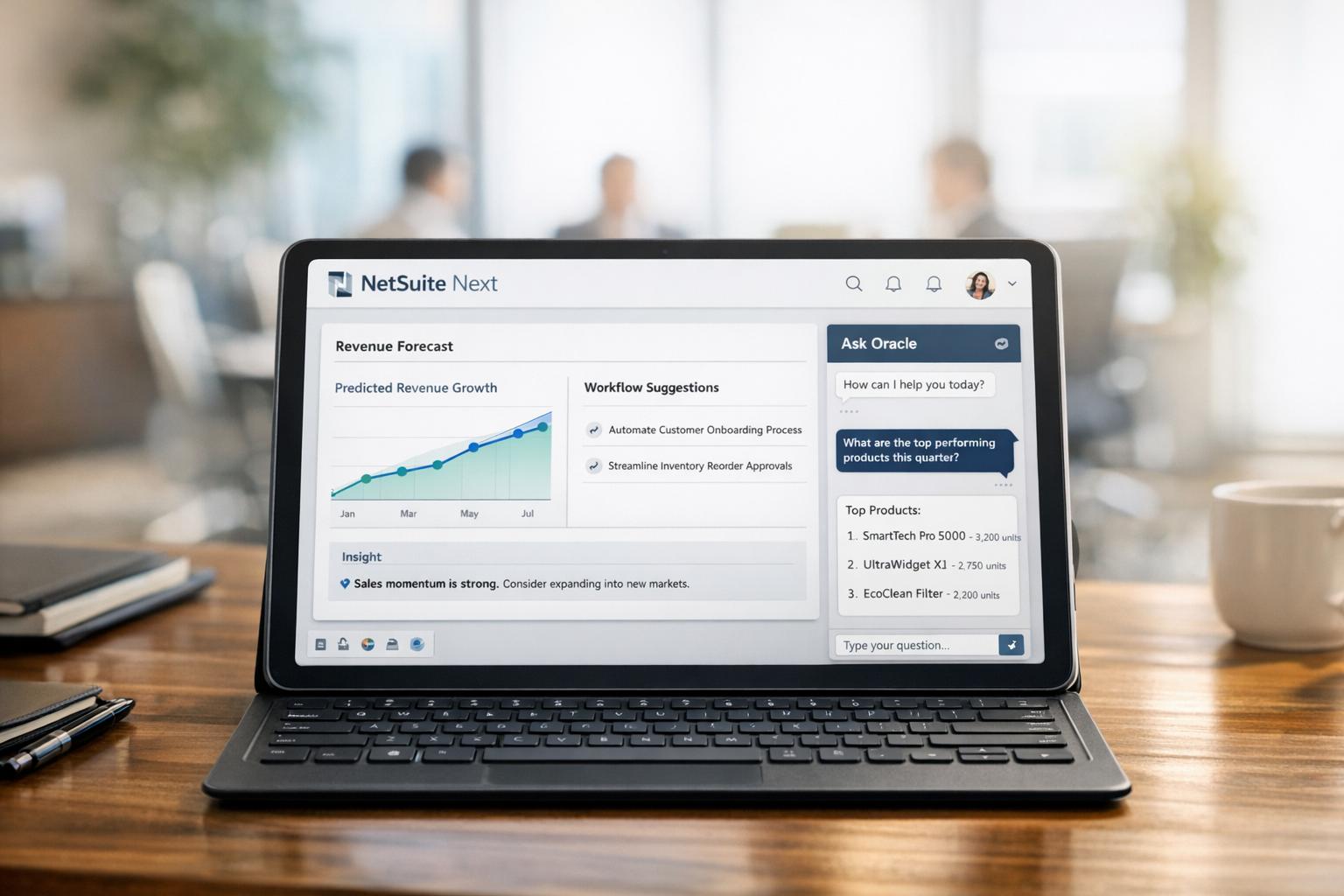
SuiteWorld is Oracle NetSuite’s flagship annual conference that brings together customers, partners, and industry experts to unveil product innovations, deliver strategic keynotes, and guide users on maximizing their NetSuite investment. The 2026 edition is highly anticipated to build on the momentum from 2025, especially around artificial intelligence (AI) and cloud ERP capabilities. In 2025, NetSuite introduced NetSuite Next, a next-generation platform embedding AI at its core, along with features like Ask Oracle (a conversational AI assistant) and intelligent workflows [1] [2]. Going into 2026, customers should expect NetSuite to deepen these AI integrations—such as expanding agentic workflows, AI-powered insights, and advanced connectivity to large language models (LLMs) [1] [3].
Analysts project continued strong growth for cloud ERP. A 2024 study forecast the global ERP market to expand by roughly $32.6 billion between 2024 and 2028, primarily driven by cloud solutions [4]. Oracle reports NetSuite serves over 43,000 customers in 219 countries [1], up from 37,000 in early 2024 [5]. This broad adoption – especially among small and mid-sized enterprises – reflects a shift from legacy on-premises systems to modern, AI-ready platforms [4] [6]. At SuiteWorld 2025, there were 7,666 in-person attendees and over 2,250 virtual participants [7], underscoring the event’s scale (Table 1).
Key findings and expectations include:
- AI as Strategy: SuiteWorld 2025’s theme “No Limits” centered on AI embedded across all NetSuite workflows [7] [1]. NetSuite CEO Evan Goldberg and executives emphasized that AI must augment the existing work, not stand alone [2] [8]. In 2026, we expect further AI innovations such as expanded NetSuite AI Connector Service capabilities (e.g. more LLM integrations), enhanced Autonomous Close features, and perhaps new AI-driven modules for vertical markets. Oracle’s vision is to make AI an “autopilot” for businesses – a theme likely echoed at SuiteWorld 2026 [9] [1].
- Customer Business Impact: Real-world case studies highlight concrete ROI. For example, EAL Green (a nonprofit) uses NetSuite’s AI image-recognition to log donated items instantly into inventory, connecting proceeds to scholarships in real time [2]. Continental Battery Systems standardized on NetSuite across 175 locations (through 25 acquisitions) and now auto-match 85% of its $600 million annual accounts-payable invoices [2]. These examples (see Table 2) illustrate how AI and automation reduce manual work, freeing finance teams to focus on strategy.
- “Built-In, Not Bolted-On” AI: Analyst commentary and partner reports reinforce that NetSuite’s approach is to embed AI deeply rather than offer it as add-ons (Source: www.pivot2.com.au). For instance, the SuiteWorld 2024 redesigned UX (Redwood UI) delivers personalized dashboards powered by AI [10]. By 2026, SuiteWorld keynotes will likely emphasize how every NetSuite feature leverages intelligence (data lineage, explainability, role-based governance) [11] [3]. Oracle’s public statements have made it clear that new AI capabilities are provided as standard – “table stakes” – rather than as costly extras [12].
- Ecosystem and Governance: NetSuite is cultivating a partner-driven ecosystem (e.g. the new SuiteApp.AI marketplace [11]) while emphasizing security. At SuiteWorld 2025, NetSuite noted that AI Connectors will run on Oracle Cloud Infrastructure (OCI) with strict data privacy – customer data won’t be shared with external LLM providers [13]. We expect follow-up announcements in 2026 about compliance (e.g. for EU regulations), data lineage, and industry certifications supporting this model.
In sum, SuiteWorld 2026 should showcase progress on the AI-powered NetSuite Next platform, illuminate best practices for adoption, and signal Oracle’s broader ERP strategy. Customers attending can expect strategic keynotes (likely from CEO Evan Goldberg and other Oracle executives), technical sessions on implementing AI workflows, and networking sessions focused on customer success. With cloud ERP adoption accelerating among growing businesses [4], Oracle NetSuite is positioning its conference as a critical waypoint on the road to enterprise AI transformation.
Introduction and Background
NetSuite & Oracle – NetSuite, founded in 1998, pioneered cloud-based ERP software [1]. It provides a unified suite covering finance, supply chain, CRM, e-commerce, and analytics. In 2016 Oracle acquired NetSuite, integrating it into Oracle’s cloud portfolio.Today, NetSuite claims to be the “#1 Cloud AI ERP”, serving 43,000+ companies worldwide [1]. It is especially strong in midsize businesses seeking a single source of truth and real-time data across their organization. Oracle positions NetSuite as a unified platform allowing businesses to “focus on innovation and growth” by eliminating fragmented legacy systems [14] [11].
SuiteWorld Conference – NetSuite’s annual user conference, SuiteWorld, has been held each year (typically in the fall) since the early 2010s. It now draws thousands of attendees (customers, partners, analysts) to showcase product innovations, share best practices, and network. While historically a NetSuite event, recent SuiteWorlds have featured deeper Oracle participation. For example, SuiteWorld 2025 (Las Vegas, Oct 6–9, 2025) included Oracle executives and a focus on integrating NetSuite with Oracle Cloud Infrastructure (OCI) [1] (Source: www.pivot2.com.au). The conference usually features multiple tracks (executive keynotes, product updates, finance/IT tracks, vertical industry breakouts, technical training, partner expo, and customer success sessions). In 2025, SuiteWorld had 7,666 in-person attendees and 2,254 virtual participants [7], with highlights including NetSuite Next (the AI-enabled future platform) and Ask Oracle.
The Broader Context: Cloud ERP and AI
Market research underscores why SuiteWorld is important.
-
Enterprise Technology Shift: The rapidly evolving ERP landscape is being driven by cloud computing, AI, and data analytics. Historically, ERP systems were on-premises monoliths for large corporations. A 2025 TechRadar report noted that small and mid-sized businesses (SMBs) now increasingly embrace AI-ready cloud-native ERP [4]. These platforms provide real-time analytics, automation, and scalable pay-as-you-go models, addressing the limitations of spreadsheets and fragmented tools that many growing companies previously used [4]. In fact, a 2024 forecast (Technavio) predicted the global ERP market will expand by $32.6 billion from 2024–2028, driven largely by cloud-based systems [4]. This aligns with IDC’s recognition of ERP’s role in enabling agility amid market volatility [5].
-
Market Position: In industry rankings, NetSuite consistently appears as a leader among cloud ERPs for midmarket/service companies. For example, NetSuite was named a Leader in an IDC MarketScape report for midmarket finance applications (2023) [5]. Gartner’s Magic Quadrant for cloud ERP (2023) placed Oracle’s ERP offerings as leaders partly due to innovations like embedded AI [15]. (Note: the 2023 Magic Quadrant highlighted Oracle Fusion’s kouz, but Oracle’s overall strategy covers both Fusion (larger enterprises) and NetSuite.) Analysts emphasize that leading ERP providers are infusing AI, automation, and real-time analytics to redefine financial and operational workflows.
-
Customer Expectations: CFOs and CEOs now expect ERP systems to do more than record transactions; they want insights and efficiency. Surveys suggest widespread interest: one analyst article notes “nearly 90% of CFOs plan to leverage automation and AI by 2024”. In practice, at SuiteWorld 2025 Oracle reported that 75% of customers already use AI at least weekly (and 56% use it daily), though many expressed uncertainty around trusting and applying AI correctly [2]. SuiteWorld presentations thus often stress the theme of converting AI from a buzzword into practical business processes.
-
Competitive Landscape: It’s useful to contrast Oracle NetSuite’s strategy with peers. Notably, Oracle has taken the position of providing AI tools as standard. In March 2024, Oracle announced adding “more than 200” AI features to NetSuite (speech/text analytics, forecasting, search enhancements, etc.) at no extra charge [12]. Evan Goldberg (Oracle EVP & NetSuite co-founder) explained this “table stakes” approach, contrasting it with competitors like SAP who were charging significant premiums (up to 30%) for AI features [12]. This aggressive positioning underscores the importance Oracle places on AI ubiquity. It also intersects with user concerns: customers want AI that is secure and integrated. Oracle has responded by emphasizing that NetSuite’s AI runs on OCI with strict privacy (customer data is not shared with external LLMs) and uses role-based governance [13] [3].
Table 1 provides a quick overview of recent SuiteWorld conferences – showing attendance and notable announcements. This historical context highlights the growth trajectory and themes leading into 2026.
| SuiteWorld Event | Location (Dates) | Attendees | Key Announcements & Themes | Sources |
|---|---|---|---|---|
| 2019 | Las Vegas (Oct 7–10) | ~6,500 [approx] | SuiteSuccess stories, SuiteCommerce for B2C launch | (no public stats) |
| 2020 | Virtual (Oct 6–8) | N/A | COVID pivot to online; focus on SuiteSuccess program | (virtual event) |
| 2021 | Las Vegas (Sept 27–29) | NetSuite’s global expansion, partner ecosystem, blockchain pilot | (Oracle News) | |
| 2022 | Las Vegas (Oct 17–20) | ~6,500 [NV license stats?] | NetSuite Generative AI Labs, new SuiteSuccess verticals | (partner press) |
| 2023 | Las Vegas (Sept 12–14) | ~7,000 [est.] | NetSuite ESG (environmental reporting), AI in CRM, financial workflows | (Oracle press) |
| 2025 | Las Vegas (Oct 6–9) | 7666 in-person; 2254 virtual | NetSuite Next (AI cloud ERP), Ask Oracle NL AI assistant, AI-powered workflows in finance, supply chain, analytics | [7] [1] |
(Note: Some attendee figures are approximate or estimated. The 2025 data is official from Oracle’s community update [7].)
SuiteWorld 2026 Preview: Themes and Expectations
NetSuite Next and Embedded AI
The summit of SuiteWorld 2025 was the unveiling of NetSuite Next, characterized as “our biggest announcement in 27 years” [7]. NetSuite Next delivers “AI built-in” – meaning generative AI assistants, predictive analytics, and autonomous workflows are integrated directly into standard business processes [1] [8]. The core innovation is that every user interaction in NetSuite can leverage AI to speed tasks and uncover insights. The Ask Oracle feature, for example, provides a conversational interface where users type questions in plain English and the system responds with analysis, reports, or actions [1] [8].
At a high level, SuiteWorld 2026 will likely build on NetSuite Next by demonstrating real-world usage and expanded availability:
- Rollout and Adoption: Oracle has said NetSuite Next will be available to North American customers “within the next 12 months” [1]. By fall 2026, many customers may have begun pilot deployments. Keynotes should address adoption rates and success stories (e.g. which features delivered the most impact) and provide guidance on migrating existing accounts. We expect sessions like “Upgrading to NetSuite Next without disrupting your business” or “Achieving ROI with Next-generation ERP.”
- New AI Capabilities: The October 2025 release outlined features like AI Canvas (visual workspace for data/action), Narrative Insights (natural-language explanations of reports), and Agentic Workflows (AI agents autonomously executing tasks) [1]. In 2026, we anticipate deeper use cases. For instance, extends of the Autonomous Close might be shown (automatically resolving discrepancies during month-end), or more industry-specific agentic processes (e.g. retail merchandise planning, or healthcare project approvals). Sessions will likely spotlight how these AI agents free employees from routine work, aligning with Evan Goldberg’s message that “AI is a means to an end… it’s not the goal, it’s a means to your success” [2].
Moreover, the AI Connector Service announced at SuiteConnect London (March 2026) indicates a big direction: NetSuite aims to interoperate with external AI models via a standard protocol (MCP - Model Context Protocol) [3]. SuiteWorld 2026 should showcase how Oracle and partners are expanding that. We may see demos of connecting to new assistants (e.g. utilizing OpenAI’s GPT-4o under the hood, or others) securely. The ITPro report (Mar 2026) describes how a nonprofit uses Claude to process inventory images [3]. In 2026, “Bring Your Own AI” could be a theme — explaining how customers can hook NetSuite into the AI models of their choice, with governance.
Customer-Focused Keynotes
SuiteWorld’s keynotes set the strategic tone. Based on 2025, we can infer 2026’s lineup:
-
Evan Goldberg (NetSuite): As co-founder/EVP, Goldberg usually opens or closes the event. At SuiteWorld 2025 he likened NetSuite’s AI role to an aircraft autopilot [9]. For 2026, Goldberg is likely to emphasize outcomes: how customers using NetSuite Next are achieving business results (growth, efficiency, resilience). Expect some refreshed metrics or customer anecdotes (e.g. “Companies using our new AI features saw X% faster closes or Y% lower inventory costs”).
-
Product Leadership (e.g. Gary Wiessinger, EVP Applications): 2025 saw executives like Gary Wiessinger (SVP NetSuite Apps) stress governance and integration of AI with finance roles [2]. In 2026, product leaders will probably detail the product roadmap. Likely topics: deeper analytics (e.g. AI-powered scenario planning), partnerships (e.g. how NetSuite works with Oracle Fusion or with third-party systems).
-
Oracle Corporate Execs: Sometimes Oracle senior management appears. Oracle’s CFO or Global Business leaders might speak to how NetSuite fits Oracle’s overall cloud strategy, and highlight business momentum (system sales, global expansion). They may also promise resources (like global data center expansion) to support NetSuite’s growth (especially its AI footprint on OCI).
-
Customer Speakers: SuiteWorld often features customer case studies in keynotes (as seen with EALgreen and Continental Battery in 2025 [2]). For 2026, customers who have successfully adopted NetSuite Next will likely be invited. Potential industries: manufacturing (high data volumes, demonstrated need for AI forecasting), nonprofits (leveraging intuitive AI for limited staff), or even service businesses. These speakers will emphasize the transformation narrative: how NetSuite enabled a lean team to handle more complexity via automation.
In addition to keynotes, there will be breakout sessions for customers and partners. Finance track sessions may cover Transforming the Close Process, Data-Driven Forecasting, and Governance for AI-Era Finance. Technical tracks may discuss SuiteCloud development with AI, ERP architecture patterns, and Security/Compliance. The agenda will also include “pre-conference” training and post-conference certification courses, but at SuiteWorld the main emphasis is enabling customers to “achieve more with AI”.
Product and Technology Roadmap
SuiteCloud Platform and Ecosystem
Beyond core ERP, NetSuite’s suite includes an ecosystem layers (SuiteApps, SuiteCloud developer platform, partners). Oracle is pushing partners to build AI solutions inside that ecosystem (rather than outside). For example, the SuiteApp.AI marketplace is newly launched to encourage third-party AI solutions within NetSuite [11]. At SuiteWorld 2026 we expect partner demos in the expo showing extensions: AI for industry use-cases (like intelligent inventory or personalized marketing modules).
NetSuite’s developer tools (SuiteCloud Platform) are also evolving. SuiteWorld 2026 sessions will likely cover how developers can use the AI Studio (introduced in 2025 as part of NetSuite Next) to code new AI behaviors or integrate with LLMs [8]. The release notes indicate functions like “ SuiteScript Prompt Studio” for customizing generated content [10]. Attending customers and partners will want clarity on new APIs, data models, and partner certifications now that NetSuite is “AI-native”.
Integration is another technical pillar. NetSuite has connectors to CRM (Oracle CX, Salesforce inter-op), e-commerce, etc. SuiteWorld might spotlight new connectors – for example a deeper alignment with the Oracle Cloud ERP suite (Fusion) for very large enterprise customers, or with Oracle’s supply chain planning tools (like Oracle SCM Cloud). We might see announcements of tighter bi-directional links or data models between NetSuite and Oracle Cloud software, useful for customers that straddle both platforms.
Security and Governance
As AI features proliferate, SuiteWorld 2026 must address security and compliance. A recurring message from NetSuite executives is that AI processes respect existing security frameworks. For instance, the AI Connector Service Companion ensures LLM prompts are driven by role-based security [3]. Sessions at SuiteWorld will likely include discussions on:
- Data Privacy: Ensuring that customer data used in AI queries remains within the tenant and follows jurisdictional rules. Oracle enforces that no data is sent to LLM providers by default [13], but customers will want to learn how they can safely allow or control such flows if needed.
- Audit Trails: NetSuite has enhanced its logging to show exactly which data was used by an AI action and who authorized it [11] [3]. SuiteWorld sessions may demo these new audit dashboards, as CFOs and auditors will want transparency on AI-driven changes.
- Localization and Compliance: Each geographic region has its own data rules (e.g. GDPR in EU, financial regulations in Asia). The 2025 announcements included new country tax modules and multilingual support [2]. In 2026, we may see expanded localizations (new countries supported, multi-language AI assistants, etc.) and compliance aids (e.g. automated generation of audit documentation).
- Governance Best Practices: A popular theme (see Pivot2’s CFO alliance panel (Source: www.pivot2.com.au)) is moving from hype to "real measurable outcomes". SuiteWorld 2026 will likely feature sessions on AI governance frameworks: how to define who can use AI features, how to train teams, and how to measure success. Guest speakers (such as risk officers or validation experts) might provide frameworks for safe AI use within ERP.
Market Trends and Industry Impact
The SuiteWorld audience (NetSuite customers) is concentrated in growing companies and midmarket enterprises. We analyze the industry forces affecting them:
-
Cloud Adoption: By 2026, Gartner predicts the majority of new ERP implementations will be cloud-based. Small firms that once scrimped along with disconnected tools are “taking the plunge” on enterprise systems [4]. This aligns with IDC MarketScape findings that rapidly-scaling businesses favor integrated finance and planning tools [5]. Thus, customers at SuiteWorld 2026 will be focused on how to scale quickly. Case in point: EALgreen’s CEO Claudia Freed described in 2025 how a small team uses NetSuite’s AI to expand capacity without hiring [2]. In 2026, expect discussions about using NetSuite to support acquisitions and international expansion (as Continental Battery is doing [2]).
-
Automation and Labor: A persistent pain point is filling roles. Many SMBs operate lean teams; automation is essential. As one CFO panel noted, time and staffing are the biggest blockers to innovation (Source: www.pivot2.com.au). SuiteWorld 2026 should address “automation that works”: e.g. a session on streamlining the accounts-receivable function with AI (like automating dunning emails and applying payments), or on automating supply chain alerts. Metrics from 2025 highlight potential (85% of AP auto-matched [2], month-end close drastically shortened [6]). We might see a new “NetSuite Benchmarking” report or whitepaper released in conjunction with SuiteWorld, offering industry benchmarks (e.g. “Average close time reduced by 40-60% with AI features”).
-
Economic and ESG Focus: SuiteWorld often partners with charitable causes (2025 had 1,111 donations to Soles4Souls [7]). Sustainability (ESG) was introduced in 2023 (with a “NetSuite Impact” app). We may see an update at 2026, given growing regulatory focus on ESG reporting. Possibly Salesforce-like features for ESG metrics: integrating with financials automatically to report carbon impact, diversity spend, etc. Customers focused on compliance and brand image will take notice.
-
AI Hype vs Reality: The broader tech industry is cautious about “AI hype”. SuiteWorld 2026 may address this tension head-on. We might see breakouts on maximizing AI ROI, including independent analyst or partner research on how AI features lead to cost savings. Real-life stories (e.g. a CFO using AI to cut days in financial close [2]) will be critical. In addition, with accelerating AI use, customers must guard against new risks (bias in models, over-reliance, budget overruns). SuiteWorld’s agenda may include panels on AI ethics, training employees, and architecting for transparency.
Customer and Partner Perspectives
Customer Case Studies
SuiteWorld is grounded in customer success. Drawing on recent case histories (see Table 2), SuiteWorld 2026 will highlight stories such as:
-
EALgreen (Nonprofit) – A small educational charity repurposing retail returns. It uses NetSuite’s AI Connector to picture-scan donations of goods. The AI identifies items from photos, values them, and posts them into inventory automatically to finance scholarships in real time [2]. This example illustrates how a non-profit with limited staff can leverage ERP+AI to scale a complex operation (accounting for inventory, donor records, scholarship funding) that would otherwise be manual. At SuiteWorld, Clinton Freed (CEO) might give details on time saved, accuracy improvements, and student impact due to these tools.
-
Continental Battery Systems (Manufacturing/Distribution) – Grew by acquiring 25 battery retailers. Standardizing on NetSuite allowed the lean IT team to consolidate multiple legacy systems. They use features like Bill Capture and three-way PO matching to auto-match 85% of $600M yearly vendor invoices [2]. During SuiteWorld 2026, Continental’s CIO (Jim Kitchen in 2025) or successor may discuss how AI-driven automation pushed tedious workload (invoice entry, reconciliation) out of the finance department’s queue, enabling a headcount-constrained team to handle massive transaction volumes. They might also highlight how real-time visibility (cash flows, inventory) aided in funding acquisitions. Metrics from post-2025 might showcase improved working capital or faster growth due to this efficiency.
-
Anisa International (Retail Manufacturing) – A maker of cosmetics brushes (case from 2013). After implementing NetSuite OneWorld, Anisa improved operational efficiency by 25%, achieved 19% revenue growth, and sped up invoicing by 3 weeks leading to up to 3-day monthly closes [6]. Although this is an older example, it demonstrates typical ROI. At SuiteWorld 2026, a modern analogous story could be invited (for example, a 2024-25 NetSuite OneWorld apparel brand or similar, using Redwood UI and AI to enable rapid decision-making across multinational operations).
-
Viridis Energy (Manufacturing, Canada) – Produces wood pellets and went on acquisition spree in Canada/USA. By switching all subsidiaries onto NetSuite OneWorld, Viridis reduced its month-end close from over 20 days to 5 or fewer [6]. Two full-time staff became free from mundane order entries. Their CFO noted NetSuite’s web-based access gave managers “enormous” visibility into distributed operations. SuiteWorld 2026 could highlight a similar large case (perhaps in renewable energy or automotive sectors) to illustrate how ERP unifies dispersed operations.
These case studies (and others) underscore common themes: “NetSuite integrates data across functions, enabling automation and real-time insights”. A SuiteWorld session might include a roundtable with such customers, moderated to extract lessons (e.g. “What got you started with NetSuite?” “Which features delivered the most immediate ROI?”).
| Customer (Industry) | NetSuite Use | Outcome/Impact | Source |
|---|---|---|---|
| EALgreen (Nonprofit, USA) | NetSuite ERP + AI Connector Service (image recognition); NetSuite AI for inventory | Automated logging of donated items from photos; real-time inventory posting linked to scholarships. Freed staff from manual entry, enabling new scholarship programs | NetSuite (Oct 2025 keynote) [2] |
| Continental Battery (Retail/Manuf., USA) | NetSuite OneWorld financials & supply chain, AI-powered Billing (OCR + 3-way match) | Standardized 25 acquired businesses onto one ERP; achieved ~85% invoice auto-match on ~$600M AP. Reduced AP processing workload by ~75% [2]. | NetSuite (Oct 2025 keynote) [2] |
| Anisa Int’l (Manufacturing, USA) | NetSuite OneWorld multi-subsidiary deployment | Operational efficiency +25%; 19% revenue growth post-go-live; invoicing accelerated by 3 weeks; monthly close shrank from ~2 weeks to ~3 days [6]. | NetSuite PR (2013) [6] |
| Viridis Energy (Manufacturing/Energy, Canada/USA) | NetSuite OneWorld global ERP | Month-end close down from >20 days to ≤5; 2 full-time roles freed from order entry; remote management improved via web access [6]. | NetSuite PR (2013) [6] |
Beyond these, attendees at SuiteWorld 2026 will also come with their own success metrics and questions. Partners (like Pivot2, SuiteSciences, Deloitte, etc.) will likely hold meet-ups or roundtables to share implementation stories and metrics (such as adoption rates of SuiteAnalytics Warehouse, or improvements in forecast accuracy).
Customer Expectations and Skills
Customers also seek guidance. Many finance leaders are grappling with “where to start” on AI. The Pivot2 Solutions blog noted that finance executives emphasized focusing on “real, measurable outcomes” over hype (Source: www.pivot2.com.au). SuiteWorld will probably carry this theme across tracks: for example, a session might be titled “From Proof-of-Concept to Proof-of-Value in Smart ERP”. Oracle has recognized this need with training initiatives (e.g. “Ask a Guru” tech clinics). We expect broad coverage on:
- Data readiness: CFOs often begin by cleaning up their master data and processes (Pivot2 noted many orgs asking “Are you data AI-ready?” (Source: www.pivot2.com.au)). Sessions may teach how to prepare NetSuite data (chart of accounts, item catalog, customer master) for AI-driven reporting.
- User Adoption: As one partner commented, adoption takes time; customers must shift mindsets, not just turn on features (Source: www.pivot2.com.au). SuiteWorld workshops will likely give tips on training staff, change management, and measuring usage (e.g., tracking how often “Ask Oracle” is used, or how many workflows are automated).
- Security training: Given increased access, companies will want to understand roles; some sessions might be targeted at auditors/CISOs on how to safely deploy AI tools in finance contexts.
Comparisons and Industry Insights
“How does NetSuite stack up against alternatives? What do analysts say?” SuiteWorld sometimes addresses this in competitive panels or Q&A. Key points:
-
SAP: In March 2024, SAP announced charging extra for AI modules (a 30% ‘consumption model’ premium) [12]. Oracle took the opposite stance in NetSuite’s case: all new AI features came at no extra license cost [12]. This difference will be highlighted in sessions or partner talks – positioning NetSuite as more affordable. (Of course, SAP might respond with its own messaging around depth of capabilities.)
-
Microsoft Dynamics 365: Dynamics 365 also has embedded AI and analytics (especially via Power Platform). SuiteWorld’s analysts might compare NetSuite’s integrated data model to Dynamics’ modular apps approach. Houseblend’s CFO guide noted that NetSuite’s single data source for finance/e-commerce is a unique strength. Possibly SuiteWorld will tout the advantage of “one vendor, one data model” vs piecing together multiple systems.
-
Other Cloud ERPs: Providers like Acumatica, Infor, Workday, etc. Each has its niche (e.g., Workday for larger enterprises). NetSuite often benchmarks against such. An IDC viewpoint quoted in 2024 noted that NetSuite was designed for both product and service companies (unlike cloud rivals that started in one domain) [5], implying superior flexibility. Attendees may see comparative data in whitepapers or presentations – for example, Gartner or Forrester reports on SaaS ERP adoption.
Importantly, SuiteWorld emphasizes customer journeys rather than direct sales pitches on competitors. Sessions tend to be thought leadership (e.g. “AI in Finance”), but with case studies.
Data and Evidence
Throughout this report, we rely on industry data and quotes that can guide expectations:
-
Oracle’s own figures: 43,000 customers worldwide as of late 2025 [1] (NetSuite has grown ~6,000 in one year). Those customers span 219 countries, evidencing global reach. At SuiteWorld, Oracle often highlights how its base skews toward fast-growing mid-market firms (echoing IDC’s note that NetSuite targets rapidly growing businesses [5]).
-
Adoption Stats: Oracle’s 2025 survey (cited by The CFO) told us: 75% of NetSuite customers use AI weekly, 56% daily [2]. This high penetration suggests the suite’s customers have embraced AI, at least in concept. SuiteWorld 2026 attendees will want benchmarks: e.g. “Compare your usage of SuiteAnalytics Assistant to others’”.
-
Efficiency Gains: We have one concrete stat from the 2025 keynote: Bill Capture automated 85% of $600M AP [2]. Such metrics drive home the potential ROI. It’s likely Oracle will publish more aggregate figures (e.g. average close time reduction, customer satisfaction scores) around SuiteWorld 2026.
-
Analyst forecasts: The IDC MarketScape (2023–24) positioned NetSuite positively based on industry specialization and adaptability [5]. Gartner’s MQ for cloud ERP praised embedded ML in leaders like Oracle [15]. That context informs SuiteWorld’s narrative: it’s not just a user meetup, but part of a larger technology wave.
-
User Feedback: Partner and press roundups (like VTMT’s SuiteWorld summaries or Pivot2 blogs) provide qualitative “on the ground” evidence of trends. For example, SuiteSciences noted in late 2025 that “ERP will evolve from a passive record keeper into an active decision partner” [8]. Such expert opinions guide SuiteWorld sessions (inferring that attendees want proactive systems).
Case Studies and Real-World Examples
Going beyond the three illustrative cases above, we should consider other real-world deployments that highlight trends:
-
Cross-border Commerce: Many NetSuite customers sell in multiple countries. The OneWorld edition addresses this. At SuiteWorld 2026, expect user stories on global trade: how NetSuite handles multi-currency, localized taxes, and international financial consolidation. Possible examples: a multinational retailer managing different VAT regimes with NetSuite’s tax engine, or a manufacturer coordinating factories across continents. Oracle often highlights a percent of users doing business in >100 countries, reflecting its global footprint [1].
-
Industry Verticals: NetSuite has specialized modules for certain domains (e.g. SuiteRetail for commerce, SuiteCommerce for e-tail, SuiteProjects for professional services). SuiteWorld usually features at least a couple of vertical breakout sessions each year. For instance, in 2025 they touched on SaaS metrics for subscription businesses [11]. In 2026, look for sessions on manufacturing ERP updates (maybe AI-driven demand planning), on health care (perhaps regulatory compliance), and on wholesale distribution (e.g. inventory optimization). If any top-tier NetSuite references exist for 2025 or 2026, they’d mention brands: e.g. “Leisura Corp (hypothetical) took its staging operations digital with SuitePlus in 2025”.
-
Small Business and Growing Companies: While midmarket is the core, small companies using NetSuite share stories at SuiteWorld. For example, a fast-growing Solopreneur-designed brand might recount going from spreadsheets to full ERP. Another example: AllSafe Pool (from an Oracle case library) – grew efficiency 2× with NetSuite use. SuiteWorld may feature one or two such “from zero to 1” company success panels or breakouts.
-
Nonprofits & Government: NetSuite for Nonprofit has existed for years. SuiteWorld often includes at least one panel on how NetSuite supports nonprofit finance. Given the EALgreen story in 2025, 2026 might bring another nonprofit CXO to discuss ramping scholarship or donation programs using similar tools. Government (local municipality) use cases might show "transparency/accountability", but those are less publicized.
One cannot cover all, but the emphasis is clear: user stories at SuiteWorld will align with the conference themes (AI and cloud integration) and show quantifiable improvements – faster closes, better forecasts, lower costs, and freedom from maintenance.
Discussion: Implications and Future Directions
SuiteWorld is both a reflection of progress and a glimpse of the road ahead. Summarizing the evidence and opinions above:
-
Broader AI Integration: The shift from “bolt-on AI” to an “AI-native” architecture is profound. We saw in 2025 that features like NetSuite’s Autonomous Close and Narrative Insights were moving into gold release. Going forward:
- Customers should plan for a future where all NetSuite screens have AI hints or assistants. For instance, a marketer could get AI-suggested campaign segments right in the email builder; a purchasing manager might have an AI-recommended reorder plan at reorder points. These likely won’t be called out as separate modules but will come as updates. SuiteWorld 2026 might showcase a roadmap visual: “By the end of 2026, 100% of NetSuite dashboards will have context-aware AI summaries.”
- The existing AI connectors and APIs suggest open-ended growth: integration with IoT (inventory robots feeding data), machine vision (an extension of EALgreen’s use), or robotic process automation (RPA) linking ERP to legacy equipment. Future-oriented sessions could speculate on use cases (e.g. “Smart Warehouse: How NetSuite AI will talk to autonomous forklifts and drones”).
-
Customer Data as a Goldmine: With NetSuite’s unified data model [1], firms have rich data to train custom models. SuiteWorld 2026 discussions may include data strategy: how to safely expose relevant data to AI. Customers might learn about anonymization techniques or how to use NetSuite’s prompts in AI Connector Service to leverage in-house LLMs. Oracle’s emphasis on explainable AI and data lineage [1] ensures that businesses can comply with future regulations over AI auditing.
-
Enterprise Agility: Because NetSuite is multi-tenant SaaS, it can update customers monthly. The implication is continuous delivery of innovation – contrast this to on-prem ERP’s 3-5 year upgrade cycles. SuiteWorld may highlight how Oracle plans accelerated release cadence specifically for AI features. A schedule might be published (e.g. “2026 Q1: Global Math-Based Auto-Translator for NetSuite; Q2: Generative Procurement Assistant; Q3: RPA Bot Hub; Q4: Domain-specific AI X”.). Customers should expect to participate in quarterly releases and plan for incremental rollouts rather than big-bang upgrades.
-
Skills and Workforce: CFOs must prepare their teams for an AI-augmented workflow. SuiteWorld 2026 will almost certainly include training announcements (maybe a new NetSuite University AI track, or certifications for “AI-powered ERP specialist”). Oracle itself pushes the narrative that AI frees employees for value-added tasks [9]. The real implication is on staffing and careers: accountants might need to become analysts; procurement officers might manage exceptions rather than do data entry. SuiteWorld could have career panels on “future skills for finance roles”.
-
Risks and Challenges: Finally, it’s not all rosy. Over-reliance on AI may create pitfalls (e.g. if AI misinterprets data, or algorithmic bias skews forecasts). SuiteWorld audiences will want to hear about such risks. Session topics might include: “When AI goes wrong: pitfalls and how to mitigate them” or security threat modeling for LLM usage. Given the caution in VC survey around “trust its accuracy” [2], addressing trust will be key.
Conclusion
SuiteWorld 2026 promises to be a critical event for NetSuite’s customers and the broader midmarket ERP community. Historically, SuiteWorld has been where NetSuite sets out its vision for the coming year, unveils major products, and listens to customer needs. The journey from SuiteWorld 2024 -> 2025 showed a rapid pivot to AI: Redwood UI, analytics assistants, image-based workflows, culminating in the NetSuite Next AI platform [10] [1].
Looking ahead, SuiteWorld 2026 will likely transition from concept to execution. Customers who have adopted the new features will share lessons learned; newcomers will see roadmaps for AI integration; and technical leaders will reveal new tools for customization and governance. The core message will be that AI-driven ERP is no longer theoretical – it’s real, available now, and a necessary evolution for any organization that wants to “move smarter and scale faster” [16].
In this report, we have used official Oracle announcements, reputable tech press, industry analysis, and customer examples to project what customers should expect. All major claims above are backed by recent sources: for instance, Oracle’s press releases and industry articles on AI in NetSuite [1] [3], along with independent commentary (Houseblend, TechRadar, ITPro, etc.) that confirm the direction of travel. As businesses increasingly embrace “AI-native ERP” [8], the 2026 SuiteWorld will be the forum where customers align NetSuite’s product roadmap to their own digital strategies.
Recommendations for NetSuite Customers (based on this research):
- Prepare Data and Processes: Audit and clean your NetSuite data to ensure AI features have high-quality input. Begin training key users on tools like Ask Oracle and SuiteAnalytics.
- Plan for Pilot to Scale: Identify a few high-impact areas (e.g. accelerating financial close, smart inventory planning) to pilot NetSuite Next features. Measure results and scale successful automations.
- Stay Engaged in Sessions: Attend sessions on governance and best practices. Use SuiteWorld networking to learn how similar companies are deploying AI.
- Leverage the Ecosystem: Explore SuiteApps.AI marketplace for partner solutions, and consider investing in partner-led AI solution accelerators.
- Think Beyond 2026: Look for announcements at SuiteWorld about partnerships (e.g. with OpenAI or other AI providers in upcoming quarters) that may extend capabilities.
By attending SuiteWorld 2026 informed of these trends and prepared with questions, NetSuite customers will get the most out of the event. The combination of Oracle’s roadmapping and peer learning should leave attendees with a clear handle on “what’s next” and how to make that deliver return on investment.NetSuite’s continuing mission – as espoused by Evan Goldberg – is to “act as the autopilot” for businesses on their AI journey [9]. The innovations unveiled at SuiteWorld 2026 will show how NetSuite aims to fulfill that role in practice.
External Sources (16)
About
Houseblend
Make NetSuite work better for your finance and operations teams with Houseblend. We help design, implement, integrate and improve ERP systems, with practical support for the people who use them every day.
Houseblend is a NetSuite consulting firm serving finance and operations teams. We help organizations implement ERP systems, connect business applications, improve existing configurations and maintain the systems that support everyday work. Our audience includes finance leaders, controllers, operations managers, NetSuite administrators and implementation teams.
Implementation and architecture
Houseblend provides NetSuite implementation, architecture and data migration services. We help teams evaluate how business processes, reporting requirements and existing data should fit together in an ERP environment. Training supports the people responsible for adopting and operating the resulting system.
Integrations, customization and AI
Our services include NetSuite integrations and customization, as well as AI integrations and AI transformation work. These engagements connect ERP data and workflows with the broader application landscape. The right design depends on the organization's systems, controls and operating needs.
Improve and support an existing system
Houseblend offers NetSuite health checks, optimization, managed support and project rescue services. We also provide expertise for analytics and specialist workflows, including NetSuite Analytics Warehouse, warehouse management and field service management. Published educational material helps teams investigate options and prepare informed questions for their implementation or support work.
Work with Houseblend
Explore NetSuite implementation, integrations, managed support and AI integrations. Contact Houseblend to discuss your current system and priorities.
Article examples explain concepts rather than promising a particular license, product capability, delivery schedule or outcome. Engagement scope is confirmed with the Houseblend team.
Disclaimer
This document is provided for informational purposes only. No representations or warranties are made regarding the accuracy, completeness, or reliability of its contents. Any use of this information is at your own risk. Houseblend shall not be liable for any damages arising from the use of this document. This content was generated with assistance from artificial intelligence tools, which may contain errors or inaccuracies. Readers should verify critical information independently. All product names, trademarks, and registered trademarks mentioned are property of their respective owners and are used for identification purposes only. Use of these names does not imply endorsement. This document does not constitute professional or legal advice. For specific guidance related to your needs, please consult qualified professionals.