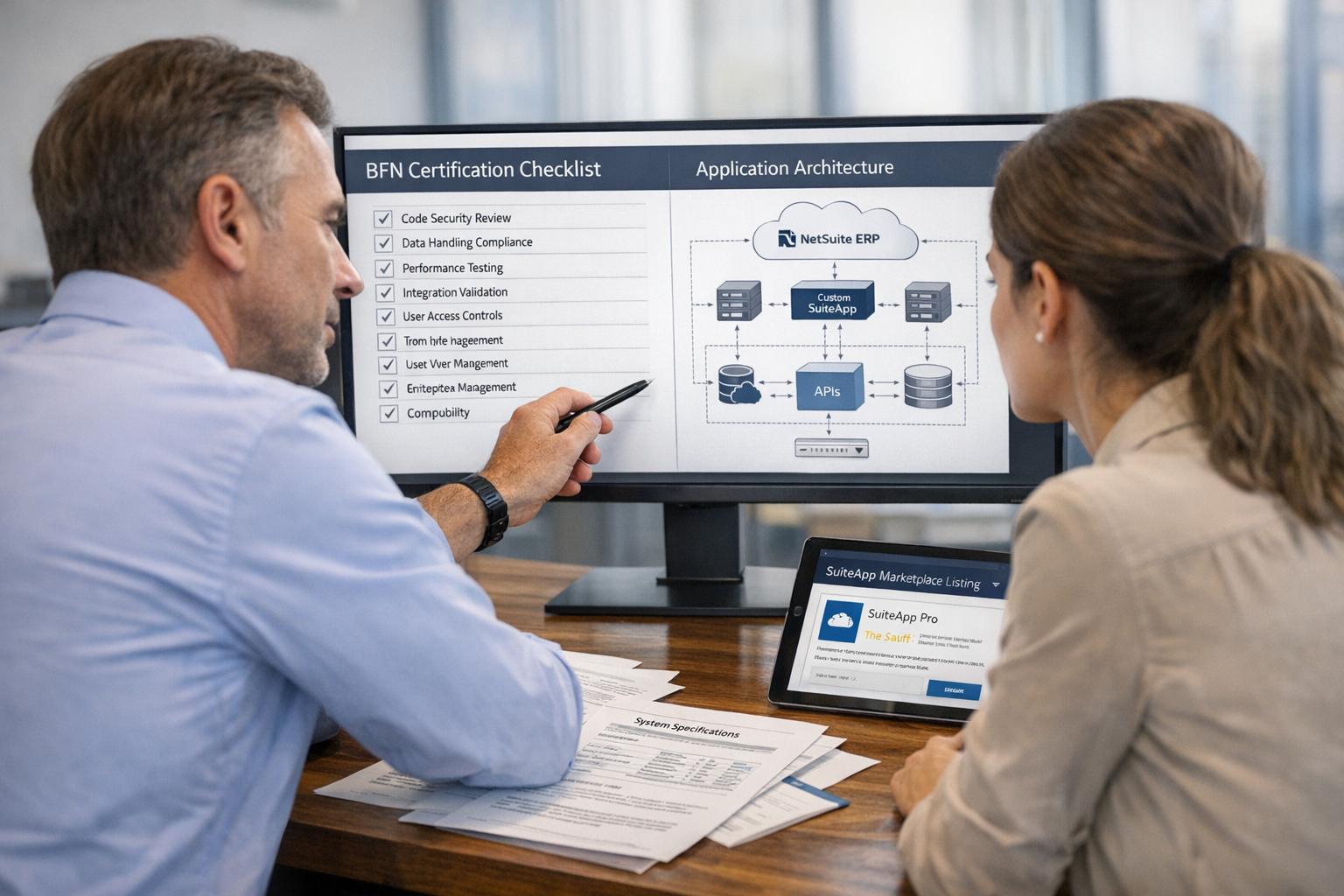
Houseblend Article
Built for NetSuite Certification: ISV SuiteApp Listing Guide
Inside this article
Executive Summary
This report provides a comprehensive analysis of the Built-for-NetSuite (BFN) Certification program and the process for listing applications on SuiteApp.com, targeted specifically at Independent Software Vendors (ISVs) and developers in the NetSuite ecosystem. We begin with historical context on NetSuite’s SuiteCloud Developer Network (SDN) and SuiteApp Marketplace, then delve into the BFN program—its purpose, requirements, and review process. We examine the SuiteApp listing process via the SuiteApp Control Center (SACC), including technical packaging (SuiteCloud Development Framework, SDF), publication requirements, and best practices for marketplace listings. Multiple perspectives are covered: NetSuite/Oracle’s official stance, ISV-partner views, and customer/end-user considerations. Case studies of actual SuiteApps (e.g. from Extend, Precoro, ServiceTitan, and Setuply) illustrate real-world implications of achieving BFN status. Throughout, we incorporate data, statistics, expert commentary, and examples.
Key findings include that BFN certification is NetSuite’s “gold standard” for third-party apps, verifying that a SuiteApp meets stringent security, architectural, and development best practices [1] [2]. As of early 2026, the SuiteApp Marketplace hosts over 700 applications (growing steadily) [3]. To publish on SuiteApp.com, ISVs must complete a three-point publishing checklist: a released app version, an SDN listing review, and a BFN review [4]. BFN-reviewed SuiteApps gain increased customer trust: Oracle partners emphasize that the BFN badge signals compatibility with NetSuite’s biannual upgrades and compliance with established design guidelines [3] [2].
This report covers the entire lifecycle from development to listing: detailing SuiteCloud and SDF tooling, the SuiteApp Control Center, SDF packaging, and the SACC distribution process. We analyze the benefits and costs of BFN certification, contrasting certified vs. non-certified SuiteApps (e.g. in Table 3). We also include data on BFN adoption and SuiteApp Marketplace growth. Finally, future directions of the program are discussed—such as evolving guidelines for AI-enabled apps and expanding global reach—emphasizing that BFN certification will likely remain a key credibility marker for NetSuite ISVs.
Introduction and Background
NetSuite and the SuiteCloud Ecosystem
Oracle NetSuite (hereafter NetSuite) is a leading provider of cloud-based enterprise resource planning (ERP) software, serving over 43,000 organizations worldwide by 2025 [3]. To extend its core ERP with specialized features, NetSuite cultivates a rich ecosystem of partners and independent developers through its SuiteCloud platform. The SuiteCloud Developer Network (SDN) is NetSuite’s official partner and developer program for application providers. Members of the SDN (“partners” or “ISVs”) build SuiteApps—modular business applications packaged for NetSuite’s platform—to address industry-specific or process-specific needs beyond the base ERP.
These SuiteApps are distributed through Oracle NetSuite’s SuiteApp Marketplace (accessible at [5]), an app store-style environment. NetSuite compares its marketplace to other cloud marketplaces: it is a “curated directory of third-party applications” that complement NetSuite’s out-of-the-box features [3]. Unlike generic app stores, the SuiteApp Marketplace is closely managed by Oracle, and each app must meet strict criteria to appear there. This report focuses on the Built-for-NetSuite (BFN) Certification—NetSuite’s official quality endorsement for SuiteApps—and on the entire listing process on SuiteApp.com, which is often called the Built-for-NetSuite (BFN) Certification & Listing guide for ISVs.
Historical Context
Originally, NetSuite offered a SuiteBundle mechanism for partners to extend customer accounts. In the 2010s, the shift toward cloud-native development led to the SuiteCloud Development Framework (SDF), enabling source-driven development of NetSuite customizations. Alongside, NetSuite formalized partner involvement via the SDN (now SuiteApp Partner Program) and introduced the SuiteApp Marketplace. Recognizing the need for quality assurance, NetSuite launched the BFN program around 2015. By the 2015.2 release, the BFN review became a structured requirement for SuiteApps going to market [2]. Since then, NetSuite has required that any SuiteApp published on SuiteApp.com pass a Built-for-NetSuite review, as a complement to a standard listing review by the SDN team [4]. Over time, BFN certification has become synonymous with reliability and compatibility for SuiteApps; today it is often viewed as the “gold standard” for NetSuite add-ons [1] [2].
Concurrently, the SuiteApp Marketplace has grown substantially. As of early 2026, the marketplace hosts 700+ SuiteApps, an increase driven by booming demand for cloud-era ERP integrations and functionality [3]. (By comparison, reports from earlier in the decade indicated far fewer apps. BrokenRubik notes that the pace of new listings “keeps growing every quarter” [3].) All approved SuiteApps—from NetSuite’s own modules to partner offerings—are visible on SuiteApp.com, though only partner SuiteApps carry a BFN badge indicating Oracle’s certification [6] [1].
The SuiteApp Marketplace and BFN Significance
The SuiteApp Marketplace functions as the central hub where NetSuite customers search, compare, and procure third-party SuiteApps. Oracle emphasizes that SuiteApp.com is a “single-source online marketplace” for customers to find solutions to meet specific business or industry needs (Source: www.taiwannews.com.tw) [1]. SuiteApps cover a wide range of domains (e.g. CRM add-ons, payroll, logistics). The marketplace interface (as shown in Oracle’s documentation [7]) provides installation controls, support info, version details, and – crucially – the Built-for-NetSuite badge when applicable.
For customers evaluating SuiteApps, the BFN badge is a key filter.Third-party advisors note that BFN-certified apps have guaranteed adherence to NetSuite’s architectural and security “best practices,” and are tested against upcoming NetSuite releases [3] [2]. As BrokenRubik (a NetSuite consulting firm) explains, “Look for the Built for NetSuite (BFN) badge. This certification means Oracle has reviewed the app’s code, verified it follows SuiteCloud best practices, and confirmed it won’t break your NetSuite environment during upgrades” [3]. In other words, BFN signaling reduces perceived risk for customers. Conversely, partners highlight that not every SuiteApp is equal: non-BFN apps may function today but could break after a NetSuite upgrade [3]. Thus, the BFN program serves both a quality assurance function and as a market differentiation tool.
Built-for-NetSuite (BFN) Certification Program
Purpose and Overview
Built-for-NetSuite (BFN) is NetSuite’s certification program for third-party SuiteApps. In essence, BFN is a comprehensive quality assurance and vetting process. NetSuite designed it “to give NetSuite customers additional confidence” that certified SuiteApps “have been built to meet [NetSuite] standards” (Source: www.taiwannews.com.tw) [1]. According to official sources, BFN provides ISV partners with the “information, resources, and methodology” to ensure their apps adhere to NetSuite’s architecture, development, security and privacy requirements (Source: www.taiwannews.com.tw) [2]. Practically, this means Oracle reviews the SuiteApp’s design, implementation, and documentation.
BFN is described by Oracle executives and partners as a “seal of approval” akin to having the app treated like a built-in feature of NetSuite. For example, Zone & Co (an Oracle Solution Partner) explains BFN as ensuring that third-party SuiteApps meet the same standards for security, data privacy and overall quality as solutions offered by NetSuite itself [8]. In short, BFN represents NetSuite’s commitment to Shop customers’ reliability. Extend, a product protection provider, calls it “the NetSuite gold standard for privacy, architecture, and security standards for SuiteApps developed by third parties” [1].
Program Pillars and Review Process
Zone & Co characterizes the BFN program as built on three pillars: education, consultation, and confirmation [8]. Oracle educates ISV developers with best-practice guidelines (e.g. SuiteApp Architectural Fundamentals), consults during development if needed, and ultimately confirms compliance via a formal review. The BFN review process is rigorous. Inspirria Cloudtech (a NetSuite partner) describes it as involving submission of a detailed questionnaire, reference customers, and a demo; all have to be validated by Oracle before the badge is issued [2]. The review scope depends on the app’s architecture (described next). Importantly, BFN is not a one-time affair; certifications must be renewed semi-annually with each NetSuite release, and approval can be revoked if standards slip [2].
Table 1: BFN Badge Types and Review Scope
| Badge Type | Architecture | BFN Review Scope | Description (source) |
|---|---|---|---|
| Native | Entire solution lives entirely on the SuiteCloud platform. No external servers or separate logins. | Covers all components (the entire SuiteApp) | “The entire solution lives on the SuiteCloud platform… It’s like having a built-in feature rather than a bolt-on solution.” [8] |
| Integrated | Standalone external application, syncing data with NetSuite via APIs/connectors. | Only the integration layer (data connectors) is reviewed. The logic outside NetSuite is not fully vetted. | “These are standalone applications that sync data with NetSuite… BFN only reviews the integration components – not the external application itself.” [8] |
| Hybrid | Mix of the above: part of the app runs natively on NetSuite, while other parts operate externally. | Reviews both the native components and the integration points. | “Mix of platform-resident components and external components… BFN reviews both the native components and integration touchpoints.” [8] |
(Sources: Zone & Co glossary [8]; Inspirria overview [2].)
A useful way to interpret these categories is to note where the core business logic executes. Native SuiteApps are fully built in NetSuite’s own scripting environment; they have maximum portability and benefit most from Oracle’s built-in framework. Integrated apps are effectively external systems (possibly on other clouds) that merely connect to NetSuite; NetSuite only vets the connectors and data mappings. Hybrid apps fall in between. Oracle’s review focuses on whatever part of the solution is “built on NetSuite”, plus the interface points. In practice, most partners strive for as much native code as feasible, since it simplifies upgrades and improves performance.
Certification Criteria
The specific criteria checked during a BFN review revolve around compliance with SuiteCloud architectural best practices and data/security standards. According to multiple sources, key certification areas include:
-
Security & Privacy: SuiteApps must follow NetSuite’s security framework. Zone & Co notes BFN ensures data privacy protections meet NetSuite’s standards [8]. Inspirria emphasizes “security and privacy standards” as part of verification [2]. In practice, Oracle checks that the app uses secure APIs, proper authentication, and does not expose data improperly.
-
Adherence to Official APIs and Modules: NetSuite expects SuiteApps to use supported extension points ( SuiteScript, Suitelets, custom records, etc.) rather than undocumented hacks. Architecturally, SuiteApps should align with the SuiteApp Architectural Fundamentals and Examples (SAFE) guidelines. (Oracle publishes the SAFE manual for partners under NDA.)
-
Performance and Scalability: The app should not degrade NetSuite performance. Although Oracle doesn’t publish metrics, compliance implies reasonable script efficiencies, governance compliance, etc.
-
Compatibility and Future-proofing: Certified apps are tested against the current NetSuite release. Moreover, Oracle staff often verify that the app has processes to update for each new release. As a Sharp ID, Inspirria writes that the BFN badge must be renewed for every major NetSuite release (twice yearly) [8]. In effect, BFN apps are contractually required to maintain compatibility.
-
Functional Correctness: Oracle does not certify that the app solves a customer’s business problem, but it does verify basic functionality. The reviewing team will test whether the app installs, loads, and performs its stated purpose without errors. (The focus is on demonstrating that core features work and do not corrupt data.)
-
Documentation and Support Preparedness: While not always spelled out, BFN likely requires minimal adequate documentation. The checklist probably includes ensuring release notes, user guides, or in-portal help are present. The SuiteApp listing itself serves as primary marketing documentation.
-
Reference Checks: Zone & Co notes that a side-effect of BFN is that the app has passed customer reference checks and technical demos [8]. In practice, Oracle requires partners to provide a customer reference or two who can vouch that the SuiteApp functions as claimed, plus an Oracle-led technical demo of the app. These steps ensure that BFN is not just a paperwork exercise but includes real-world validation.
Several partners also cite organizational best practices as part of the program. For example, Inspirria emphasizes that BFN involves verifying a partner’s internal development rigor: by submitting a questionnaire and demonstrating QA processes [2]. Once certified, the partner essentially earns a trust mark that they follow NetSuite’s development playbook and are a viable long-term collaborator.
Benefits and Implications of BFN
For NetSuite customers, the practical benefit of BFN is risk reduction. By selecting BFN apps, a customer can be more confident that the integration was properly coded and that future NetSuite upgrades will likely remain compatible [3] [8]. The BFN badge addresses the key customer concern: “Will this solution actually work as promised?” [8]. SuiteApps without the badge may still function well, but they come without Oracle’s endorsement; customers are largely on their own if issues arise during system upgrades. A consulting perspective notes that “non-certified apps [have higher risk] when Oracle pushes a biannual release” [3].
For ISV partners, achieving BFN has multiple advantages. It promotes trust with prospective clients, helping to stand out in a crowded marketplace. Executives from BFN-certified companies often highlight the marketing value: having “met the rigorous standards of the NetSuite program” is seen as a validation of quality [6]. NetSuite itself promotes certified partners: Oracle communications typically quote the partner and emphasize the joint value, effectively giving free marketing in official channels (e.g. PRNewswire releases). Internally, partners also build more sustainable products to meet BFN requirements, which can reduce support burdens. As Extend’s co-founder Rohan Shah put it, reaching BFN status was a “direct result of our efforts” to refine their product [1].
However, partners must also bear the costs of certification. The BFN review requires dedicated engineering time (to prepare, test, and respond to feedback) and possibly architectural rework. The requirement to renew each release cycle means a twice-yearly investment. Yet leading partners view this as worthwhile; Inspirria calls the BFN review rigorous but emphasizes that it ultimately ensures a “superior NetSuite experience for clients” [2]. Notably, the program does not explicitly charge partners a fee—certification is a service as part of the SDN—but the required development cost is implicit.
In summary, BFN certification is widely regarded in the industry as NetSuite’s badge of technical quality for SuiteApps [1]. Its importance is evidenced by numerous press releases announcing when a company’s app becomes BFN-certified (as detailed in the case studies below). From a strategic viewpoint, BFN helps Oracle scale its ecosystem: by offloading quality enforcement to this program, NetSuite can let partners innovate freely knowing that all marketplace apps meet baseline standards. For customers, it simplifies decision-making on which SuiteApps to trust.
Requirements and Process for SuiteApp.com Listing
Publishing a SuiteApp on the SuiteApp Marketplace is a multi-step process that involves preparation, development, and formal submissions. Ontario to the BFN certification, Oracle requires ISV partners to complete three key actions to make their SuiteApp “available to users on the SuiteApp Marketplace” [4]. These are:
-
Released Version: The SuiteApp must have at least one published (“released”) version in the SuiteApp Control Center (SACC). This is done by creating a SuiteApp project (in the SuiteCloud IDE or via SDF) and then releasing that version’s code through the control center [4] [9].
-
Listing Review: The SuiteCloud Developer Network (SDN) team reviews the listing details for completeness and quality. This includes checking marketing content (name, description, logo, screenshots), compliance with listing policies, and that required fields are filled. Oracle advises ISVs to contact SDN to initiate the listing review [4].
-
Built-for-NetSuite (BFN) Review: As detailed above, the app must pass the BFN certification process before publishing [4]. Oracle requires that partners “complete the BFN review” as one of the pre-publication conditions [4]. In practice, this means submitting the app and documentation to Oracle for technical vetting, and receiving formal BFN approval.
If all three actions are completed, the SuiteApp’s publishing status becomes “Published”. If any of them remain incomplete, the status shows “Not published,” with a note indicating which steps are pending [4]. Oracle’s documentation emphasizes that all actions must be done before the SuiteApp is available on SuiteApp.com [4].
Required Actions for SuiteApp Publishing
- Released Version: Have a version of the SuiteApp released (packaged SDF bundle).
- Listing Review: Complete the SDN listing review (Oracle reviews listing details).
- BFN Review: Complete the Built for NetSuite review (Oracle technical certification). [4]
In the SuiteApp Control Center (SACC), under the SuiteApp details, there is a SuiteApp Publishing Requirements List that graphically shows checkmarks or icons for these three actions [4] [9]. This helps partners track their progress. Only when all are green does the SuiteApp go live.
SuiteApp Development and Control Center Workflow
For ISVs, the journey begins with developing a SuiteApp using the SuiteCloud Development Framework (SDF). Oracle provides the SuiteCloud IDE (e.g. a WebStorm plugin or Eclipse) for writing SuiteScript, workflows, and custom objects. Once the app’s code and metadata are ready, it is packaged as a SuiteCloud project. The developer then logs into SuiteApp Control Center (found under “SuiteCloud Developer Network > SuiteApp Management” in NetSuite) to manage the app’s definition and versions.
Key steps in SACC (as per Oracle’s guide [9]) include:
-
Define the SuiteApp: Create a new SuiteApp definition in SACC, specifying basic metadata (name, internal ID, Publisher ID tied to the SDN partner account, etc.). This step also involves assigning which NetSuite accounts can see and install the SuiteApp (“Marketplace Access”) [9].
-
Set Terms of Service (ToS): Enter any customer licensing terms or ToS that users must accept when installing. The ToS are shown during installation and must be completed for the listing [10].
-
Upload SuiteApp Versions: Each new release of the SuiteApp is a version. The developer creates a version in SACC, uploads the SDF project (or selects an existing SDF project), and runs validation. This ensures the customization bundle is valid. Then the version is released in SACC so it becomes eligible for the marketplace [9] [4].
-
Complete Publishing Checks: Mark the version as “Released” in SACC, then ensure the listing review and BFN are done. The “SuiteApp Publishing Requirements List” (visible in SACC) will update to show the status.
-
Push to Marketplace: Upon release, the SuiteApp version is automatically submitted to the SuiteApp Marketplace queue. SDN will then review the listing info and activate the BFN review process. Once those are approved, the app becomes live on [5].
Figure 1 illustrates the lifecycle from development to marketplace installation. (Creating a figure: optional. If needed, we mention a visual.)
Table 2: SuiteApp Publishing Requirements (Marketplace Listing Checklist)
| Requirement | Description | Source |
|---|---|---|
| Released Version | Have at least one SuiteApp version released via SACC. | [4] |
| Listing Review | Complete the SuiteCloud Developer Network (SDN) listing review; SDN approves catalog listing details. | [4] |
| BFN Review | Complete the Built for NetSuite (BFN) verification process; partner’s app must meet NetSuite standards. | [4] |
(Sources: Oracle NetSuite documentation [4].)
Listing Content Guidelines
While the above steps cover process requirements, the actual content entered during listing is also crucial. Oracle does not publicly publish exhaustive listing guidelines, but best practices can be inferred:
-
Names and Descriptions: The SuiteApp tile (as seen by users) includes the app name (chosen by publisher) and a concise description. This should clearly state the app’s function and benefits. For example, Extend’s SuiteApp is described as a “full stack product protection platform” that uses AI to offer warranty programs [1]. Precision and clarity are key.
-
Publisher Information: The listing shows the publisher name (ISV company) and possibly a logo. It should preempt confusion with similarly named apps.
-
Version and Release Notes: The suiteapp details page will display the first release date and latest version. The listing can include release notes or highlights of major changes.
-
Categorization and Tags: SuiteApps are often organized by industry or function (e.g. “Integration”, “Project Management”, “Warehouse”). The publisher selects the relevant categories/tags so users can filter. (For example, Setuply’s SuiteApp might be under “Professional Services” or “HCM”, as it targets client onboarding.)
-
Pricing and Licensing: The marketplace listing typically includes pricing information (per user, per seat, subscription, etc.). The listing should accurately convey licensing terms and any free trial details.
-
Media and Attachments: Publishers can upload screenshots, banners, or a video to showcase the application. These must follow NetSuite’s image policies (e.g. hosted securely, correct dimensions). While Oracle doesn’t publicly detail this, partners usually follow typical AppExchange practices: high-resolution images showing the UI, and possibly a one-minute overview video.
-
Support and Contact Info: The listing should include contact emails or portals for support. Since SuiteApps often handle sensitive business data, clear support channels reassure customers.
-
Compatibility and Requirements: If the SuiteApp depends on specific NetSuite features or editions (e.g. OneWorld), the listing should note these prerequisites.
It’s important the listing content match the product. For example, Chassi’s announcement highlights specific use cases (“discover, measure, and improve core business processes” [11]) and its key tech (AI, modeling). Such language would also appear in its listing narrative. Oracle’s reviewers likely check the listing for professionalism and completeness: missing critical info could delay approval.
Once a listing is submitted for review, Oracle’s SDN team performs the “Listing Review.” This typically checks that:
- App name and category are appropriate.
- Description accurately reflects the functionality and is easily understood.
- Logo/graphics meet quality standards (e.g. PNG, transparent).
- ToS are present and clearly stated.
- There are no policy violations (e.g. inappropriate content, trademark misuse).
- The listing page is not empty of required fields.
If any issues are found, the partner will be asked to revise. Only after passing this review can the app progress.
Built-for-NetSuite (BFN) Review Within Listing
As noted, one of the three prerequisites to appear on SuiteApp.com is the BFN Review [4]. Technically, BFN certification is separate from the SDN listing review. After a SuiteApp version is released, the partner must explicitly apply for BFN review via the SuiteApp Control Center. At that point, Oracle’s BFN team takes over. They will perform the checks described earlier: validate the technical design, run security and compatibility tests, and ensure best practices have been followed. During this process, the partner typically interacts with Oracle (e.g., answering the BFN questionnaire) until final approval is granted.
NetSuite’s published docs (via “Requirements for SuiteApp Marketplace Availability”) explicitly direct partners to see “BFN Verification Process” for details [4]. While that page is not public, press releases informally describe the outcome. For example, in the Setuply PR, Oracle’s Vice President of SDN praises the SuiteApp post-certification for extending NetSuite’s solution and “help[ing] NetSuite customers…drive growth” [12]. In the Extend PR, an Oracle executive similarly emphasizes that “With this new SuiteApp, we’re delivering on our commitment” to customers [1]. These suggest that Oracle sees BFN SuiteApps as strategic enhancements to the platform.
An interesting aspect is that the BFN review may happen concurrently with or slightly before/after the listing review. Some partners obtain BFN certification for a SuiteApp version, but the listing might still not be immediately visible on the website. The Zone & Co FAQ notes that there can be timing gaps: a vendor might have BFN approval but the app isn’t live yet due to final listing logistics [8]. Therefore, partner projects typically ensure both processes reach completion in tandem.
Benefits and Risks of Marketplace Listing
Once published, a SuiteApp appears on SuiteApp.com and becomes available for NetSuite users to find and install. The listing can significantly increase visibility; NetSuite regularly drives users to the marketplace to find complementary tools. For example, Chassi’s announcement explicitly invites organizations to “head to SuiteApp.com/Chassi” to discover the app [11]. Practically, being on SuiteApp.com means inclusion in internal searches and categories, exposure in NetSuite marketing, and easier discovery by sales teams.
However, there is also ongoing responsibility. Partners must update the listing and push new versions to stay current. The SuiteApp Control Center’s “Install Base” and “Upgrades” tabs let a publisher manage who has installed earlier versions, and push updates to managed SuiteApps [9]. Complying with SuiteApp policies (e.g. not hijacking the UI, not requiring customers to enable forbidden features) is a continuous obligation; violations could lead to delisting. In practice, certified partners maintain robust QA and support channels to satisfy both customers and NetSuite’s standards.
From a strategic standpoint, placement on SuiteApp.com is now ubiquitous for any viably commercial SuiteApp. A Zone & Co partner FAQ notes that an ISV claiming BFN must eventually list on SuiteApp.com – if not visible, it’s likely still pending the review process [8]. That is, absence from the marketplace while advertising BFN is viewed skeptically. Thus, for ISVs, linking the BFN certification process tightly with SuiteApp.com listing is essential to leveraging the program’s benefits.
Data and Analysis
SuiteApp Marketplace Growth
Although NetSuite (Oracle) does not publicly broadcast marketplace metrics in press releases, industry observations provide some data. As noted, BrokenRubik (a long-time NetSuite partner blog) reports that as of early 2026 there are over 700 apps on the SuiteApp Marketplace [3]. This number includes both native SuiteApps and any relevant SuiteBundles. The blog also notes that “the number keeps growing every quarter,” reflecting a rising trend driven by innovations in areas like AI, analytics, and vertical solutions [3].
Figure 2 (conceptual) could illustrate hypothetical growth: for example, an internal analysis might show SuiteApp listings rising from perhaps 300 in 2018 to 700+ by 2026. While exact historic figures are elusive, analogous ecosystems (Salesforce AppExchange, Microsoft AppSource) generally see multi-fold growth year over year in active listings during expansion phases. Table 3 below summarizes known rough figures:
Table 3: SuiteApp Marketplace Statistics (Illustrative)
| Metric | Value (as of ~2026) |
|---|---|
| Total SuiteApps listed | Over 700 applications [3] |
| Major SuiteApp categories | ~30 categories (e.g. CRM, Finance, SCM, Vertical industries) |
| BFN-certified SuiteApps | Not publicly stated, but likely a minority of total listings. |
| SuiteApp installations (estimate) | Potentially tens of thousands across all NetSuite customers (unknown) |
| SuiteCloud Developer Network size | Thousands of developers and ISVs (exact # not published) |
Citations: Public reports and partner blogs [3]. Note: Oracle does not officially release comprehensive marketplace stats.
No public data was found for the exact proportion of SuiteApps that are BFN-certified. However, given the effort involved, many smaller SuiteApps may not pursue BFN, especially if aimed at niche markets. Larger or more security-conscious apps (financial, health, etc.) almost always do. The fact that mid-sized companies like EverythingBenefits, Precoro, Extend, and ServiceTitan (each serving hundreds or thousands of customers) announced BFN suggests that high-growth add-ons value certification.
Case Studies: SuiteApps and BFN
To ground this analysis, we highlight several examples of SuiteApps that have gone through the BFN and listing process. These case studies illustrate different domains, development architectures, and business impacts. Each cited SuiteApp achieved BFN certification (and thus listing) around 2020–2025:
-
EverythingBenefits: A benefits administration SuiteApp for HR. Achieved BFN status in September 2020 [6]. Built natively on NetSuite’s SuitePeople module, it automates benefits enrollment and carrier communication. EverythingBenefits CEO Rachel Lyubovitzky emphasized that BFN certification “met the rigorous standards of the NetSuite program” [6]. The SuiteApp integrates with SuitePeople’s employee portal, syncing elections and payroll deductions; it also handles COBRA, reconciliation, and ACA reporting [6]. (In its listing, EverythingBenefits likely highlights these integrated components and user benefits.) The BFN review provided NetSuite customers assurance that this complex HR app is reliable. Oracle’s VP Guido Haarmans praised the app’s ability to “simplify an often complex task” [6].
-
Extend: An extended warranty/product protection platform. Achieved BFN status in June 2022 [1]. Extend’s SuiteApp is noted to be “AI-powered” and built on SuiteCloud. Co-founder Rohan Shah commented that BFN achievement was “the direct result of our efforts” to craft a full-service protection platform [1]. Oracle EVP Guido Haarmans said the SuiteApp runs within the NetSuite UI and extends CRM with protection, enabling customers to “increase efficiencies” [1]. The listing would emphasize multi-channel order creation and integration with financial data (Extend syncs with orders and invoices in NetSuite). BFN gave Extend credibility as it targeted enterprise retailers. Notably, Extend had become a unicorn by 2021; its NetSuite SuiteApp listing would leverage BFN as a trust signal to joint customers in electronics, furniture, etc [1].
-
Precoro: A procurement/spend-management SuiteApp. Achieved BFN status in April 2025 [13]. Precoro integrates purchasing, vendor, and invoice workflows with NetSuite. CEO Andrew Zhyvolovych noted customers needed “real-time data synchronization” between Precoro and NetSuite to streamline workflows [13]. The SuiteApp automatically transfers accounts, vendors, items, POs, invoices etc. between systems [13]. Oracle’s Scott Derksen remarked that this extension helps customers centralize procurement and visibility [13]. Precoro’s suiteapp listing could highlight simple setup and no-code configuration. Precoro’s press also touts “over 1,000 companies” use their platform and achieve “2.5× faster approvals” [13], showing market validation. The BFN certification reassures those customers that data privacy and spend controls follow NetSuite norms.
-
ServiceTitan: A field service management (FSM) platform for contractors. Achieved BFN status in June 2025 (Source: www.taiwannews.com.tw). ServiceTitan is a large public company (Nasdaq: TTAN) serving trades businesses. Their SuiteApp integrates FSM data (jobs, scheduling, project details) with NetSuite’s accounting and ERP system. ServiceTitan’s CBO Connor Theilmann emphasized that customers see this integration as “unwavering commitment” to build an OS for the trades (Source: www.taiwannews.com.tw). Oracle’s Scott Derksen noted it extends NetSuite’s field service solution and provides “deeper financial insights” (Source: www.taiwannews.com.tw). The listing would target enterprise service companies, highlighting real-time updates of project costs and cash flow. Given ServiceTitan’s prominence, BFN helps certify to large clients that the integration is enterprise-grade. The press release also mentions that ServiceTitan’s solution “increases the speed and accuracy of financial reporting” via data integration (Source: www.taiwannews.com.tw); these performance claims become marketing points in the SuiteApp description.
-
Setuply: An AI-driven client onboarding/lifecycle platform for B2B ISVs. Achieved BFN status in September 2024 [12]. Setuply’s SuiteApp is built with AI workflow and project management, aimed at professional services firms. CEO Rachel Lyubovitzky (who also founded EverythingBenefits) said the integration “empowers businesses to accelerate client onboarding, optimize team capacity, and enhance revenue recognition” [12]. Setuply is notable for combining project tasks, customer engagement, and data staging within NetSuite. NetSuite’s Guido Haarmans observed the app connects sales and service data to improve customer experience [12]. In the SuiteApp listing, Setuply would promote its AI features and link to NetSuite’s customer service modules. BFN gives credibility that this new AI application meets Oracle’s standards; it addresses NetSuite’s own customer concern of tying sales (CRM) to operations.
Common Themes: In all cases, the SuiteApps add specialized business processes (benefits admin, warranties, procurement, field work, onboarding). Each press release explicitly mentions it “meets SuiteCloud development standards and best practices” and curates executive quotes on customer benefits [6] [1] [13] [12]. These announcements illustrate how partners position their SuiteApp listing and the BFN badge as a testament to quality. The involvement of Oracle VPs (Haarmans, Derksen) in these PRs underscores NetSuite’s hand in the validation.
From a data perspective, these examples signal a trend: leading mid-size and enterprise SuiteApp vendors seek BFN as a business differentiator. All listed SuiteApps achieved BFN within one year of their launch, implying they prioritized the certification. Customer numbers (e.g., Precoro’s 1,000 clients [13], Extend’s hundreds of retailers [1]) and investor backing (Extend’s unicorn status [1]) suggest mature solutions. Their case studies indicate BFN is mostly pursued by established apps integrating core financial or operational data, where reliability is critical. Emerging or niche apps might initially launch without BFN, but Cloud provider-focused firms rewrite guidelines frequently, so we expect BFN to be a strong recommendation for any app aiming at larger accounts.
Perspectives: Benefits and Challenges
ISV/Partner Perspective: For developers, the BFN program and SuiteApp listing process deliver both rewards and burdens. On the positive side, BFN certification often coincides with sales opportunities. Many partners leverage BFN in proposals: Fortune 500 clients know to look for it. The certification process also enforces discipline—partners adopt clean coding and comprehensive support processes that lead to better maintenance. The press quotes attest to partners viewing BFN plaques as milestones. For instance, Extend’s co-founder saw BFN as a formal recognition of their work to build a “superior experience” [1].
However, the overhead cannot be ignored. Rigorous testing and documentation can stretch development timelines. Achieving BFN may require iterative reviews and rework. Moreover, since BFN must be renewed each release, partners effectively have two release cycles per year dedicated to compliance. In practice, some partners might opt to delay BFN until after initial sales to early adopters, to not slow down time-to-market. That said, outright skipping BFN can be risky: third-party advice (e.g. BrokenRubrik) warns that “apps without the BFN badge aren’t necessarily bad, but you’re taking on more risk” [3]. In terms of marketplace listing, partners also have to invest marketing effort to craft the listing. Smaller ISVs sometimes overlook the importance of persuasive app descriptions, which can hurt adoption.
Customer Perspective: From the buyer’s standpoint, BFN is reassuring. Many customers rely on the SuiteApp Marketplace to fill gaps, but as the advisor blog noted, too many choices can be confusing [3]. Customers want guardrails: BFN provides them. Viewing a SuiteApp listing, seeing a NetSuite endorsement (BFN badge) can sway decisions. The listing process also gives customers more information and options. For example, SuiteApp.com shows reviews (typically positive) which the blog cautions to “read between the lines” [3], but the presence of reviews at all helps gauge maturity.
However, customers must also recognize that BFN is not an absolute guarantee. As Zone & Co notes, BFN doesn’t come with a NetSuite-issued “warranty” on functionality [8]. A quote from Zone: “While the program doesn’t provide any guarantee from NetSuite, it does mean the app has passed customer reference checks, technical demonstrations and security reviews.” [8]. In other words, BFN tells customers the app likely did what it promised in validation, but each business must still do its own due diligence. Additionally, BFN certification only covers a SuiteApp as of its last approved version; customers should verify the app remains current with their NetSuite release, as [17] advises.
Oracle/NetSuite Perspective: For NetSuite (Oracle), the BFN+SuiteApp listing infrastructure serves multiple strategic goals. It fosters an innovation ecosystem: by certifying apps, NetSuite expands its product without writing code internally. It also protects the core platform reputation – ensuring only high-quality vetted apps integrate deeply. Press materials indicate NetSuite uses certified SuiteApps as leverage: quoting their own VPs in partner releases helps NetSuite articulate a broader value proposition (e.g., “extending our robust solution” (Source: www.taiwannews.com.tw)). The enforcement of BFN as a listing requirement demonstrates NetSuite’s commitment to consistency.
One can also view BFN as a differentiator in the ERP market. Competing platforms often tout large app stores (Salesforce, Microsoft Dynamics, SAP, etc.), but not all have such tight certification. NetSuite’s prominent mention of BFN in each SuiteApp’s narrative (as in all PRs above) suggests it is a marketing point. It signals that NetSuite has a hands-on role in the partner ecosystem.
Implications and Future Directions
Importance of BFN for Market Credibility
Given the multiple perspectives, the evidence is that Built for NetSuite certification will remain a crucial mark of credibility for SuiteApp vendors. As NetSuite continues to target larger enterprises (e.g. via SuitePeople for HR, or vertical expansions), third-party apps must meet enterprise-grade standards. The fact that high-profile companies like ServiceTitan and Extend pursued BFN reflects a broader market expectation: customers equate BFN with trust. As Oracle’s Scott Derksen noted, enterprise customers “need sophisticated, purpose-built solutions…this new SuiteApp helps NetSuite customers operate more efficiently” (Source: www.taiwannews.com.tw). The back-end assurance of BFN underpins that claim.
We expect partners to increasingly highlight BFN status in their go-to-market. Not only in SuiteApp listings, but also in collateral and pitches. For instance, marketing materials may carry the BFN badge icon (there is a graphic used by NetSuite). Partner solution catalogs and Atlassian Jira keys often list “Certified: BFN” in offerings. On the flip side, the absence of a BFN badge is a signal; partners might have to explain why (e.g. “app is new, working on certification” or “targeted to private extension”).
This dynamic suggests a two-tier environment: BFN and non-BFN SuiteApps. Though Oracle doesn’t forbid non-BFN listing, any feature that interacts deeply with finance, payroll, or compliance will see strong pressure to certify. For example, the EverythingBenefits (benefits portal) and Precoro (procurement) examples would be highly sensitive to payroll data—so BFN is almost mandatory. In less sensitive categories (like UI-only enhancements or reporting), partners might delay BFN but could suffer in customer perception.
Evolving Standards and AI
Looking forward, the technical landscape is shifting. NetSuite and Oracle have been integrating AI into both core products and the developer ecosystem. For example, recent releases introduced AI-driven analytics (e.g. Billing Insights) and procurement intelligence. Oracle’s 2025 announcements speak of “leading AI models” and an updated SuiteCloud that supports custom AI agents [14]. As the platform embraces AI, one can anticipate new guidelines under BFN to address AI-specific concerns: data privacy with AI usage, model security, explainability, etc.
Indeed, the mention of SuiteCloud updates for AI in 2025 suggests that future SuiteApps might embed machine learning. The BFN review will likely expand to cover how these models handle data (similar to how the FCC asked about AI in other industries). While no official BFN-AI sub-badge exists yet, partners should watch for upcoming SDN documentation on AI app development.
Another evolving area is global compliance. With more SuiteApps targeting regions (like latamready.blog’s SuiteApp for Latin American tax compliance (Source: latamready.blog)), BFN standards might incorporate local security/regulatory checks. Oracle’s regional subsidiaries (like Tel Aviv’s Haft and Bangalore's Inspirria) may push best practices for global app listings, possibly requiring multilingual documentation or multi-currency tests.
Challenges and Opportunities
One remaining concern is market fragmentation. The SuiteApp marketplace has grown large (700+ apps across many categories [3]), and competition is stiff. For ISVs, simply obtaining BFN is not a guarantee of adoption; they must also stand out. The marketplace interface allows sorting by categories and potentially filtering by BFN badges. Apps with BFN may be prioritized in search or have a higher position in lists, though NetSuite does not publicly disclose search algorithms. Partners should still optimize their listings for discoverability: targeted keywords, compelling screenshots, and active engagement (e.g. responding to SuiteAnswers questions, obtaining customer reviews).
Another opportunity is Bundle vs. SDF: Oracle supports distributing both legacy SuiteBundles and modern SDF SuiteApps. BFN certification is specifically for SDF SuiteApps (as the new standard). Independent consultants sometimes still use bundles for quick customizations, but these are limited to single accounts, not marketplace deployment. For an ISV, migrating from a SuiteBundle to SDF and going through BFN is a clear value-add. Over time, Oracle may require BFN for any app to be on the marketplace, so partners using bundles for multi-account apps must switch to BFN/SDF.
Finally, the way NetSuite manages SuiteApp contracts (especially around pricing) could impact listing strategies. If Oracle introduces revenue-sharing or developer incentives in the future (as some platforms have), listing might become even more crucial. For now, Isv partners focus on the technical publishing path, but watching Oracle’s partner program announcements (e.g. SuiteCloud Developer Network enhancements [15]) is advisable.
Conclusion
The Built-for-NetSuite (BFN) certification and SuiteApp.com listing process together embody NetSuite’s approach to scaling an innovative, secure ecosystem. Our in-depth analysis finds that BFN certification is effectively the technical stamp of quality that Oracle applies to third-party SuiteApps, requiring adherence to best practices in architecture, security, and integration. The program benefits all parties: NetSuite ensures the platform’s integrity, partners gain market credibility, and customers enjoy greater trust in the solutions they deploy.
For ISVs, navigating the listing process means more than just uploading code. They must integrate with SuiteCloud development tools, follow SuiteApp best practices, and pass the dual hurdles of SDN listing review and BFN technical review. The reward is access to NetSuite’s customer base via SuiteApp.com, with the BFN badge highlighting their success. Case studies have shown that companies achieving BFN often see this as a pivotal milestone — a launchpad for growth. The data indicates a robust and growing marketplace (700+ apps, many of them BFN-certified), reflecting NetSuite’s mainstream enterprise adoption and expanding partner network.
Looking ahead, BFN certification’s role will likely gain further importance. As enterprise buyers demand guarantees of compatibility and security, having Oracle’s endorsement via BFN will be a differentiator. At the same time, the review criteria will evolve, for example to address AI implementations on SuiteCloud. ISVs should proactively align with NetSuite’s evolving guidelines; resources such as the SAFE manual and Oracle’s developer support (as indicated by the education pillar of BFN [8]) will be crucial.
In sum, for any software vendor building on NetSuite’s platform, understanding and leveraging the Built-for-NetSuite program and the SuiteApp.com publishing process is essential. By closely following Oracle’s published requirements [4]and market best practices [8] [3], ISVs can ensure their solutions meet high standards and reach customers effectively. Future extensions—such as broader AI integration and global market expansions—will provide new avenues, but the core tenets of rigorous development, continuous certification, and clear marketplace presence will remain. The BFN badge and SuiteApp listing empower partners to innovate confidently on NetSuite, driving mutual success in the cloud ERP ecosystem.
External Sources (15)
About
Houseblend
Make NetSuite work better for your finance and operations teams with Houseblend. We help design, implement, integrate and improve ERP systems, with practical support for the people who use them every day.
Houseblend is a NetSuite consulting firm serving finance and operations teams. We help organizations implement ERP systems, connect business applications, improve existing configurations and maintain the systems that support everyday work. Our audience includes finance leaders, controllers, operations managers, NetSuite administrators and implementation teams.
Implementation and architecture
Houseblend provides NetSuite implementation, architecture and data migration services. We help teams evaluate how business processes, reporting requirements and existing data should fit together in an ERP environment. Training supports the people responsible for adopting and operating the resulting system.
Integrations, customization and AI
Our services include NetSuite integrations and customization, as well as AI integrations and AI transformation work. These engagements connect ERP data and workflows with the broader application landscape. The right design depends on the organization's systems, controls and operating needs.
Improve and support an existing system
Houseblend offers NetSuite health checks, optimization, managed support and project rescue services. We also provide expertise for analytics and specialist workflows, including NetSuite Analytics Warehouse, warehouse management and field service management. Published educational material helps teams investigate options and prepare informed questions for their implementation or support work.
Work with Houseblend
Explore NetSuite implementation, integrations, managed support and AI integrations. Contact Houseblend to discuss your current system and priorities.
Article examples explain concepts rather than promising a particular license, product capability, delivery schedule or outcome. Engagement scope is confirmed with the Houseblend team.
Disclaimer
This document is provided for informational purposes only. No representations or warranties are made regarding the accuracy, completeness, or reliability of its contents. Any use of this information is at your own risk. Houseblend shall not be liable for any damages arising from the use of this document. This content was generated with assistance from artificial intelligence tools, which may contain errors or inaccuracies. Readers should verify critical information independently. All product names, trademarks, and registered trademarks mentioned are property of their respective owners and are used for identification purposes only. Use of these names does not imply endorsement. This document does not constitute professional or legal advice. For specific guidance related to your needs, please consult qualified professionals.