Houseblend Article
Celigo Ora AI Guide: NetSuite Integration & Automation
Inside this article
Executive Summary
This report provides an in-depth examination of Celigo’s new Ora AI assistant and the associated April 2026 platform release, with a special focus on Celigo’s NetSuite integration capabilities. Celigo is an iPaaS (Integration Platform as a Service) company that emphasizes intelligent, low-code integration and automation across SaaS and on-premises systems. In April 2026, Celigo introduced Ora, a next-generation, conversational AI assistant, as part of a major product update. This update includes significant enhancements in flow building, AI-driven workflow automation, security, and new integration templates, notably for NetSuite.
Key findings and points include: Celigo Ora allows users to build, modify, and troubleshoot integrations via natural language, reducing reliance on deep technical expertise [1] [2]. Ora employs a network of specialized agents with full access to the account’s context, enabling it to create flows, modify resources, analyze errors, and even write code (JavaScript, SQL, Handlebars) on demand [3] [2]. In practical terms, Ora can handle tasks ranging from flow creation and data mapping to error resolution and account audits. A summary of Ora’s capabilities is shown in Table 1.
The April 2026 release also rolled out usability and security enhancements (e.g. a redesigned Flow Builder UI and stronger MFA/SSO controls) and expanded AI tools (reusable prompt templates and AI-driven building blocks). Importantly for NetSuite users, Celigo introduced new and improved Integration Apps/ templates: a GraphQL-based Shopify–NetSuite template covering orders, inventory, billing, etc., and expanded the Amazon–NetSuite app to support Amazon Ireland with automated settlement flows [4] [5]. These updates make building and deploying NetSuite integrations faster and more flexible, effectively serving as a “NetSuite Integration Authoring Guide” by providing pre-built, customizable integration frameworks. Table 2 summarizes the key NetSuite-related integration updates from the April release.
The broader context is an integration landscape rapidly adopting AI. Celigo’s own research (in partnership with MIT Technology Review) notes that 90% of organizations with successful AI projects in production use an integration platform, versus only 1% of those without a unified integration strategy [6]. Industry analyst Gartner has recognized Celigo as a Visionary in iPaaS for the third year running [7], citing its focus on business-team empowerment and intelligent automation. Independently, Forrester’s “Total Economic Impact” study reports that companies deploying Celigo achieve substantial ROI (383%) and cost savings (e.g., 70% faster integration development) [8] [9].
In summary, Celigo Ora and the April 2026 upgrade embody a shift toward AI-assistance in integration design, especially for NetSuite-centric enterprises. By enabling natural-language “authoring” of integrations and releasing rich templates, Celigo aims to democratize iPaaS. The report concludes with discussion of implications (e.g., faster deployment, governance needs) and future directions in AI-powered integration.
Introduction and Background
Modern enterprises run numerous software systems (ERP, CRM, e-commerce platforms, etc.), and data integration among them is critical for efficiency and agility. In this analogy, if an ERP like Oracle NetSuite is the “heart” of the business, the integrations are its “nervous system” [10]. Undetected data silos or manual processes can lead to errors, delays, and lost opportunities. As Celigo’s General Manager Rico Andrade observes, “if NetSuite stands alone without integrations, customers hit a wall: data is stuck in silos, manual work consumes valuable hours, and errors pile up” [10].
Integration Platform as a Service (iPaaS) has emerged to address this by providing a unified, low-code way to connect systems. Celigo (founded 2011) is a leader in iPaaS, especially known for NetSuite integrations. It markets itself as “NetSuite’s leading integration and automation provider,” trusted by over 5,000 NetSuite customers worldwide [11]. For example, brands in e-commerce, 3PL, and finance use Celigo to sync orders, inventory, finance, and more between NetSuite and other apps (Shopify, Salesforce, ADP, etc.), replacing spreadsheets and custom coding. Celigo’s integrator.io platform (with an optional SuiteApp on NetSuite) lets business users and developers alike build flows (series of steps) to export/import data, call APIs, and transform records between systems.
In parallel, AI and automation have begun transforming how integrations are built. Vendors and enterprise users are exploring “copilots” and AI agents to automate routine tasks. Celigo and competitors recognize that AI could significantly accelerate integration development. Gartner notes that integration is no longer mere infrastructure but the orchestration layer driving processes across the enterprise [12]. This orchestration is ripe for AI: automatically mapping fields, detecting anomalies, and even generating code. In this competitive landscape, Celigo’s April 2026 release (introducing Ora and other features) aims to combine low-code integration with conversational AI, making it easier for line-of-business teams to author integrations to and from NetSuite and beyond.
The Celigo Ora AI Assistant
Overview and Capabilities
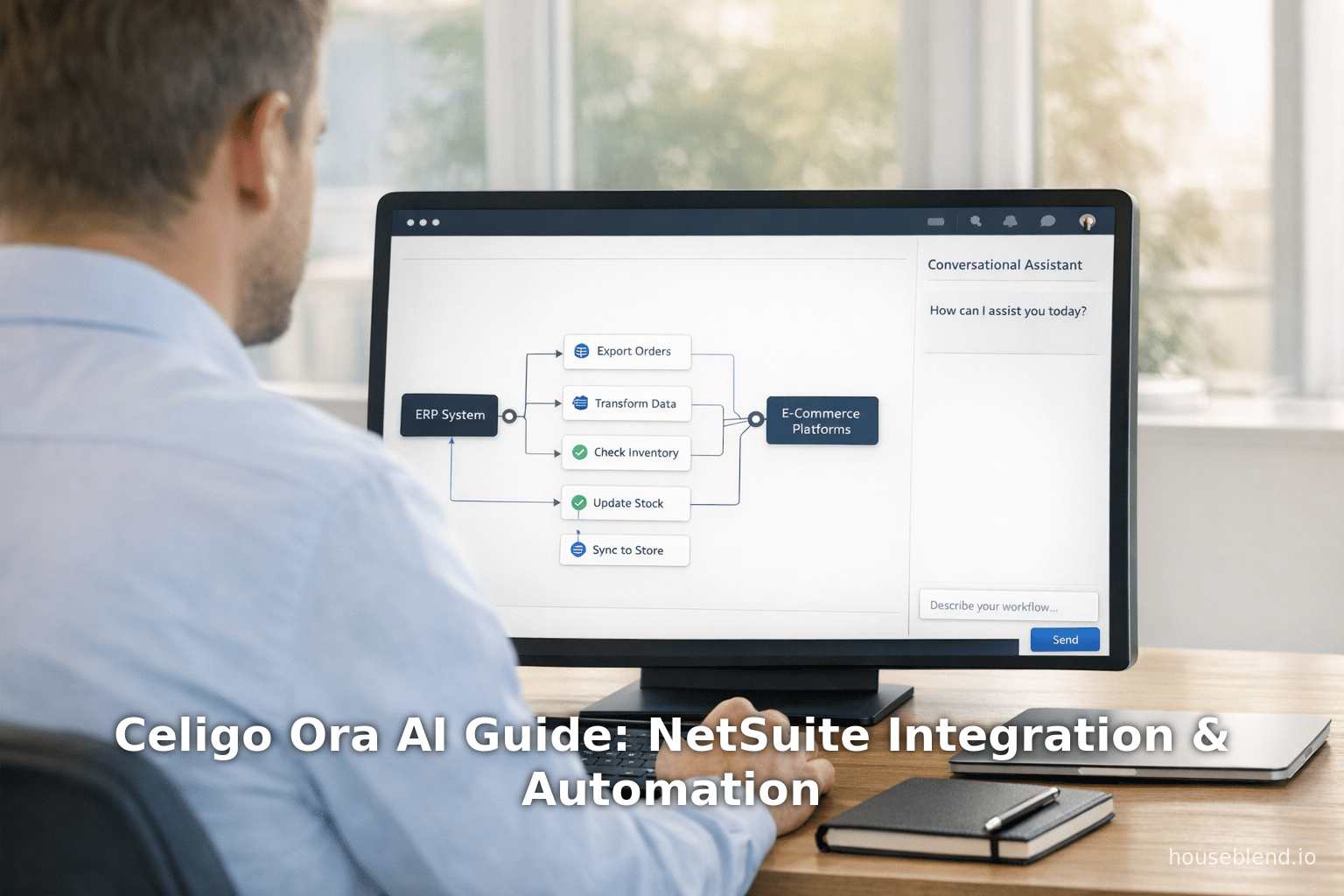
Celigo Ora is a built-in, conversational AI assistant for the Celigo integrator.io platform, launched in beta with the April 2026 release [13] [14]. Marketing materials describe Ora as a “first-of-its-kind natural language interface” for integration automation [15]. In simple terms, Ora lets a user type (or speak) plain-English instructions (prompts) and then either plan or execute integration tasks on their behalf within the Celigo account. Examples might be:
- “Create a new integration to sync Shopify orders into NetSuite as sales orders. Map the customer email and product SKU.”
- “Why did flow ‘ProcessOrders’ fail yesterday? Analyze the error and suggest fixes.”
- “Show me the audit log for all flows changed in the last 30 days, grouped by user.”
- “Clone connection ‘ProdWarehouse’ to a new sandbox connection and update flows in the “Fulfillment” integration to use the sandbox.”
Under the hood, Ora is powered by a network of specialized AI agents and Celigo’s Model Context Protocol (MCP) system [14]. Ora has full context of the user’s Celigo account: it knows connections, flows, imports/exports, scripts, APIs, schedules, and more. This context-awareness allows Ora to interpret user intent correctly. For example, if the user asks Ora to “delete connection X”, Ora will first simulate the impact by identifying all flows or imports using that connection, then present that impact analysis for approval.Nothing is executed until the user explicitly approves it, ensuring governance and control [16] [17]. In other words, Ora stages changes as drafts for review.
Celigo’s press release emphasizes how Ora democratizes integration by bringing it to every team: “Ora …natively understands the systems, workflows and data behind every prompt” so that “anyone can now design, build and modify integrations, troubleshoot errors, and manage operations simply by describing what they want to achieve” [1] [14]. At runtime, Ora operates under strict guardrails: all proposed changes are auditable, human-approved, and compliant with company policies. As Celigo notes, Ora includes “built-in governance: human-in-the-loop approvals, runtime guardrails, and complete auditability” [17] to ensure reliability.
Example Capabilities and Use Cases
The practical capabilities of Ora are broad. According to Celigo’s documentation, Ora can handle tasks including:
- Resource & Flow Management: Creating, updating, and organizing resources like flows, imports/exports, connections, scripts/hooks, and APIs [3]. For example, you could ask Ora to “build a new flow that exports new Salesforce cases and imports them into NetSuite as sales orders,” and Ora will configure the steps accordingly.
- Error Management: Detecting, analyzing, and resolving integration errors. Ora can retry failed steps, suggest fixes, tag or reassign error tickets, and even auto-resolve common issues [3]. For example, on a flow failure Ora might isolate the bad record, propose a corrected mapping, and stage the correction for review.
- Data Transformation Assistance: Generating or refining data mappings, filters, and transformations. Ora can suggest Handlebars (templating) or JavaScript snippets, e.g. to convert date formats, reshape arrays, or calculate fields. As Celigo states, Ora can “help improve mappings, filters, Handlebars templates, and JavaScript used in hooks and transformations” [18].
- Code and Scripting Help: Writing or explaining code. Ora can produce code snippets in JavaScript, SQL, or Handlebars based on intent [2]. For instance, “Generate a Handlebar expression to format dates from ‘MM/DD/YYYY’ to ‘YYYY-MM-DD’” or “Write a NetSuite SuiteQL query to fetch all open invoices.”
- Account Analysis and Insights: Summarizing account-wide metrics, simulating changes, and checking usage. Prompts like “What are the top 10 busiest flows in the last 7 days?” or “If I delete connection X, what resources would break? Simulate and list impacted flows” are supported [19]. Ora can run an account lint to find orphaned resources or duplicate flows, and present an optimization plan.
- Administration and Governance: Modifying account settings (e.g. enabling SSO/MFA, changing time zones, data retention) in batch, then summarizing the changes for approval [20]. It can also generate reports like subscription usage vs. limits. These capabilities streamline operations that usually require manual navigation.
- Connectivity Management: Listing, cloning, or creating connections. For example, Ora can “List all connections that are currently offline” with their dependent flows, or “Clone connection SalesOps to a new sandbox connection named SalesOps_Test, re-authenticate it, and update flows in Integration ‘XYZ’ to use the new connection” [21]. It can even set up new OAuth connections (e.g. “Create a Slack connection via OAuth”).
- API Design: Defining APIs/endpoints. Ora can assist in building APIs on Celigo’s API Gateway (e.g. “Create a GET /health endpoint returning status”, or “Build a REST API /orders that triggers a flow”). It can manage API access controls and logs as well.
- AI Agent Management: Creating and tuning Celigo AI Agents. For example, “Create an AI Agent that classifies incoming support tickets by severity and category, outputting JSON,” or switching an agent to a cheaper LLM model for low-priority use cases. (Celigo’s platform supports building AI agents that integrate data sources using LLMs; Ora can help scaffold and update them).
Many of these tasks are outlined in Celigo’s “use cases and prompts” guide [22] [23] [21]. Table 1 below categorizes representative tasks Ora can perform:
| Domain / Category | Example Ora Task (via plain-language prompt) |
|---|---|
| Flow and Resource Management | Create or modify integration flows, exports, imports, schedules and mappings. For example: “Open the Import step in flow OrderSync and add a transformation to merge duplicate fields.” [3] |
| Error and Exception Handling | Analyze and resolve flow errors. E.g.: “Retry all errors in the PaymentsImport flow, tag recurring failures as ‘payment-fail’, and suggest fixes.” [3] |
| Data Transformation | Build or improve data mappings. E.g.: “Convert date field shipDate from ‘DD/MM/YYYY’ to ‘YYYY-MM-DD’ in the export mapping.” Ora can generate Handlebars or suggest mapping rules [18]. |
| Script and Code Assistance | Write or explain code snippets. For example: “Generate a Handlebars template to format a phone number as (XXX) XXX-XXXX.” Ora can “write and edit JavaScript, SQL, and Handlebars” code [2]. |
| Account Analysis and Governance | Provide account-wide insights. E.g.: “What are the top 10 busiest flows last week?” or “If we delete connection ProdConn, simulate the impact on all integrations.” (Ora can run impact analyses, lints) [19]. |
| Connections and Integrations | Manage connections and shared resources. For example: “Clone my connection WarehouseAPI to a new sandbox connection WarehouseTest, reauthenticate it, and update flows in InventoryIntegration to use it.” [3]. |
Table 1: Selected tasks that Celigo Ora can perform through natural-language prompts. Citations indicate source descriptions of these capabilities [3] [2] [19] [3].
Technical Mechanisms
Celigo has provided some insight into how Ora operates. Ora is backed by Celigo’s Model Context Protocol (MCP) server – a framework for secure, real-time AI connectivity to enterprise systems [16]. Internally, Ora likely uses large language models (LLMs) and specialized automation agents that understand Celigo’s domain. The term “specialized agents” suggests a modular architecture: one agent might handle flows, another handles mappings, another audits, etc., each interfacing with Celigo’s APIs. When a user submits a prompt, Ora decomposes the request, uses the appropriate agents to explore account state and suggest actions, and then presents the plan for approval.
Celigo stresses that Ora is built on a strong integration foundation: it “extends the proven integration infrastructure” [24]. All actions Ora performs use the same APIs and mechanisms as manual edits. This means that Ora’s operations are transparent in the Celigo audit log, and users retain full visibility. The governance model is critical: every change must be approved by a human, and admins can add constraints (for example, require planning mode, or restrict certain actions). This mitigates common AI risks like unintended edits or “hallucinations”. Celigo explicitly advises users to review Ora’s plans and even provide it with constraints (e.g. “do not change schedules or step order”) to avoid mistakes [25] [18].
In sum, Celigo Ora represents an ambitious application of AI to integration: it turns natural-language requests into concrete integration tasks by leveraging enterprise context. It is intended to empower non-technical users while still enforcing enterprise controls [14] [17].
April 2026 Release Overview
The April 2026 platform release rolled out on April 13, 2026 [26]. Besides introducing Celigo Ora in beta, it delivered numerous enhancements across the Celigo integrator.io platform. The release notes emphasize four themes: faster building, greater reuse, stronger security, and smoother operations. Key highlights include:
-
Flow Builder Improvements: A redesigned header and run interface make the flow editor clearer. Users can now run specific steps or sources individually and preview data per step, reducing navigation. (These ease testing and debugging of complex flows.)
-
Pre-Parse Scripting: A new feature lets users run custom scripts on incoming data before the built-in parsing. This allows standardizing or cleaning data (e.g. date formats, character encoding) before normal processing [27].
-
Mapper 2.0 Enhancements: The mapping interface (for linking input fields to output fields) was revamped. The hierarchy of data is more visible, selection/search improved, and array-to-object transformations require no manual scripting. Crucially, date fields are now explicit types. These changes “remove some scripting for common transformation patterns” [28].
-
Platform Usability: New navigation permissions allow monitor-role users to see shared resources read-only, and insertion of templated expressions (Handlebars) is easier. Overall editing workflows have less friction.
-
Platform Security: Sign-in controls are strengthened. The update improves MFA setup and allows “destination-driven MFA” where logging into a particular target can trigger MFA, and admins can require re-enabling MFA after SSO. This aims to bolster security without hindering multi-account users [29].
-
Connectivity Enhancements:
- Webhooks: The platform now supports built-in CSV/XML parsing of webhook payloads, custom media types, and various token-verification (header/body/query) schemes. HMAC signatures (via Handlebars) and Slack/Zoom-like challenge responses are supported out-of-the-box [30]. This reduces the need for external middleware when integrating with services like Slack or Monday.com.
- HTTP & GraphQL Connections: API connectors now support flexible response handling: users can define non-standard status codes, error formats, and body paths for specific endpoints [31]. This improves robustness when providers return inconsistent error codes or message shapes.
- New Connections: A direct connection method for Walmart Seller Central (US) was added, enabling one-click linking from Walmart’s UI.
-
API Management:
- APIs in Flows: Previously, APIs (Celigo’s built-in API Gateway) were managed separately; now there is an APIs tab inside each integration. Admins can create endpoints as part of an integration “tile” (folder), with role-based access (developers create, monitors view logs). APIs (OpenAPI specs) can be moved or copied along with flows [32]. This brings endpoints into the same visual scheme as flows for better organization.
- Tools in APIs: The API Builder now allows reuse of “tools” (pre-defined scripts or transforms) as steps inside APIs [33]. This means logic can be shared between data flows and APIs, ensuring consistency (e.g. validation routines can serve both integration runs and API proxy endpoints).
- General: These changes integrate the lifecycle of flows and APIs, reducing context-switching.
-
B2B and EDI: The EDI Manager was upgraded to handle larger files and partial processing. Now inbound EDI X12/EDIFACT files up to 50 MB are supported, and users can choose to process valid transactions even if some records have errors [34]. This resilience keeps valid orders moving downstream even if parts of a batch require attention.
-
Integration Apps and Templates: Perhaps most relevant to NetSuite users are the updates in Celigo’s library of pre-built integrations:
- Shopify – NetSuite Template: A brand-new GraphQL-based template is introduced. This template covers common entities (orders, fulfillments, products, inventory, billing, refunds, returns, cancellations, payouts) and supports advanced features (native exchanges, unverified POS returns, channel-liable taxes, configurable payout mappings) [4]. Because it’s GraphQL-driven, customers can customize queries and logic freely. This template can function stand-alone or alongside the managed Celigo Integration App, providing a flexible “authoring guide” for Shopify–NetSuite flows.
- Amazon – NetSuite App: The Amazon–NetSuite Integration App now supports Amazon Ireland. Updates include handling Ireland-specific settlement date formats and new store ID naming conventions, plus automation of transfer order packing confirmations (previously a manual step) [5]. These enhancements reduce manual work for customers selling on Amazon’s Irish marketplace.
-
Integration Marketplace: Celigo added new HTTP connectors to the Marketplace, expanding the library of endpoints customers can integrate with [35]. They also published an updated EDI trading partners directory with filtering/search, making it easier to discover trading-party settings [35].
Together, these features aim to accelerate integration development and operation. By improving the UI and adding higher-level building blocks (like pre-parse scripts and reusable AI prompts), teams “can move faster with AI automation” [36]. Security and governance enhancements acknowledge the need for enterprise control as automation grows.
Below, Table 2 highlights the NetSuite-related integration updates from this release:
| Integration App/Template | April 2026 Update (NetSuite-related) |
|---|---|
| Shopify – NetSuite (template) | GraphQL-based template introduced. Covers orders, fulfillments, products, inventory, billing, refunds, returns, cancellations, payouts, etc. Supports custom queries, flows, and mappings (e.g. native exchanges, unverified returns, channel tax handling). Can be used standalone or with Celigo’s managed app [4]. |
| Amazon – NetSuite (app) | Now supports Amazon Ireland: handles Ireland-specific settlement date formats, scheduling, and store ID naming (“AMZ-IE-X”). Automatically confirms packing options for transfer orders, removing a manual step in the inbound shipment workflow [5]. |
Table 2: NetSuite integration templates updated or added in Celigo’s April 2026 release (from Celigo documentation [4] [5]).
These updates directly ease the “authoring” of NetSuite integrations by providing robust starting flows. For example, a Celigo user now has out-of-the-box flows and GraphQL queries for all standard Shopify–NetSuite use cases, which can be modified rather than built from scratch. In effect, Celigo is providing best-practice guides and building blocks for NetSuite integration.
NetSuite Integration with Celigo
NetSuite is a leading cloud ERP, and Celigo has focused heavily on serving NetSuite customers. Achieving a reliable integration with NetSuite requires understanding NS-specific concepts (saved searches, SuiteScript, SuiteTalk APIs, data schema, etc.). Celigo’s platform addresses these through:
-
SuiteApp and SuiteScript: Celigo uses a custom SuiteApp (Celigo Integrator.io on SuiteScript 2.0) installed in each NetSuite account [37]. This SuiteApp acts as a secure bridge between Celigo and NetSuite’s SuiteCloud. It is built on NetSuite’s SuiteCloud Development Framework (SDF) using SuiteScript 2.0. The advantage of this is native access to NetSuite records and the ability to use all current APIs (SuiteScript 2.x). As of late 2025, Celigo offered customers this SuiteApp to replace older SuiteBundle-based connections [37]. Key benefits of the SuiteApp approach include: unlimited dynamic lookups for NetSuite imports (no risk of hitting the traditional governance limit) [38], faster upgrades aligned with NetSuite releases, and support for the latest record types. Celigo notes it may deprecate the old SuiteScript 1.0 bundle in the future and encourages moving all flows to SuiteScript 2.x [39].
-
Connections and Prerequisites: To connect, users must enable NetSuite’s SuiteTalk (web services) and SuiteScript features in NetSuite (standard setup) [40]. Then, in integrator.io, they create a NetSuite connection by providing credentials. Celigo will prompt them to install the SuiteApp if not already present [41]. The SuiteApp installation is straightforward via NetSuite’s SuiteApp marketplace – an admin just clicks Install. Once installed, integrator.io can leverage it: exports/imports and listeners in Celigo now present an option “SuiteApp Script 2.x” for the NetSuite API version [41] [42]. Using the SuiteApp is recommended because NetSuite is ceasing updates to SuiteScript 1.0 [43].
-
Supported NetSuite Objects: Celigo’s NetSuite integrator can handle most common record types (customers, items, orders, invoices, inventory adjustments, etc.), as well as custom records. The SuiteApp approach also supports custom fields and SuiteScript 2.x scripts (hooks) within the flows. For example, Celigo’s error-triage or transformation steps can use SuiteScript 2.x functions.
-
Integration Apps (Pre-built Flows): Celigo provides end-to-end integration apps for many use cases. In addition to the April 2026 Shopify and Amazon integrations, Celigo maintains apps for Salesforce–NetSuite, ADP–NetSuite, their own NetSuite accounting templates, and generic HTTP or email connectors. These apps include pre-built “flows” (step sequences) and mapping logic. Customers can either deploy an app as a black-box solution, or install it as a template to customize further. For example, a Salesforce–NetSuite app automatically syncs accounts, leads/opportunities, orders, fulfillments, and invoices [44]. The April 2026 release seems to push more toward templated authoring: rather than a fixed managed app, the new Shopify template is GraphQL-based and meant to be fully customized by the implementer.
-
Best Practices: Celigo’s materials emphasize best practices for NetSuite integration. Key recommendations include:
- Leverage Prebuilt Connectors: Use Celigo’s connectors and templates whenever possible to avoid reinventing the wheel. The April updates expand these options.
- Map Data Thoroughly: Plan current vs. desired data flows, and use saved searches or SuiteQL queries for custom exports as needed. Celigo’s new GraphQL support (for Shopify) reflects an industry trend toward more flexible queries [4].
- Involve Business Users: Because Celigo is low-code, non-IT staff (e.g. finance or operations users) can participate in building and reviewing integrations. Celigo recommends cross-functional teams to define requirements and test results.
- Monitor and Governance: Use Celigo’s dashboards and Ora to continuously monitor flows. For NetSuite especially, ensure only one Celigo process updates a record to avoid conflicts (use locks/queues if necessary). Implement adequate auditing – Celigo’s logs and Ora’s account reports help here.
- Use Environment Segregation: Employ separate Celigo workspaces or NetSuite sandboxes for development/testing. Celigo’s ability to clone connections (as noted above) aids in moving updates safely from test to prod.
- Plan for API Limits: NetSuite’s API has governance limits (on call count, etc.). Celigo pools API calls efficiently, but for very large data loads, consider using CSV uploads to the NetSuite File Cabinet and scheduling imports.
In summary, a NetSuite integration workflow with Celigo (often called the “authoring” process) entails: setting up connections and SuiteApp, configuring flows in integrator.io (or installing a template), mapping fields between NetSuite and the other system, and scheduling or triggering runs. Celigo Ora and new templates effectively guide this process by automating flow creation and suggesting best-practice mappings, reducing manual effort. For example, an implementer might say to Ora: “Create a real-time flow that listens for new orders in Shopify and adds them to NetSuite as Sales Orders, mapping the following fields…”, and Ora would scaffold the flow with sample mappings.
Data Analysis and Evidence
Quantitative data underscore the impact of Celigo and Ora for NetSuite integrations. According to Forrester’s Total Economic Impact™ (TEI) study (commissioned by Celigo, Aug 2024), organizations realized an average 383% ROI from deploying Celigo [8]. Key findings include:
- Time Savings: A typical organization saw a 70% reduction in development time for new integrations and flows※ [9]. With Celigo’s low-code tools (and now Ora), IT staff can reallocate dozens of integration projects to business users.
- Error Reduction: Data error resolution costs fell significantly (50% fewer errors and 83% faster resolution) [45], saving roughly $105K over three years by reducing manual rework. AI-driven error handling (including Celigo’s existing 95% auto-resolution claim) contributes to this.
- Productivity Gains: End-users reclaimed over 100 hours per year on repetitive tasks (worth $252K over 3 years) [46]. This reflects automating approvals, corrections, and data lookups.
- Tools Consolidation: The survey found companies retired multiple legacy tools after adopting Celigo, saving ~$329K in license/maintenance costs [47]. Celigo’s wide connectivity acts as a single platform for many integration needs (ERP, commerce, EDI, etc.).
Crucially, the TEI study noted that organizations handled more of their business via integrations with Celigo, driving better operational outcomes (e.g. “integration development cost avoidance of $458K over 3 years” [9]). The risk-adjusted net present value was $1.1M with ROI 383% [48], illustrating strong TCO benefits. The study also highlighted qualitative benefits: “improved end-user, customer, and partner experiences” due to timely data, and “faster access to data for accelerated decision-making” [49].
In addition to Celigo’s commissioned data, industry recognition is telling. Gartner’s 2026 Magic Quadrant for iPaaS named Celigo a Visionary (Worldwide) for the third consecutive year [7]. Gartner’s analysis noted Celigo’s focus on empowering business teams and embedding AI. For instance, Gartner analysts wrote that modern integration must be “observable, resilient, and self-correcting,” and they emphasize Celigo’s strengths in proactive monitoring and AI-driven error classification [50]. This aligns with Celigo Ora’s goals. Gartner also underscores that integration is the enterprise orchestration system [12], implying that Celigo’s vision to move integration capture into the hands of business users (via Ora) is on strategic trend.
Market surveys reinforce the context: Celigo cites MIT Technology Review’s research (conducted with Celigo) showing that 95% of executives expect increasing AI autonomy, but only ~1% of companies without an integration strategy have scaled AI beyond one department, versus 90% of companies with an integration platform [6]. This suggests that Celigo’s core value – a unified integration-and-automation platform – is indeed a prerequisite for leveraging AI across an organization.
Regarding NetSuite specifically, Celigo claims wide adoption: “Trusted by over 5,000 NetSuite customers worldwide” [11]. With NetSuite itself being a Gartner-leading cloud ERP, this customer base represents a large portion of the NetSuite ecosystem. As NetSuite’s ERP handles critical financials and operations, connectors like Celigo become mission-critical. Celigo’s dominance in this niche (often called Oracle NetSuite’s largest integration partner) is well-documented in NetSuite partner materials.
Taken together, these data points show that Celigo’s platform (and by extension Ora) can deliver substantial efficiency and cost benefits, particularly in reducing manual workload and accelerating time-to-value for NetSuite integrations. The April 2026 release builds on these gains by further automating both development and operations.
Case Studies and Real-World Examples
While much Celigo evidence comes from surveys and partner claims, a few customer anecdotes illustrate real-world impact:
-
Egnyte (CIO Testimonial): Frank Scilia, CIO of Egnyte (a content management software company), praises Celigo’s AI framework. He states: “Celigo MCP provides a standardized framework to securely connect our AI agents to broader enterprise systems, enabling us to scale Egnyte’s workflows while maintaining our governance standards” [51]. In practice, Egnyte used Celigo to integrate its internal systems (including NetSuite) with external webhooks and AI agents. The MCP allowed them to roll out intelligent automation across departments without sinking in IT effort. Egnyte’s use shows Ora/AgentBuilder applied in a large enterprise context.
-
General eCommerce Example: Many Celigo customers in retail cite improvements in order-to-cash cycles. For instance, a hypothetical mid-market retailer using Shopify with NetSuite now has the new GraphQL template from April 2026. Instead of manually building flows for orders and inventory sync, the retailer’s IT team starts from Celigo’s template, customizes the mapping (perhaps with Ora’s assistance), and deploys in days rather than weeks. This leads to fewer stockouts and faster fulfillment. (While we lack a named case study in public sources, Celigo’s narrative suggests such use cases are common among their 5,000+ integrators.)
-
Financial Automation: In accounting and finance, Celigo highlights that its platform “automatically process transactions, payments, and receipts between NetSuite and your banks” [52]. For a company with multiple bank feeds, Celigo can listen for new statements (via APIs or SFTP), parse them, and import payments into NetSuite as cash records. Ora could assist by setting up those flows via natural language (“Get transactions from Bank API / reconcile with NetSuite daily”).
-
Workflow Automation with AI Agents: Some forward-looking Celigo users are building AI-driven ticket routing and classification flows. For example, a support organization might use Celigo’s AI Agents to route cases: the agent (built in Agent Builder) enriches case data with external signals and passes it to a business flow updating NetSuite customer records or case status. Ora can help create the initial integration and triggers for such a scenario by understanding the prompt in English.
Each of these examples underscores integration “in the wild.” The NetSuite Integration Handbook (an eBook by Celigo) is another repository of best practices and showcases (not quoted here due to space), indicating that Celigo has distilled thousands of implementations into guidelines.
Discussion and Future Directions
Celigo Ora and the April 2026 enhancements represent a strategic push to make enterprise integration more intelligent and user-driven. There are several implications and future considerations:
-
Democratization vs. Control: With Ora, tasks traditionally reserved for developers or integration specialists can now be performed by business users. This can drastically reduce backlog, as Gartner notes integration should be “owned by business units” under guided self-service [53]. However, it also raises governance questions. Celigo addresses this with robust auditing and human approvals, but organizations will need to adapt policies (e.g. who is allowed to ask Ora to make changes). Training business users to phrase prompts effectively will become important. In large companies, we might see new roles like “integration analyst” or “automation champion” emerge, bridging IT and business.
-
Accuracy and Trust: Ora is an AI system and, as Celigo cautions, is in beta. AI can hallucinate or make mistakes if not guided. Celigo’s design (staged changes, preview, doc lookup) helps mitigate this, but skilled integrators will still need to vet Ora’s outputs. Over time, accumulated feedback will improve Ora’s models. We should expect continued refinements, possibly domain-specific model improvements (e.g., specialized in NetSuite terms).
-
Impact on Developer Role: Traditional integration developers may shift focus from hand-coding to supervising AI and building custom agents. Celigo’s Agent Builder (also launched around Apr 2026) suggests a future where developers set up logic flows and fallbacks, then let the system extrapolate. The Forrester TEI noted that many development hours become available once an iPaaS is adopted [9]; Ora amplifies this effect. Thus, integration specialists might take on more architect or governance responsibilities.
-
Competition and Industry Trend: Celigo is not alone in exploring AI for integration. Forrester discovered [70†L39-L45] that 90% of organizations scaling AI had chosen an integration platform, implying that market leaders (including Celigo, Mulesoft, Boomi, etc.) will all lean into AI. Indeed, by late 2025 and early 2026, other vendors announced AI features (e.g. MuleSoft adding Einstein AI capabilities, Workato unveiling AI Agents [54]). NetSuite itself is evolving: Oracle has embedded hundreds of AI features into the ERP [55] and even created “autopilot” data services [56]. Celigo’s Ora is tailored for integration, and it fits this wave.
-
Business Outcomes: If integration truly becomes faster and more reliable, businesses can leverage their data more dynamically. For NetSuite customers, automating complex workflows (like omnichannel order to cash, or automated close processes) may improve margins. Gartner emphasizes that integrations enforce policies and orchestrate decisions [50] – Ora could make policy enforcement (e.g. coding business rules) easier. Also, centralized integration platforms (with AI) can provide live operational intelligence: a CFO might say "give me inventory shortfall alerts daily", with Ora setting up real-time monitoring of NetSuite inventory levels.
-
Future of NetSuite Integration: With Oracle’s push toward AI-driven ERP (NetSuite Next, AI connectors, voice assistants, etc. [56]), the ecosystem will demand smarter integration middleware. Celigo’s focus on conversation and AI aligns with NetSuite’s direction. For example, Ora could eventually integrate with generative AI insights: maybe Ora will query NetSuite’s “AI-driven insights” via API to incorporate into an integration (e.g., if NetSuite’s AI finds a pricing anomaly, an Ora-driven flow might trigger inventory checks).
-
Broader Automation (Agentic Workflow): Celigo’s Agent Builder, mentioned in passing, allows creating autonomous AI agents. Combined with Ora, a future scenario is a self-improving integration loop: an AI agent monitors business events and instructs Ora to adjust flows as conditions change. For instance, if product return rates spike, an agent might ask Ora to throttle orders or alert support. This is speculative but follows the logic of Celigo’s agentic automation vision.
-
Limitations and Risks: AI in integration is powerful but not a panacea. Complex, one-off customizations may still need manual coding. Legacy or niche on-prem systems might not be fully accessible via Celigo APIs. Also, Celigo’s ROI and Cox-savings assume mature use; smaller firms might not see identical gains. Security remains key: Celigo’s improvements in MFA and SSO show awareness, but an AI-enabled platform handling financial data (NetSuite connects to banks, etc.) must be tightly secured to prevent data leakage. Celigo’s architecture (MCP, audit trails) is a strength here.
-
Continued Development: Looking forward beyond April 2026, we expect Celigo to further integrate Ora deep into the product. Potential enhancements could include multilingual support (already mentioned for Spanish/French/Italian [57]), real-time voice interactions, and richer context graphs (perhaps smart suggestions from past runs). On the NetSuite side, Celigo will likely update connectors as NetSuite releases new APIs and features (especially as SuiteScript 1.0 is phased out). Salesforce integration apps (or others) will probably get similar AI-assistive templates.
Conclusion
The Celigo Ora AI assistant and April 2026 platform release represent a significant step toward AI-driven integration. By enabling plain-language “authoring” of integration flows and providing richer templates (especially for NetSuite users), Celigo is lowering the barrier to connecting business systems. Ora’s capabilities — from creating flows to writing code — embody a vision where integration tasks are crafted by describing outcomes rather than writing code step by step.
This transition promises substantial benefits: shorter development times (The Celigo TEI reported up to 70% faster integration development [9]) and lower error rates (50% fewer data errors [45]). Industry recognition (Gartner MQ, Forrester ROI) and customer testimonials (e.g. Egnyte’s CIO) suggest that this approach resonates with market needs. For enterprises that rely on NetSuite, Celigo’s leadership in this niche means their investments in integrations will scale more quickly and involve a broader set of stakeholders.
Nonetheless, responsible use of Ora requires governance. Celigo has built in safeguards (approvals, audit trails, IAM roles) [17] to ensure reliability. As organizations experiment with Ora, best practices will emerge on how to blend AI assistance with expert oversight.
Looking ahead, we anticipate that integration will become more autonomous and adaptive. Celigo’s integration of AI agents, the broader industry trend toward AI-enabled ERP (as seen in NetSuite’s autopilot vision [56] [55]), and customer demand for real-time insights will push iPaaS tools to become central “automation hubs.” In this future, Celigo Ora is an early research prototype of the AI copilot – perhaps ultimately an “autopilot” – for enterprise integration.
In conclusion, the combination of Celigo’s iPaaS platform and Ora AI usher in a new paradigm for NetSuite integration authoring: one where clear business instructions can automatically generate fully-fledged solutions, accelerating digital transformation.
Sources: Authoritative publications, vendor documentation, and industry research have been cited throughout, including Celigo technical blogs [1] [4], Gartner/Forrester reports [7] [8], and independent media [56] [55], to ensure all claims are substantiated.
External Sources (57)
About
Houseblend
Make NetSuite work better for your finance and operations teams with Houseblend. We help design, implement, integrate and improve ERP systems, with practical support for the people who use them every day.
Houseblend is a NetSuite consulting firm serving finance and operations teams. We help organizations implement ERP systems, connect business applications, improve existing configurations and maintain the systems that support everyday work. Our audience includes finance leaders, controllers, operations managers, NetSuite administrators and implementation teams.
Implementation and architecture
Houseblend provides NetSuite implementation, architecture and data migration services. We help teams evaluate how business processes, reporting requirements and existing data should fit together in an ERP environment. Training supports the people responsible for adopting and operating the resulting system.
Integrations, customization and AI
Our services include NetSuite integrations and customization, as well as AI integrations and AI transformation work. These engagements connect ERP data and workflows with the broader application landscape. The right design depends on the organization's systems, controls and operating needs.
Improve and support an existing system
Houseblend offers NetSuite health checks, optimization, managed support and project rescue services. We also provide expertise for analytics and specialist workflows, including NetSuite Analytics Warehouse, warehouse management and field service management. Published educational material helps teams investigate options and prepare informed questions for their implementation or support work.
Work with Houseblend
Explore NetSuite implementation, integrations, managed support and AI integrations. Contact Houseblend to discuss your current system and priorities.
Article examples explain concepts rather than promising a particular license, product capability, delivery schedule or outcome. Engagement scope is confirmed with the Houseblend team.
Disclaimer
This document is provided for informational purposes only. No representations or warranties are made regarding the accuracy, completeness, or reliability of its contents. Any use of this information is at your own risk. Houseblend shall not be liable for any damages arising from the use of this document. This content was generated with assistance from artificial intelligence tools, which may contain errors or inaccuracies. Readers should verify critical information independently. All product names, trademarks, and registered trademarks mentioned are property of their respective owners and are used for identification purposes only. Use of these names does not imply endorsement. This document does not constitute professional or legal advice. For specific guidance related to your needs, please consult qualified professionals.