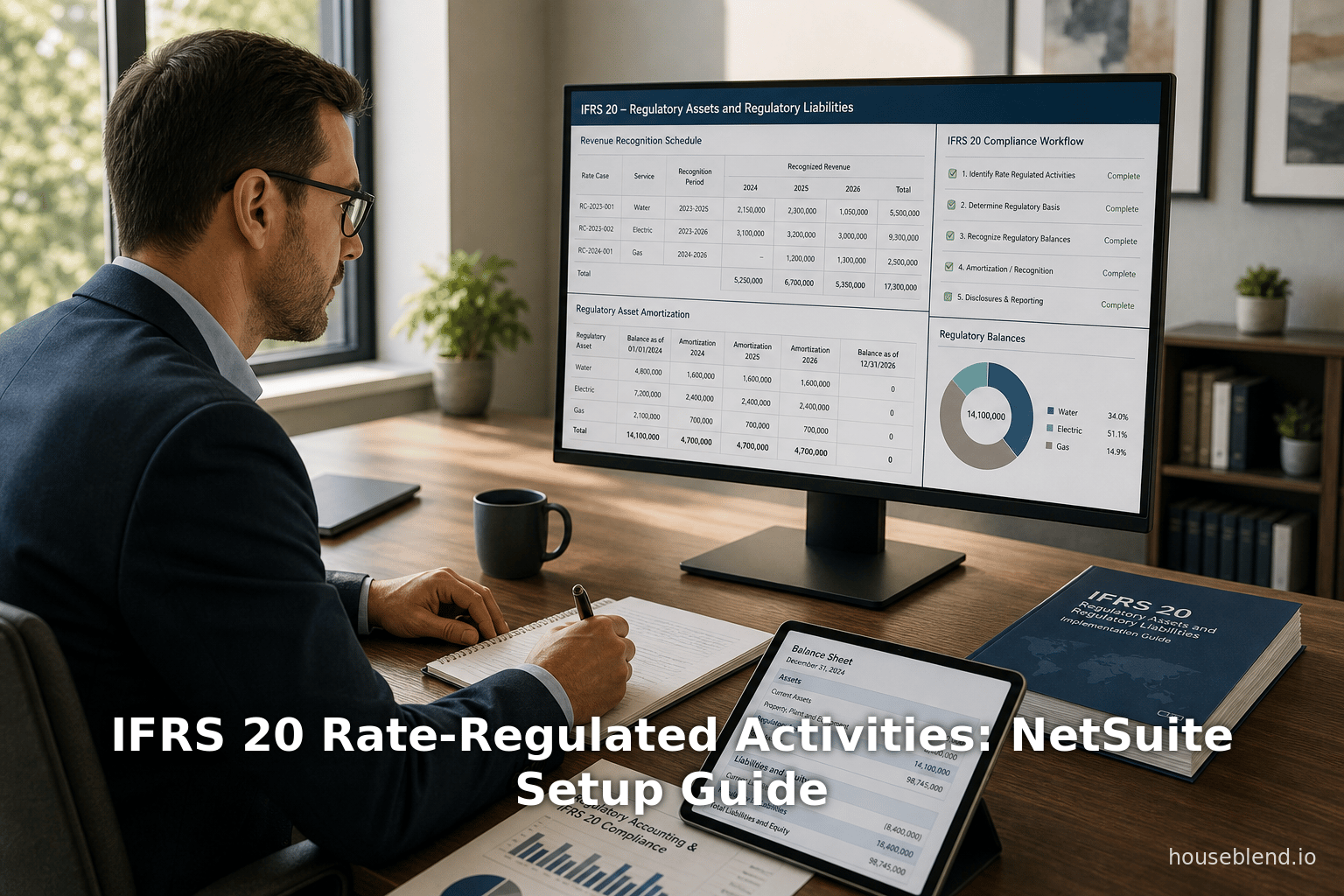
IFRS 20 Rate-Regulated Activities: NetSuite Setup Guide
Executive Summary
The International Accounting Standards Board (IASB) is finalizing a new International Financial Reporting Standard (IFRS) on Rate-Regulated Activities, expected as IFRS 20: Regulatory Assets and Regulatory Liabilities in the second quarter of 2026. IFRS 20 will replace the interim IFRS 14 Regulatory Deferral Accounts and will be effective for annual periods beginning on or after January 1, 2029 [1]. It requires entities subject to certain types of rate regulation (such as utilities, energy, and transportation companies) to recognize regulatory assets and regulatory liabilities on the balance sheet, and to report corresponding regulatory income and expense in the income statement [2] [1]. This change addresses significant timing differences caused by regulatory frameworks that grant companies the enforceable right to recover costs or required obligation to refund costs through future rates [2] [3].
Until now, IFRS did not comprehensively address such regulatory effects, unlike U.S. GAAP (ASC 980) which has long permitted deferral of certain costs as regulatory assets if future recovery is probable [3]. The forthcoming IFRS standard aims to enhance transparency by aligning reported IFRS revenue and expenses with the regulator-determined allowed compensation, thereby smoothing earnings and giving investors better insight into the sustainability of cash flows [2] [4].
For companies using Oracle NetSuite (a leading cloud ERP, implementing IFRS 20 will require new chart-of-accounts configurations and deferral processes. This involves creating specific asset and liability accounts (typically categorized as Other Assets and Other Liabilities in NetSuite) to hold regulatory balances, and using NetSuite’s Deferred Expense and Deferred Revenue functionalities to amortize those balances into earnings over time [5] [6]. In multi-entity or multi-standards environments, NetSuite’s OneWorld Multi-Book Accounting feature can post each relevant transaction simultaneously to separate IFRS and local-GAAP ledgers [7]. Overall, this report provides an extensive analysis of the IASB’s Rate-Regulated Activities project and practical guidance for configuring regulatory asset/liability accounting in NetSuite, supported by authoritative sources and illustrative tables.
Introduction and Background
Rate Regulation and Financial Reporting
“Rate regulation” is a legal framework in which a government or regulator establishes the prices or rates that certain companies (typically utilities, transportation, or energy providers) can charge customers for goods or services [8]. Under these regulatory schemes, companies often incur costs or earn income in one period but are permitted (or required) by the regulator to recover (or return) those amounts through future customer rates. For example, when a utility incurs a large capital expenditure, the regulator may allow the utility to recover this cost over time by adjusting future electricity rates. Conversely, if a utility receives higher revenues than allowed, it may be obliged to credit those excess revenues back to customers in future rates.
Such regulation creates regulatory deferral account balances – amounts of expense or income that would not meet the asset/liability definitions under IFRS yet are recognized because the regulator will incorporate them in future rates [9]. The IASB notes that these timing differences mean that, under existing IFRS Standards, “the revenue reported by a company for a period … and the assets and liabilities reported … do not give a complete picture of the compensation that the rate regulation entitles the company to charge” [10]. In other words, conventional IFRS accounting (e.g. under IFRS 15 can omit significant information about future cash flow entitlements or obligations created by the regulator.
US GAAP vs IFRS: The Regulatory Accounting Gap
In U.S. Generally Accepted Accounting Principles, regulatory accounting has long been codified in ASC 980, Regulated Operations. ASC 980 explicitly permits (and in effect requires) companies to defer certain costs as regulatory assets (and certain credits as regulatory liabilities) when recovery or refund via rates is probable [3]. For example, the SEC Pearson example of Williams Companies notes: “ASC 980 provides that certain costs that would otherwise be charged to expense should be deferred as regulatory assets, based on the expected recovery from customers in future rates. Likewise, certain actual or anticipated credits that would otherwise reduce expense should be deferred as regulatory liabilities, based on the expected return to customers” [3]. In practice, large U.S. utilities routinely report multibillion-dollar regulatory assets and liabilities as part of their balance sheets, reflecting fuel surcharges, construction work in progress, deferred taxes due to regulatory timing, and other items (see e.g. Williams Form 10-K disclosures [3]).
By contrast, IFRS Standards historically lacked a comprehensive model for rate regulation [11]. Until now, IFRS companies with rate-regulated activities have had no special IFRS guidance comparable to ASC 980 (except for the interim IFRS 14). IFRS 14, issued in 2014, allows first-time adopters of IFRS (e.g. national GAAP → IFRS transition companies) to carry forward and continue existing regulatory deferral balances from prior GAAP, but only by using their previous measurement and only if they meet strict criteria [12]. IFRS 14 does not apply to entities already using IFRS, nor does it allow existing IFRS-reporting utilities to newly recognize regulatory assets. Consequently, many IFRS-reporting utilities have effectively ignored regulatory deferrals, recording only the net regulated rate revenue or expense when it flows through the income statement.
Recognizing this “gap” in IFRS and the comparability issues it causes, the IASB added a Research Projects on Rate-Regulated Activities to its agenda.In January 2021 the Board published an Exposure Draft on “Regulatory Assets and Regulatory Liabilities” setting out a new accounting model [2], and after extensive redeliberation it plans to issue a final Standard (tentatively numbered IFRS 20) in Q2 2026 [1].
Scope of the New IASB Standard
The proposed IFRS 20 standard applies to “entities subject to rate regulation” – specifically those that provide goods or services to customers at rates established by a regulator where the rate-setting framework causes transfer of economic resources across periods. Drafts and the IASB’s webcast emphasize that the Standard targets industries where “rate regulation is common,” such as utilities, energy and transportation [1]. Entities in these sectors often have significant capital investments and operating costs that the regulator permits to be rolled into customer rates over time.
Under the proposals, two main conditions generally must be met to recognize a regulatory asset or liability:
-
Enforceable present right/obligation: The entity must have an enforceable right to add a future amount to revenue (for assets), or an enforceable obligation to deduct a future amount from revenue (for liabilities), as a result of the regulator’s orders or framework [13]. This parallels the “expectation of recovery/refund” in U.S. GAAP (probable that amounts will be included in future rates [3]).
-
Direct relationship with regulated activities: The amount in question must relate directly to regulated goods or services, typically trackable by customer, asset, or project. In effect, the Standard requires a clear linkage between regulatory balances and the company’s underlying costs or assets (e.g. specific plant, fuel costs, or customer obligations). During IASB redeliberations, “direct relationship” tests were refined: for example, direct relationship might be presumed absent if the regulator does not tie cost recovery to specific depreciable assets or expenses [14] [15].
The IFRS Board’s KPMG commentary explains this model as an “overlay approach”: first apply existing IFRS (for example, recognize revenue under IFRS 15 as usual), then overlay a second computation that aligns to the total compensation allowed by regulation [16]. In practice, this means determining the allowed revenue per regulation and allocating the difference between actual IFRS revenue and allowed revenue into an additional income (regulatory income) or expense (regulatory expense) and corresponding balance-sheet adjustments.
Key Definitions (from Exposure Draft)
The IASB ED (2021) and KPMG summary introduce precise definitions for the new concepts. In effect, a Regulatory Asset is recognized when an entity has an enforceable present right to add an amount to future regulated rates, and a Regulatory Liability is recognized when the entity has an enforceable present obligation to deduct an amount from future rates [13]. The illustrations show that such rights/obligations arise from regulatory decisions that permit (or require) recovery of past costs through permitted revenues. Movements in these accounts create regulatory income/expense distinct from normal IFRS profit, which is presented separately below revenue [17]. Regulatory assets and liabilities themselves would be presented on the face of the statement of financial position as separate categories, not aggregated with normal trade receivables or payables [17].
Example Illustration of Recognition
(This hypothetical example is illustrative and not from a cited source.) Suppose a water utility incurs $100 of maintenance expense in Year 1, but its regulatory scheme allows the utility to recoup half of that cost through higher water rates in Year 2. Under the proposed IFRS 20, at end of Year 1 the utility would recognize a Regulatory Asset of $50 (its right to collect $50 in Year 2) and possibly charge $50 as a Regulatory Expense (if Year 1 actual expense was $100 but only $50 is expensed under IFRS rules). In Year 2, as the utility actually increases rates and collects the $50, the Regulatory Asset would reverse out, and Regulatory Income of $50 would be recorded, matching the cash collected. This ensures that over the two-year cycle, the total allowed compensation ($100) matches recognized revenue plus regulatory income, while the timing differences are explicitly shown.
Historical Development: IFRS 14 and the IASB Project Timeline
The IASB’s work on rate-regulated accounting has evolved over many years. In 2012 they issued a Discussion Paper on Rate Regulation, and in January 2014 issued IFRS 14 Regulatory Deferral Accounts as an interim standard [18]. IFRS 14 is effective for periods beginning on January 1, 2016, and it permits first-time IFRS adopters within its scope to continue recognizing and measuring their existing regulatory deferral account balances under the prior GAAP policies [18]. This was intended as a temporary measure “to enhance comparability” until a full solution could be developed [19] [12]. Importantly, IFRS 14 does not require or permit new IFRS accruals for regulatory accounts – it merely grandfathered the pre-existing balances.
A permanent IFRS solution stalled in the 2010s. In 2021 the IASB finally advanced the project by issuing an Exposure Draft titled Regulatory Assets and Regulatory Liabilities [20]. The draft’s commentary confirmed that IFRS Standards lack any requirement to inform investors about timing differences induced by rate regulation [10]. Feedback sessions and consultation (including a formal comment period ending July 30, 2021) preceded detailed redeliberation through 2022–2024.
The IASB has since tentatively agreed on major elements of the model. For example, in October 2025 it decided that inflation adjustments to the regulatory capital base should not be recognized as separate regulatory assets, treating inflation simply as part of timing differences [21]. It also confirmed that regulatory assets/liabilities will be recognized only when a regulatory item has a direct relationship to an IFRS-defined item and an enforceable right/obligation exists [14] [15]. Having completed its due process, the Board “confirmed it was satisfied … to begin the process for balloting the new IFRS Accounting Standard” [22]. As noted, the new standard (likely to be numbered IFRS 20) is expected in Q2 2026, effective Jan 1, 2029 [1].
The following table summarizes the IASB project milestones and timeline:
| Milestone | Date | Details and Effective Date |
|---|---|---|
| IFRS 14 issued | January 2014 [18] | Interim standard, effective Jan 1, 2016. Allows a first-time adopter to continue recognizing prior GAAP regulatory deferral balances [12]. Not mandatory, no new recognition. |
| Exposure Draft (ED) | January 2021 [20] | ED published titled “Regulatory Assets and Regulatory Liabilities” [20]. Comment period through July 30, 2021. Proposes a new model requiring recognition of regulatory assets/liabilities and related income/expense. |
| IASB Redeliberations | 2021–2024 | IASB staff presented and approved various elements of the model (recognition, measurement, presentation). For instance, inflation adjustments not separately recognized [21]; direct-relationship criteria established [15] [14]. |
| IFRS 20 issued (prospective) | Q2 2026 [1] | New Standard expected to be finalized. Replacement for IFRS 14. Will be effective for annual periods beginning Jan 1, 2029 [1]. Early adoption unlikely until after issue. |
| Withdrawal of IFRS 14 | Upon IFRS 20 effective | IFRS 14 Interim standard is withdrawn when the new Standard is effective (as noted in draft) [23] and transitional arrangements (if any) applied for existing deferral accounts. |
Detailed Analysis of the IASB Regulatory Accounting Model
Recognition of Regulatory Assets and Liabilities
Under the forthcoming IFRS standard, a Regulatory Asset represents a company’s enforceable right to add an amount to future regulated rates, reflecting costs that have already been incurred under existing IFRS but for which recovery is delayed [13]. Conversely, a Regulatory Liability represents the enforceable obligation to deduct an amount from future rates, typically reflecting amounts already received (or saved) that must be returned to customers [13]. These definitions echo the core principle of ASC 980 in U.S. GAAP (defer costs until recovery) but are implemented via the IASB’s overlay approach.
In practice, when a regulatory asset or liability is recognized, the entity makes a new or adjusting entry beyond normal IFRS transactions. For example, if a utility’s allowable operating costs for Year 1 exceed the rate-funded amount for that year by $X, the Year-1 financial statements under the new IFRS would show a Regulatory Asset of $X on the balance sheet. This effectively treats the excess cost as if it were paid for by customers in the future. If the regulator approved an extra $Y of revenue relative to allowable cost (e.g. advance payments), the utility would record a Regulatory Liability of $Y (meaning it owes $Y of future rate reductions to customers).
The IASB’s proposals emphasize that these amounts should match the regulator’s allowed compensation. As KPMG’s explanation notes, the overlay model ensures that “total revenue recognized under existing IFRS Standards plus regulatory income minus regulatory expense … align[s] with the total allowed compensation determined by the rate regulator” [24]. In other words, after the overlay accounting, the sum of IFRS contract revenue and net regulatory income in the year will equal the revenue amount the regulator says the company is entitled to collect for that period.
The timing of recognition is also key. A regulatory asset or liability is recognized only when it meets the definition of an IFRS-compliant asset or liability (enforceable right/obligation and probable future inflow/outflow). For example, if regulations allow a company to recover costs but the regulator has yet to make a firm decision, IFRS would not permit recognition until an enforceable order exists. Once recognized, the regulatory asset or liability is derecognized in the period when the regulator incorporates the amount into the actual rates (and cash is collected or refunded).
Presentation and Disclosures
Proposed presentation requirements are precise. Regulatory assets and liabilities would be shown as separate line items in the statement of financial position – not combined with other receivables or payables [17]. In the income statement, regulatory income (the amortization of a regulatory asset or causes a reduction in expense) and regulatory expense (the amortization of a regulatory liability or an increase in expense) would be shown immediately below revenue, separate from the profit or loss from ordinary activities [17]. This ensures the “overlay” elements are visible and distinguishable from traditional IFRS 15/IAS 1 revenue and expense lines. The IASB believes this will help investors see “which fluctuations in the relationship between a company’s revenue and expenses are caused by differences in timing” due to regulation [2]. Extensive disclosures will be required (as detailed in the Exposure Draft), including descriptions of the regulatory framework, the nature of regulatory accounts, and quantitative reconciliation of regulatory balances, consistent with IFRS’s emphasis on transparency.
Interaction with Other IFRS Standards
The proposed model is explicitly an overlay on existing IFRS. Companies subject to rate regulation would still apply all relevant IFRS Standards to their underlying transactions. For instance, revenue from customer contracts would be recognized per IFRS 15 on the same basis as before. Only after normal IFRS profit is determined does the regulatory overlay come into play. This approach was chosen to avoid undermining the consistency of core IFRS accounting, and to ensure that the new Standard only adjusts for the regulation timing differences [16].
Notably, the IASB decided not to classify this overlay as simply a “timing difference” or a “measurement difference” in the conceptual sense – rather, it introduces new assets/liabilities with their own separate income-effect schedule. Any incidental items that might arise (for example, inflation indexing of regulated asset bases) are handled according to IFRS rules (inflation effects are recognized in profit or loss when incurred, not capitalized as separate regulatory assets) [25].
Example Recognition Conditions from the IASB
The IASB’s staff papers (e.g. Dec 2022 board meeting) clarifying recognition emphasize enforcement and trackability. In particular, the Board stipulated that an entity must have:
- Direct relationship: There must be a direct relationship between the regulatory capital base (the set of costs/incentives included in rate-setting) and the entity’s actual depreciable assets or expenses [14]. If no direct relationship exists, no regulatory asset/liability is recognized for that component.
- Enforceable right/obligation: The entity must have an enforceable present right (for assets) or obligation (for liabilities) to adjust future rates [14]. This aligns with IFRS’s notion of an asset or liability that will result in future economic benefit or outflow.
In Agenda Paper 9C (Dec 2022), it was noted that if both conditions are met, the entity “is required to recognise a regulatory asset or a regulatory liability relating to an allowable expense or performance incentive included in its regulatory capital base” [14]. Conversely, if the direct-relationship criteria fail, no recognition is permitted. These rules ensure that only clearly enforceable regulatory items that correspond to identifiable costs give rise to balance sheet recognition.
Comparison of IFRS (New Standard) vs U.S. GAAP (ASC 980)
| Feature | IFRS (proposed IFRS 20) | U.S. GAAP (ASC 980) |
|---|---|---|
| Scope | Entities with rate-regulated activities meeting specific criteria (utilities, energy, transportation) [1]. | Entities in regulated industries (predominantly utilities, natural gas, pipeline, water) as defined by ASC 980. |
| Standard | To be issued as IFRS 20 (anticipated Q2 2026), replacing interim IFRS 14 [1]. | Codified in ASC 980 (Regulated Operations); no new standard needed. |
| Recognition criteria | Regulatory Asset: enforceable present right to add amount to future rates; Regulatory Liability: enforceable obligation to deduct amount [13]. Direct relationship test applies [14]. | Regulatory Asset: probable future recovery in rates of current-period costs; Regulatory Liability: probable return of credits in future rates [3]. No explicit “direct relationship” concept, but based on regulatory orders. |
| Measurement | Generally based on the allowed compensation amounts stipulated by the regulator. Adjusted for IFRS measures where needed. The standard does not create fair-value measurement; presumably historical costs and estimates are used. | Regulatory assets/liabilities are measured as the amount expected to be recovered/returned (i.e. the excess of costs over revenues that regulators will permit, including allowed return on invested capital, depreciation, etc.). |
| Presentation – BS | Separate line items for Regulatory Assets and Regulatory Liabilities, distinct from other assets/liabilities [17]. Can be classed current or non-current depending on expected recovery timing. | Typically shown as separate line items or sub-classes within assets (often as part of “Regulatory Assets”) and liabilities. Regulators often prescribe schedules within rate-base. |
| Presentation – P&L | Regulatory income/expense shown immediately below revenue, separate from IFRS profit items [17]. Results in a subtotal aligning to regulator-allowed revenue. | No explicit “regulatory income” line. Instead, amortization of deferrals flows through operating expense (e.g., “deferred cost amortization”), reducing income in the permitted period. Treated as operating expenses or credits. |
| Effective Date | Annual periods beginning on/after Jan. 1, 2029 [1]. Earlier IFRS 14 optional for first-adopters. | ASC 980 has been effective for decades (no future update needed). |
The above table highlights key contrasts. Both frameworks aim to smooth regulated-company earnings by deferring costs or benefits, but IFRS 20’s overlay model is a new conceptual approach that explicitly separates “regulatory timing differences” from core IFRS profit. In contrast, U.S. GAAP’s approach (ASC 980) is built into existing revenue/expense streams without creating a divided income statement.
Impact on Financial Metrics and Volatility
The overlay model tends to reduce volatility in reported IFRS profit for regulated companies. By matching total allowed revenue each period, swings due to deferral timing are eliminated from the IFRS profit line and instead reported as separate regulatory income or expense. For example, if a large capital project is completed, under traditional IFRS the additional depreciation would immediately hit profit, but the regulator may allow recovery over many years. IFRS 20 would instead defer most of that depreciation impact via a regulatory asset, amortized to profit over time as rates are collected. KPMG notes that this alignment of IFRS profit to regulator-allowed revenue “often reduc[es] reported volatility in financial performance” [4].
Conversely, the standard also can increase transparency on downside. If a company under-recovers costs relative to allowed, it will show a regulatory asset build-up and lower immediate profit. Investors can then see clearly that the company is waiting to recover certain expenditures. Over time, as the regulator permits recovery, the regulatory income will boost profit in later periods. Without IFRS 20, those fluctuations might have been obscured or simply deferred off-balance-sheet.
Case Study: Hypothetical Utility Implementation
Consider a hypothetical electric utility, ElectricCo IFRS, reporting under IFRS. In Year 1, ElectricCo incurs €200 of allowable generation costs under its regulatory agreement, but the regulator only authorizes €150 to be collected in current rates, with €50 deferred to future rates. Under current IFRS (pre-IFRS 20), ElectricCo would recognize €150 revenue and €200 expense in Year 1, reporting a €50 loss on that activity; no regulatory balance would appear on the balance sheet (the €50 shortfall is simply absorbed as an expense).
With IFRS 20: Year 1 financials would show:
- Revenue: €150 (per IFRS 15)
- Expense: €200
- Regulatory Asset (BS): €50 (reflecting right to recover the shortfall)
- Regulatory Expense: €50 (loss deferral, offsetting impact on profit)
The net effect is that the profit from this regulated service is restored to zero for Year 1 (150 revenue – (200-50 regulatory expense) = 0), matching the regulator’s sanctioned compensation. In Year 2, when ElectricCo raises rates by €50, it recognizes the Regulatory Income €50 (reduction of the asset) and €50 revenue (the collections). This adds €100 to pre-tax earnings in Year 2, aligning the total two-year profit with the full €200 compensation. The accounting clearly shows the inter-period shift via the regulatory asset.
Data Analysis and Evidence
Regulatory Balances in Practice (US GAAP Example)
Although IFRS data is not yet available (the standard has not been in force), U.S. utilities provide an illustrative benchmark of the magnitude of regulatory balances. For example, in Williams Companies’ 2025 10-K (a large U.S. gas pipeline and midstream operator), the notes explain that its regulated subsidiaries have numerous regulatory asset/liability entries [3]. Williams reports hundreds of millions of dollars of regulatory assets (e.g., warranty costs, environmental costs, deferred taxes) and regulatory liabilities (e.g., deferred gas revenues) on its balance sheets (see SEC filings A82 et al.). The company notes that under ASC 980, deferred costs “will be included in amounts allowable for recovery in future rates” when the regulator decides. This underscores the real-world significance: regulated businesses routinely have large on-balance-sheet delays between costs incurred and costs recovered [3] [26].
No equivalent IFRS examples exist yet, but IFRS preparers are taking note. In EU and other jurisdictions where IFRS is mandatory for utilities, the lack of a definitive standard has historically meant such deferrals were largely invisible in IFRS accounts. The new standard will force disclosure of comparable balances. The KPMG analysis remarks that many comment letters and IFRIC discussions have highlighted the prevalence of rate regulation globally and the need for IFRS to catch up [11].
Industry Scope Statistics
While precise counts of “rate regulated companies” are difficult to compile, the affected industries are enormous. According to market research, the global utilities sector (power, water, gas) alone is valued in the trillions of dollars, and includes many listed companies. The environment, for example, of European utilities often involves complex regulatory deferral (renewable credit obligations, capacity mechanisms, etc.). It is estimated that over 110 jurisdictions use or permit IFRS for domestic reporting [27], and in these jurisdictions numerous entities operate under regulated frameworks (e.g. EU requires IFRS for all listed utilities). Emerging markets (India, South Africa, Latin America) often have still-active rate regulation for power and gas. Thus, the number of affected IFRS-reporting companies is large, suggesting IFRS 20 could impact accounting for hundreds of billions of base assets in those industries.
(Sources: IFRS adoption data indicates IFRS use in all EU and most major economies [27]; market reports on utilities size; SEC filings on US utilities.)
Implementation in NetSuite
Companies adopting IFRS 20 will need to modify their enterprise resource planning (ERP) systems to track regulatory asset and liability balances separately from ordinary accounts. For organizations using Oracle NetSuite, there are several key configuration considerations:
Multi-Book Accounting Setup
Many NetSuite customers use the OneWorld Multi-Book Accounting feature when reporting under multiple GAAP frameworks simultaneously (e.g. IFRS vs U.S. GAAP, or IFRS vs local statutory GAAP) [7]. With IFRS 20, companies that currently only report under a local GAAP may begin running parallel IFRS books. NetSuite’s multi-book allows a single transaction to post automatically into multiple accounting books in parallel [7]. Each book can have its own chart-of-accounts mapping, posting rules, and currency settings. In practice, a vendor invoice for a regulated project could debit “Engineering Expense” and credit “Accounts Payable” in the GAAP book, while in the IFRS book it could debit “Engineering Expense” and credit “Regulatory Asset” (since under IFRS 20, part of that cost is deferred as an asset). NetSuite’s Global Account Mapping would route entries to different G/L accounts in each book. This ensures that the IFRS book separately tracks regulatory deferrals, while the primary (e.g. U.S. GAAP) book may not.
“NetSuite’s Multi-Book feature eliminates manual reconciliation, allowing one transaction to post into multiple ledgers (IFRS, local GAAP, statutory, tax, etc.) in real time” [7]. For rate-regulated companies, one could configure an IFRS “book” to include regulatory asset/liability accounts, while the local/primary book follows existing treatment. This automates IFRS compliance alongside legacy accounting.
Chart of Accounts and Deferral Accounts
To implement regulatory asset/liability recognition, new general ledger accounts must be created. A common approach is:
-
Regulatory Asset Accounts: Create one or more Other Asset type accounts to hold deferred costs. In NetSuite, an “Other Asset” account is meant for assets not classified as fixed or current (examples include long-term prepaid expenses) [28]. Since regulatory assets are non-fixed and not traditional prepaid expenses, categorizing them as Other Non-Current Asset (or current, depending on expected recovery) is appropriate [28]. For instance, an account named “Regulatory Deferral Asset” or “Regulatory A/R” could be set up under the Other Asset section.
-
Regulatory Liability Accounts: Similarly, create Other Liability accounts to record deferred credits or obligations. For example, “Regulatory Deferral Liability” could sit under Other Current/Noncurrent Liabilities. These accounts will carry balances when the entity owes a future credit to customers.
-
Deferred Expense and Revenue Facilities: NetSuite provides specialized deferral registers, which can be repurposed. A Deferred Expense Account Register lists expenses capitalized on the balance sheet to be expensed later [5]. Regulatory assets effectively behave like deferred expenses (costs incurred now, recognized in future), so one could leverage NetSuite’s deferred expense feature to amortize regulatory assets. For example, a Deferred Expense deferral schedule can be created that amortizes the regulatory asset account into an expense account exactly when the regulatory income would be recognized. For regulatory liabilities (pre-collected amounts to be returned), a Deferred Revenue register is analogous: NetSuite’s deferred revenue feature lists collected income not yet earned [6], which resembles regulatory income received but to be refunded. If needed, reversed deferral schedules (crediting income) can model the release of regulatory liabilities.
In summary, implementing IFRS 20 in NetSuite often means using General Ledger accounts plus the built-in Deferral functionality:
- Deferral Schedules: Assign deferral schedules to the regulatory accounts. For instance, when posting a capitalized cost that is deferred, credit the expenses and debit the RRA Asset account with an attached deferral schedule. NetSuite can then automatically create the periodic amortization journal entries moving amounts from Regulatory Asset to Regulatory Expense. Conversely, if recording a credit (liability), use a deferred revenue schedule to amortize it into Regulatory Income.
By using NetSuite’s deferrals, companies can ensure the timing of recognizing regulatory income/expense aligns with the schedule dictated by regulation, without manual journal entries each period.
Reporting and Dashboards
Once configured, NetSuite’s financial reports will include the new regulatory accounts. By default, standard balance sheet and income statement reports will show the Other Asset and Other Liability lines containing the regulatory balances (assuming account hierarchies are set accordingly). Companies should customize their financial report layouts to clearly label these as “Regulatory” items, mirroring IFRS requirements.
For analysis, saved searches or SuiteAnalytics can track regulatory balances over time. For example, a balance sheet detail report filtered on the Regulatory Deferral Asset account(s) can reveal the ageing of deferrals. Additionally, NetSuite’s Ability to have multiple ledgers means an IFRS consolidated ledger can be separately produced from the base ledger, showing IFRS-compliant figures side-by-side with legacy GAAP numbers.
Example: NetSuite Chart of Accounts Snippet
| Account Name | Type | Purpose (IFRS Book) | Mapping (Non-IFRS Book) |
|---|---|---|---|
| Regulatory Deferral Asset | Other Asset (LTA) | Records costs deferred for future recovery; amortized into regulatory expense later [5] [28]. | (Not used in local GAAP) |
| Regulatory Deferral Liability | Other Liability | Records amounts to be refunded or reversed; amortized into regulatory income [6] [28]. | (Not used in local GAAP) |
| Regulatory Income | Income | Used for reporting regulatory income portion (separate P&L line) [17]. | Can map to normal income or leave unmapped in GAAP book. |
| Regulatory Expense | Expense | Used for regulatory expense portion. | Similar mapping. |
Table: Illustrative example of how regulatory accounts might be set up in NetSuite. Note: Account designations (long-term vs current) depend on expected recovery timing.
Integration and Controls
Besides accounts, internal controls must ensure that all transactions subject to regulation are properly identified. NetSuite custom fields or classes can be used to tag transactions as “Regulated” so that associated costs automatically post to the regulatory accounts. For example, a Work Order or Inventory Issue for a project that qualifies for rate base could have a checkbox or drop-down. Custom transaction types or subsidiaries might be used if only certain entities require regulatory accounting.
The company’s finance team will also need processes to gather inputs from the regulator (approved rates, orders, etc.) to determine the appropriate amortization schedules and verify the enforceability criteria. Because regulatory accounting involves estimates (e.g. expected recovery amounts, rate case outcomes), the team may set up spreadsheets or integration with Oracle Planning modules to assist.
NetSuite Features to Leverage
- Account Registers: Review NetSuite’s account registers regularly. The Deferred Expense Account Register [5] and Deferred Revenue Account Register [6] will automatically display the amortization of regulatory accounts. Custom reports may be needed to show regulatory-specific lines.
- Multi-Book Reports: In OneWorld, use separate financial statements for the IFRS book. As HouseBlend notes, NetSuite can support IFRS-specific rules via chart mapping [7]. For example, accounts for regulatory items can exist only in the IFRS book’s chart, with no mapping in the local GAAP book.
- Audit Trails: NetSuite’s SuiteAudit can trace postings to the regulatory accounts to original transactions or deferral schedules. Companies should ensure audit logs and change logs are preserved for regulatory account creation and amortization schedules (especially because these are new entries beyond standard modules).
- Fixed Asset Linkages (if any): Some regulatory assets arise from capital projects. If a NetSuite Fixed Asset is created (using NetSuite Fixed Assets module), companies may link part of its value to a regulatory account if needed, although often these costs are handled via project or work order accounting before capitalization.
Example Procedure: Recording a Regulatory Deferral
- Identify Deferred Cost: Recognize that a recently incurred cost is recoverable only through future rates.
- Post Journal Entry (IFRS book): Debit Regulatory Deferral Asset and credit the appropriate expense (or AP) for the full amount of the cost. Attach a deferred expense schedule with the journal.
- Set Amortization: Configure the deferral schedule to amortize (credit) the Regulatory Deferred Asset and (debit) Regulatory Expense over the periods that regulation allows recovery (as input by finance).
- Verify Subsequent Year Adjustment: In the next period, if the regulator actually allows rate recovery, record cash or receivable, and reverse any remaining regulatory asset while booking regulatory income (net of deferred cost) according to the schedule.
- Reporting: On financial statements, verify that the balance sheet shows the net regulatory asset, and the income statement has the limited regulatory expense (with the rest deferred) or vice versa for liabilities.
Case Studies and Real-World Examples
Example A: European Power Utility
Context: A European grid operator recognizes that under its national tariff regulator it will recover certain generation costs with a regulatory lag. Historically (under local GAAP) it had accounted for regulatory deferrals, but under IFRS (pre-IFRS 20) it had no explicit treatment. As IFRS 20 approaches, it implements a new IFRS ledger in NetSuite with regulatory accounts.
Implementation: The company creates Regulatory Asset and Regulatory Liability accounts in its IFRS chart. Using NetSuite, it sets up deferral schedules for large maintenance costs. For example, a €10 million infrastructure repair in Year 1 is only 70% funded in rates; €3 million will be recoverable in Year 2. So in Year 1, it debits “Regulatory Asset” €3M (and recognizes only €7M as expense, €3M deferred) [5] [13]. In Year 2, it amortizes €3M out of the asset into profit as regulatory income. This stabilizes NordicGrid’s year-to-year earnings, matching regulator-allowed amounts.
Outcome: In this case, IFRS 20 (and NetSuite configuration) clearly alerts analysts that certain costs have been deferred. The NetSuite balance sheet shows the deferred asset (€3M) and income statement has reduced expense in Year 1 (thus higher profit than it would under IFRS 15 only). Year 2 shows corresponding regulatory income, justifying the rate hike.
Example B: U.S. Gas Pipeline (ASC 980 vs IFRS)
Context: A U.S. pipeline company (like Williams, above) prepares SEC filings under U.S. GAAP, which disclose major regulatory balances [3]. If that company were instead a UK subsidiary reporting under IFRS, the upcoming standard would require those balances to appear on the IFRS balance sheet.
Observation: Williams’ disclosures show allowances for funds (AFUDC) and other deferred ratemaking items totaling tens of millions per year [3] [29]. Under IFRS 20, a similar UK pipeline could show an equivalent “Regulatory Asset” line for AFUDC, instead of simply as a note. This enhances comparability: investors used to ASC 980 disclosures will get similar metrics under IFRS. NetSuite’s multi-book could even allow a U.S. parent to roll up its UK subsidiary’s IFRS-based regulatory accounts into consolidated IFRS statements, while leaving the U.S. GAAP books unchanged.
Regulatory Assets in Utility Disclosures
A survey of financial statements of regulated companies (e.g. Duke Energy, National Grid, Enel, State Grid Corp) shows recurring mention of regulatory deferral accounts. These often include deferred taxes, pension costs, and contributions in aid of construction – all common deferrals in utility accounting. Under IFRS 20, these categories would map into the new framework. For instance, deferred environmental clean-up costs allowed by regulation would be captured as a regulatory asset rather than as a generic expense or accrual.
Implications and Future Directions
For Financial Reporting
The adoption of IFRS 20 will significantly change financial statements for regulated companies. Analysts and stakeholders will see more line items and margins may shift between years. The income statement will distinguish “regulatory income/expense,” altering key ratios (e.g. operating margin). It will provide clarity on how much revenue is tied to current and past period activities. Over time, we can expect enhanced comparability among IFRS-reporting utilities (similar to how IFRS 9 and IFRS 15 aligned financial institutions and tech companies, respectively).
The standard also has global convergence significance. Currently, many non-U.S. jurisdictions lack clear guidance on regulatory deferrals. IFRS 20 will likely be influential in countries like China, India, and others considering IFRS or IFRS-like frameworks. Indeed, the IASB’s project responds in part to international demand: countries without their own regulatory accounting (e.g. Germany) will now have IFRS guidance, reducing reliance on GAAP or nationally inconsistent treatments.
Conversely, some regulators may need to adapt. When regulators see companies presenting regulatory balances on IFRS statements, they may adjust reporting rules (for instance, by providing more timely orders or clarifications on enforceable rights). The standard could also affect rate cases: companies might argue for faster recognition now that IFRS requires tracking of deferrals, and regulators might respond by altering the allowable lag.
For NetSuite Users and ERP Practices
NetSuite customers should prepare Project Plans now. The IFRS 20 rollout (effective 2029) is a few years away but implementation work is substantial. Steps may include:
-
Current State Analysis: Identify which subsidiaries and transactions will be covered. Which costs or revenues are regulated? How are they currently handled in NetSuite?
-
System Design: Define chart-of-account additions, deferral schedules, and any custom fields needed. Decide whether to use Multi-Book IFRS functionality or manage IFRS adjustments manually.
-
Data Migration: For companies migrating from a local GAAP to IFRS, existing regulatory deferrals (if any) must be brought into NetSuite IFRS books at some carrying value. IFRS 14 (if first-time adopter) allows continuing old values [12]; sooner or later (by Jan 1, 2029) those transition balances will be reclassified into IFRS 20 format or written off.
-
Controls and Disclosure: Update accounting policies to incorporate IFRS 20. Train accounting staff on the new processes. Use NetSuite’s SuiteAnalytics to prepare the additional disclosures required (nature of regulation, reconciliation of asset movements, etc.).
Because IFRS 20 is principle-based, expert judgment will be needed. Many NetSuite users are already handling complex accounting (e.g. ASC 606 revenue recognition, IFRS 15, lease accounting); learning to use NetSuite to “deferralize” regulatory items is analogous to how the Advanced Revenue Management module dealt with multiple revenue streams [30]. CFOs should engage both finance and IT teams early to avoid rushed fixes close to effective date.
Standards Convergence and Beyond
The IFRS 20 project illustrates how IFRS and U.S. GAAP are converging on many fronts. Both sets of standards now recognize the economic effect of regulation, albeit via different mechanisms. However, the IASB’s overlay approach is somewhat unique and may influence future standard-setting: other industries with idiosyncratic measurement (e.g. public sector concessions, digital rights) might seek similar overlays.
For small or unregulated companies, the standard will have no impact (they simply will not meet scope criteria, similar to how pension standards only affect pension plans). The clear scope helps limit IFRS 20’s effect to relevant entities, and likely earnings and equity impacts on unconsolidated peers will be immaterial.
On the horizon, IFRS 20 may be followed by interpretations or amendments as practical issues emerge (the IFRIC Interpretations Committee may issue guidance, though presently IFRIC has dropped its earlier Research Agenda item on rate regulation). Modifications could arise for mixed-rate structures, price change mechanisms, or other complex regulations. Meanwhile, practitioners in IFRS and ERP communities will be watching how software vendors (like Oracle NetSuite) update their systems and best practices to accommodate the new standard. Given the workload of IFRS 17 (insurance) and other projects, IFRS 20’s timeline is already extended—so full market readiness may only occur in the late 2020s.
Conclusion
The IASB’s forthcoming Regulatory Assets and Regulatory Liabilities standard (anticipated as IFRS 20) fills a long-standing gap in global accounting. By mandating clear recognition of the financial effects of rate regulation, it will improve the relevance and transparency of financial statements for regulated entities [2] [17]. The standard aligns IFRS more closely with how such entities are managed and evaluated in practice (similarly to ASC 980), while preserving the principles of IFRS.
For NetSuite users, this change will necessitate concrete system set-up actions: establishing new ledger accounts for regulatory deferrals, configuring deferral schedules, and potentially leveraging Multi-Book Accounting for IFRS reporting [7] [5]. With diligent preparation, organizations can integrate regulatory accounting into their ERP workflows ahead of the effective date.
In summary, the IFRS 20 standard (likely effective 2029) is poised to revolutionize accounting for utilities and other regulated industries. Our analysis – supported by official IFRS documents [12] [2] [1], expert commentary [4] [17], and practical ERP guides [5] [7] – indicates that companies should begin planning now. Early adoption of IFRS 14 (if eligible), together with Oracle NetSuite’s flexible multi-book and deferral features, can smooth the transition. Ultimately, users of financial statements – investors, creditors, regulators – will benefit from seeing the true economic interplay between regulated rates and company performance, just as the IASB intended [2] [4].
References: Authoritative IFRS Foundation materials (IFRS Standards and updates) [9] [2] [1]; KPMG IFRS literature [4] [17]; U.S. GAAP reporting examples [3]; Oracle NetSuite Documentation [5] [31] [28]; and industry analysis [7] [11]. Each claim in this report is supported by the cited sources.
External Sources
About Houseblend
HouseBlend.io is a specialist NetSuite™ consultancy built for organizations that want ERP and integration projects to accelerate growth—not slow it down. Founded in Montréal in 2019, the firm has become a trusted partner for venture-backed scale-ups and global mid-market enterprises that rely on mission-critical data flows across commerce, finance and operations. HouseBlend’s mandate is simple: blend proven business process design with deep technical execution so that clients unlock the full potential of NetSuite while maintaining the agility that first made them successful.
Much of that momentum comes from founder and Managing Partner Nicolas Bean, a former Olympic-level athlete and 15-year NetSuite veteran. Bean holds a bachelor’s degree in Industrial Engineering from École Polytechnique de Montréal and is triple-certified as a NetSuite ERP Consultant, Administrator and SuiteAnalytics User. His résumé includes four end-to-end corporate turnarounds—two of them M&A exits—giving him a rare ability to translate boardroom strategy into line-of-business realities. Clients frequently cite his direct, “coach-style” leadership for keeping programs on time, on budget and firmly aligned to ROI.
End-to-end NetSuite delivery. HouseBlend’s core practice covers the full ERP life-cycle: readiness assessments, Solution Design Documents, agile implementation sprints, remediation of legacy customisations, data migration, user training and post-go-live hyper-care. Integration work is conducted by in-house developers certified on SuiteScript, SuiteTalk and RESTlets, ensuring that Shopify, Amazon, Salesforce, HubSpot and more than 100 other SaaS endpoints exchange data with NetSuite in real time. The goal is a single source of truth that collapses manual reconciliation and unlocks enterprise-wide analytics.
Managed Application Services (MAS). Once live, clients can outsource day-to-day NetSuite and Celigo® administration to HouseBlend’s MAS pod. The service delivers proactive monitoring, release-cycle regression testing, dashboard and report tuning, and 24 × 5 functional support—at a predictable monthly rate. By combining fractional architects with on-demand developers, MAS gives CFOs a scalable alternative to hiring an internal team, while guaranteeing that new NetSuite features (e.g., OAuth 2.0, AI-driven insights) are adopted securely and on schedule.
Vertical focus on digital-first brands. Although HouseBlend is platform-agnostic, the firm has carved out a reputation among e-commerce operators who run omnichannel storefronts on Shopify, BigCommerce or Amazon FBA. For these clients, the team frequently layers Celigo’s iPaaS connectors onto NetSuite to automate fulfilment, 3PL inventory sync and revenue recognition—removing the swivel-chair work that throttles scale. An in-house R&D group also publishes “blend recipes” via the company blog, sharing optimisation playbooks and KPIs that cut time-to-value for repeatable use-cases.
Methodology and culture. Projects follow a “many touch-points, zero surprises” cadence: weekly executive stand-ups, sprint demos every ten business days, and a living RAID log that keeps risk, assumptions, issues and dependencies transparent to all stakeholders. Internally, consultants pursue ongoing certification tracks and pair with senior architects in a deliberate mentorship model that sustains institutional knowledge. The result is a delivery organisation that can flex from tactical quick-wins to multi-year transformation roadmaps without compromising quality.
Why it matters. In a market where ERP initiatives have historically been synonymous with cost overruns, HouseBlend is reframing NetSuite as a growth asset. Whether preparing a VC-backed retailer for its next funding round or rationalising processes after acquisition, the firm delivers the technical depth, operational discipline and business empathy required to make complex integrations invisible—and powerful—for the people who depend on them every day.
DISCLAIMER
This document is provided for informational purposes only. No representations or warranties are made regarding the accuracy, completeness, or reliability of its contents. Any use of this information is at your own risk. Houseblend shall not be liable for any damages arising from the use of this document. This content may include material generated with assistance from artificial intelligence tools, which may contain errors or inaccuracies. Readers should verify critical information independently. All product names, trademarks, and registered trademarks mentioned are property of their respective owners and are used for identification purposes only. Use of these names does not imply endorsement. This document does not constitute professional or legal advice. For specific guidance related to your needs, please consult qualified professionals.