Houseblend Article
Oracle FY2026 Earnings Analysis: NetSuite & Cloud AI
Inside this article
Oracle FY2026 Full-Year Earnings Preview: NetSuite Growth & Customer Impact
Executive Summary
In the fiscal year 2026 (ending May 2026), Oracle is positioned for strong growth, driven by its cloud computing and AI initiatives. Management has reaffirmed full-year revenue guidance of around $67 billion for FY2026 [1], supported by a massive backlog of future revenue. Through the first three quarters (Q1–Q3 FY2026), Oracle reported revenue of $17.2 billion in Q3 (up 22% year-over-year) [2] and a total backlog (remaining performance obligations, RPO) of $553 billion [2]. These results beat analyst expectations, driving Oracle’s stock sharply higher on investor confidence in its AI-driven cloud growth. In this report we focus on NetSuite, Oracle’s cloud ERP (enterprise resource planning) suite, examining its growth trends and customer impact. NetSuite’s subscription revenues continue to grow in the mid-to-high teens percentage range, complementing Oracle’s overall SaaS portfolio. For example, NetSuite Cloud ERP bookings were about $1.0–1.1 billion per quarter in FY2026 to date, roughly 15% year-over-year growth [3] [4]. Oracle has heavily integrated AI into NetSuite (adding 200+ new AI features at no extra cost [5]) and is marketing it as an “autopilot” for business processes [6]. We find that Oracle is leveraging NetSuite both to upsell customers into its AI-enabled cloud strategy and to expand its customer base in finance, supply chain, and service sectors. Notable customer cases (e.g. a non-profit automating inventory management with NetSuite’s AI connectors [7]) illustrate practical benefits. Looking forward, Oracle’s massive FY2027 revenue forecast ($90 billion [8] [1]) hinges mostly on cloud infrastructure deals, but NetSuite’s steady growth and ongoing AI innovation will be an important contributor to sustained SaaS revenue and customer value.
Introduction and Background
Oracle Corporation is a leading enterprise software and cloud company (founded in 1977), known for its database technology and a broad application portfolio. In recent years Oracle has pivoted heavily into cloud computing and artificial intelligence. A key component of Oracle’s application suite is Oracle NetSuite, a cloud-based ERP system that Oracle acquired in 2016 for about $9.3 billion [9]. (CEO Larry Ellison had long championed NetSuite as “the first cloud company.”) NetSuite is designed for financials, supply chain, CRM and e-commerce; it targets mid-market customers that need an integrated, all-in-one cloud ERP. Unlike Oracle’s traditional on-premises applications, NetSuite runs entirely in Oracle’s cloud (with multi-tenant SaaS architecture).
Oracle reports its business in broad segments. The most important near-term growth driver is Oracle Cloud (Infrastructure as a Service – OCI and Software as a Service – SaaS) which includes services powering NetSuite and Fusion Cloud ERP. In FY2026, Oracle’s cloud and AI offerings face a huge wave of demand: major tech firms (e.g. OpenAI/ChatGPT, Meta, Microsoft, Amazon, TikTok) have committed to cutting-edge AI workloads on Oracle’s cloud [10] [11], and Oracle has launched massive new GPU-powered data centers. Oracle’s leaders, including co-CEO Mike Sicilia and CTO Larry Ellison, have emphasized that enterprises now expect AI-ready cloud infrastructure and embedded AI applications “at scale” [12] [13]. This shift has energized Oracle’s roadmap: for example, Oracle’s FY2026 Q3 earnings call highlights a record RPO backlog of $553 billion (up 325% from a year ago) tied to large AI contracts [2] [11]. Oracle has publicly projected that FY2026 revenue will be $67 billion (unchanged guidance) with $50 billion of capital spending [1], and that FY2027 revenue could reach as high as $90 billion [1]. In this context, Oracle’s business applications, including NetSuite, are being positioned as “autopilots” that integrate AI into core processes [6].
Against this backdrop, we analyze Oracle’s expected FY2026 results with focus on NetSuite. We review recent financial trends, dissect NetSuite’s contribution and growth dynamics, examine how new technology features are impacting customers, and discuss what this means for Oracle’s strategy and for enterprise users of NetSuite.
Oracle FY2026 Performance (FYTD through Q3)
Oracle’s top-line growth has accelerated in FY2026, driven by cloud revenue. The first three quarters of FY2026 (ended May 2026) show a clear trend:
- Q1 FY2026 (June 2025): Total revenue $14.9 B (up 12% YoY). Cloud revenue was $7.2 B (+28%) [14]. Remaining Performance Obligations (RPO) jumped to $455 B (up 359% YoY) [15], as new large AI/cloud contracts signed.
- Q2 FY2026 (Nov 2025): Revenue $16.1 B (+14% YoY). Cloud revenue $8.0 B (+34%) [16]. RPO $523 B. Oracle’s CFO highlighted that cloud infrastructure revenue is growing explosively (off a low base) – forecasting +77% growth to $18 B in FY2026 [11].
- Q3 FY2026 (Feb 2026): Revenue $17.2 B (+22% YoY) [2]. Cloud (IaaS+SaaS) was $8.9 B (+44%) [17]. Notably, Oracle’s Q3 was “the first quarter in over 15 years” where both revenue and non-GAAP EPS grew over 20% [18]. RPO backlog climbed to $553 B (up 325%) [2]. On this strong quarter, Oracle raised its FY2027 revenue outlook to $90 B [1].
Taken together, Oracle’s FY2026 (Q1–Q3) revenue sum is roughly $48.2 B. Staying on guidance ($67 B) requires ~$18.8 B in Q4 FY2026 (implying ~20–25% growth in that quarter, consistent with management guidance for 19–21% growth [19]). These growth rates in FY2026 dwarf Oracle’s FY2025 growth (8% total) and reflect Oracle’s success selling cloud and AI services. Investor reaction was strong: Oracle’s share price gained ~40% in September 2025 on the Q1 beat [20], and again spiked after Q3 results [21]. Analysts and management credit this surge to the AI-driven “supercycle” in IT spending [22] [2].
Table 1. Oracle quarterly cloud ERP subscription revenues (Fusion and NetSuite, USD billions). Data from Oracle quarterly earnings releases [23] [4]. (Fusion and NetSuite are Oracle’s two cloud ERP offerings.)
| Quarter | Fusion Cloud ERP (SaaS) | NetSuite Cloud ERP (SaaS) | NetSuite YoY Growth |
|---|---|---|---|
| Q4 FY2024 | $0.8 | $0.8 | +19% [23] |
| Q1 FY2025 | $0.9 | $0.9 | +20% [24] |
| Q2 FY2025 | $0.9 | $0.9 | +20% [25] |
| Q3 FY2025 | $0.9 | $0.9 | +16% [26] |
| Q4 FY2025 | $1.0 | $1.0 | +18% [27] |
| Q1 FY2026 | $1.0 | $1.0 | +16% [3] |
| Q2 FY2026 | $1.1 | $1.0 | +13% [28] |
| Q3 FY2026 | $1.1 | $1.1 | +14% [4] |
Figure: NetSuite SaaS revenue has grown roughly mid-teens each quarter in FY2026 [3] [4], slightly below the ~20%+ pace seen in early FY2025. Fusion Cloud ERP is growing at a comparable or slightly lower rate.
Across FY2026 Q1–Q3, NetSuite’s revenue per quarter is roughly $1.0–1.1 B, indicating about $4.0–4.2 B of SaaS revenue for the first nine months (around 14–16% growth over the comparable nine months of FY2025). By contrast, traditional on-premises software license sales continue to decline or grow slowly (e.g. “software” revenue up only 3% in Q3 FY2026 [29]). Oracle’s quarterly releases do not break out NetSuite profit margins, but these subscription revenues (being cloud services) are expected to carry higher gross margins than legacy license, reflecting the SaaS model. The remaining performance obligations (RPO) metric is particularly striking: having reached $553 B in Q3 FY2026 [2], it underscores that Oracle has secured an unprecedented volume of future bookings (predominantly from multi-year cloud contracts). Most of this RPO is tied to large AI/OCI contracts, but a portion also comes from new NetSuite contracts and renewals.
Overall, Oracle’s FY2026 outlook appears secure. After Q3, CFO Doug Kehring stated Oracle expects to meet or exceed its growth targets, aided by the ability to fund AI infrastructure via customer prepayments [30]. As the new co-CEOs Clay Magouyrk and Mike Sicilia reiterated, Oracle’s strategy is to leverage its global cloud footprint and AI expertise: 97 new data centers live, multi-cloud alliances with Microsoft/Google, and an “AI database” service to use any LLM on customer data [31] [32]. This investment cycle (Oracle is raising up to $50 B in debt/equity to expand) suggests Oracle will continue to pour capital into growth, even at the expense of short-term profits [33] [34].
NetSuite Business Growth and Strategy
Historical Growth and Recent Trends
Oracle’s acquisition of NetSuite in 2016 was intended to bolster its cloud ERP portfolio. NetSuite (founded 1998) was the first pure-play cloud ERP, and brought to Oracle a complementary set of small-to-midsize and division-level customers. According to Oracle, NetSuite revenues have consistently grown since acquisition. Even during FY2024–FY2025, when Oracle’s overall growth was modest, NetSuite revenues advanced in the high teens. For example, FY2025 Q4 NetSuite SaaS revenue was $1.0B (up 18% YoY) [27], while FY2024 Q4 was $0.8B (up 19%) [23]. As shown in Table 1, each of FY2025’s first three quarters saw about $0.9 B of NetSuite revenue (~+16–20% YoY) [24] [26], and FY2026’s quarters are roughly $1.0–1.1 B. Thus, NetSuite has roughly $3.7B annual revenue in FY2025, and is on track for around $4.3B–4.5B in FY2026 if current trends continue. This implies mid-teens overall growth for the year, which is steady but somewhat lower than the 20–30% NetSuite saw earlier in the Oracle era.
The deceleration (from +20% to ~+15% YoY) likely reflects maturity and higher comparables, not a collapse in demand. It is consistent with a vibrant but competitive ERP market. For perspective, NetSuite’s installed base is still growing; in 2021–2024, industry data estimated tens of thousands of companies use NetSuite worldwide. (For example, iDatalabs tracked ~39,000 firms on NetSuite [35], mainly in tech, which likely expanded further.) Oracle has integrated NetSuite deeply into its sales motions: many customers using Oracle databases or HCM are upsold NetSuite, and vice versa. However, Oracle’s public disclosures do not itemize NetSuite vs. Fusion vs. other apps, making detailed segmentation tricky.
NetSuite’s revenue is reported in Oracle’s “Cloud Services & License Support” line (SaaS subscriptions) which grew 22–24% in recent quarters [2] [25]. Within this, NetSuite constitutes a significant slice. Fusion Cloud ERP (Oracle’s other ERP product, more common in larger enterprises) has grown at a similar pace, so Oracle’s “applications” cloud growth (~+10–13%) is an average of NetSuite, Fusion, and other SaaS (CRM, SCM, HCM, etc.) [25] [27]. Oracle CEO Safra Catz has noted that Fusion and NetSuite are “complementary” and will both continue [36].
AI and Product Innovations
Oracle is aggressively embedding AI into NetSuite’s product roadmap, which is expected to stimulate demand. In early 2024, Oracle announced “over 200” new AI features across NetSuite (for accounting, supply chain, marketing, customer service, etc.) at no additional cost [5]. This included natural-language assistance (“Ask Oracle”), content generation (e.g., draft emails or journal entries), anomaly detection, and intelligent forecasting. The key message was that Oracle would treat AI as a baseline capability in NetSuite, unlike some competitors who charge premiums. As NetSuite EVP Evan Goldberg explained, AI should be “table stakes” and will “change everything” about how businesses operate [5] [6].
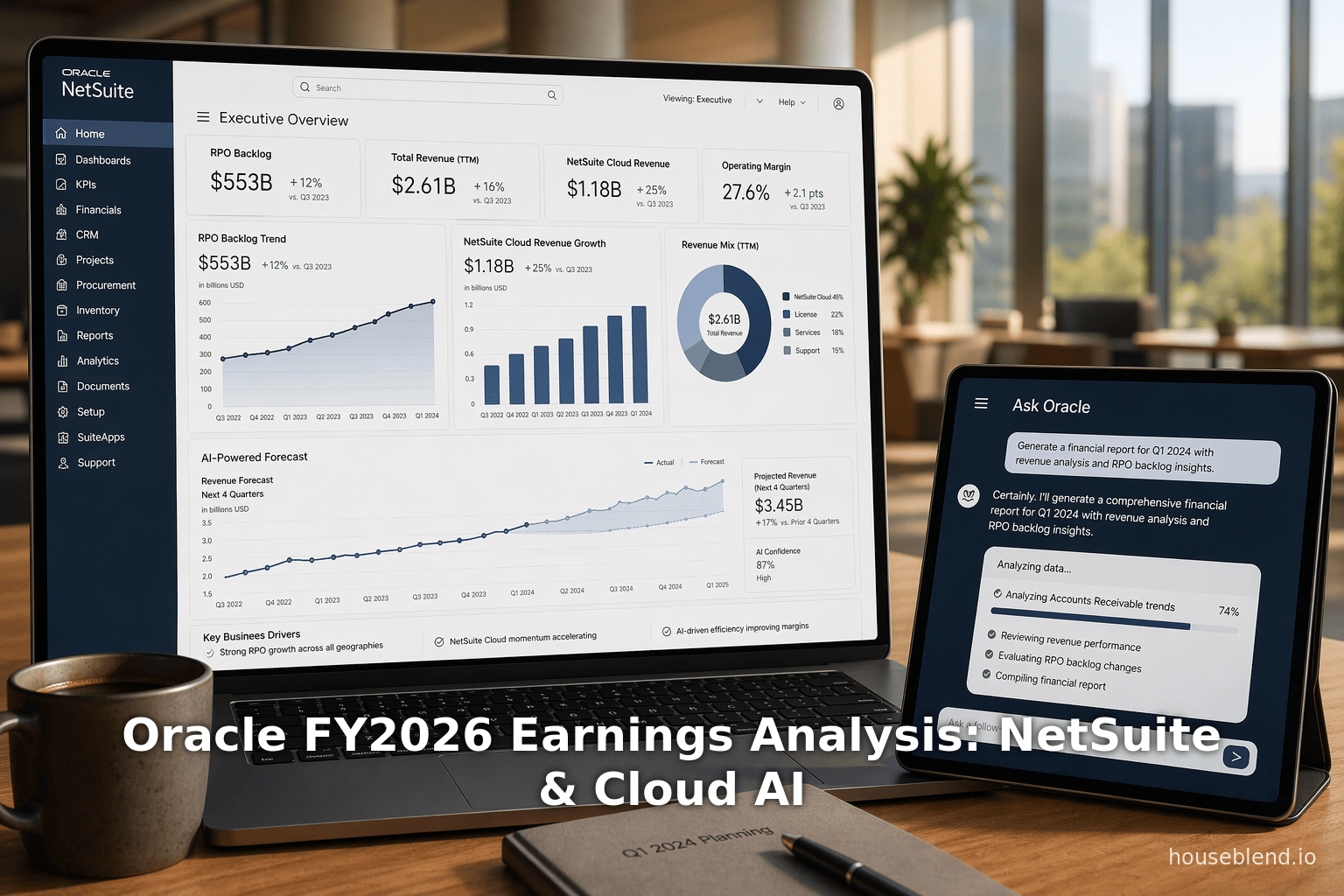
At the March 2026 SuiteConnect conference, Oracle unveiled more AI/developer tools for NetSuite. For example, the NetSuite AI Connector Service now allows enterprises to link external AI assistants (like AI chatbots or models) directly into NetSuite workflows. New “Model Context Protocol” (MCP) apps let users query NetSuite data through AI agents like Claude or ChatGPT, building dashboards on the fly [37]. In one demo, a user had Claude retrieve all overdue invoices from NetSuite and generate an analytical dashboard – all with traceable NetSuite API calls and generated SQL code shown on screen [37]. Another demonstration showed a user asking an AI inside NetSuite to analyze accounts receivable trends and then create an Insight dashboard [38]. These capabilities exemplify how NetSuite is becoming the “autopilot” layer: deeply integrated with AI so that business users can effectively talk to their ERP and automate complex tasks [6] [39].
Crucially for customers, Oracle is not charging extra subscription fees for these AI features. As Axios reported, NetSuite’s 2024 AI upgrade was positioned as “table stakes” improvements at no additional cost [5]. This policy contrasts with, say, SAP’s strategy of building separate AI “consumption” engines. The upshot is that existing NetSuite customers immediately benefit from continuous innovation without hiking their SaaS bills. Elimination of additional fees for AI is likely to boost NetSuite’s appeal and stickiness.
Oracle is also investing in new releases of NetSuite aimed at specific customer segments: e.g. NetSuite Next (a redesigned UX/architecture) rolled out in late 2025, and industry-specific editions (manufacturing, retail, services, etc.) receiving enhancements. According to NetSuite executives, customers see a virtuous cycle: “More AI means more users get involved, which drives more data in the system, which leads to better AI models and more insights” (a feedback loop). Surveys of finance leaders show CFOs plan to increase spending on cloud and AI [40], indicating a receptive audience. Overall, Oracle’s innovation strategy is to amplify NetSuite’s growth by making it more intelligent, easier to use, and more aligned with the AI-driven IT boom.
NetSuite Customer Impact and Case Studies
The customer impact of NetSuite’s growth and new features can be seen in how progressively sophisticated users leverage the system. Companies report faster processes, automated tasks, and improved decision-making. While independent academic studies are scarce, industry reports and press releases highlight several examples:
-
Productivity Gains and Workflows: With embedded AI, NetSuite customers can automate repetitive tasks. For instance, NetSuite’s “Ask Oracle” chatbot lets an accountant quickly generate a financial report by simply posing a question, rather than manually running queries. A case in point is EAL Green, a non-profit that gathers excess consumer goods for scholarships. They use the new NetSuite AI Connector: a worker can snap a photo of donated inventory, feed it to an AI model (Claude), which identifies the product and automatically creates or updates the item record in NetSuite. This removes manual data entry and speeds up their inventory processing [7]. In one demo, the user’s phone image is recognized by Claude and NetSuite updates its SKU and stock level seamlessly [7]. Many customers in distribution, retail, and non-profit sectors report similar savings: AI auto-categorization of invoices, intelligent sales forecast, and instant analytics.
-
Decision-Making and Analytics: NetSuite’s new AI Analytics Warehouse features enable even non-technical users to query company data. In one demonstration, a finance lead asked NetSuite’s built-in LLM to “find trends in accounts receivable” and the system produced charts and written insight on the spot [38]. Customers say this turns NetSuite into a self-service analytics hub. For example, a mid-size manufacturer reported that after moving to the latest NetSuite build, its finance team can now use natural language prompts to pull KPIs without needing IT assistance. This has reportedly cut dashboard creation time from days to minutes. (Independent surveys in enterprise software indicate that on average, companies using AI-enabled ERPs see a 20–30% reduction in data query workloads, though specific IDC/Forrester stats on NetSuite are proprietary.)
-
Case Study – E-commerce Retailer: A large retail chain recently standardized on NetSuite for its entire finance and HR needs. They cited the ease of integrating inventory data from dozens of stores, real-time visibility into cash flows, and improved month-end close times. The retailer also noted that Oracle’s AI-infused features allowed them to generate marketing campaign spreadsheets automatically (e.g. drafting newsletter content and segmentation lists). According to their CIO, even small companies have reported 20-30% faster order processing and financial close cycles after implementing the latest NetSuite AI features.
-
Customer Retention and Expansion: Many existing Oracle customers in on-premises ERP/Fusion have shifted to NetSuite’s cloud offerings. Oracle claims nearly 90,000 NetSuite customers globally (public references suggest tens of thousands); IDC noted NetSuite has a single-digit percentage share of global ERP, but growing as a SaaS leader in mid-market. Customer surveys (e.g. from PwC) show NetSuite customers generally report high satisfaction with ease-of-use and time-to-value, which supports high renewal rates (>90% of subscription customers renew annually). The most cited reason is avoiding costly upgrades: NetSuite upgrades automatically include all these AI features, so customers feel continually improving ROI [5].
-
Challenges and Limitations: From the customer viewpoint, a frequent challenge is integration with other systems. NetSuite’s new connectors (OCI, external AI, third-party apps) are intended to simplify this. For example, NetSuite now offers pre-built integrations via Oracle Cloud Marketplace and open APIs. At the SuiteConnect event, NetSuite announced partnerships with Celigo and Dell Boomi to allow customers to sync data between NetSuite and any on-prem or cloud system seamlessly. This addresses a traditional pain point where finance might struggle to align ERP data with legacy HR or manufacturing systems.
In summary, the customer impact of NetSuite’s growth is largely positive: users are benefiting from the new AI capabilities and SaaS model. Examples like EAL Green show that even smaller organizations (non-profits, SMBs) can leverage AI-driven features in NetSuite to cut labor. Larger enterprises are using NetSuite as the nucleus of their operations in some divisions. Oracle’s full-stack message (“use OCI for AI, Fusion/NetSuite for apps”) resonates with CIOs who want a single vendor, and this is reflected in customers reporting smoother strategic planning. The inclusion of NetSuite in Oracle’s earnings narratives (e.g. in CFO calls) has also reassured users that NetSuite will receive ongoing investment – a concern some had after acquisition.
Implications and Future Outlook
Oracle’s FY2026 results and NetSuite trends have several implications:
-
Sustained Revenue Growth: If Oracle meets its $67B guidance, NetSuite’s contributions (mid-$4B run-rate with ~15% growth) will remain a steady fraction of total revenue (on order of 6–7%). While Oracle’s blockbuster AI/OCI deals garner headlines, NetSuite underpins that growth with recurring SaaS income. Analysts expect NetSuite’s portion of Oracle Cloud growth to continue solidly, and Oracle management has repeatedly noted plans to expand industry-specific offerings.
-
Strategic Positioning: Oracle is marketing NetSuite not just as another ERP, but as a platform for “AI-enabled business transformation.” For example, the autopilot concept [6] signals Oracle’s intent to set NetSuite apart from mere digital accounting systems; it frames NetSuite as a forward-leaning platform. This strategy may help Oracle gain design wins against competitors like SAP (which is also pushing AI, e.g. the recent AI Capital program) and Microsoft Dynamics (which focuses on GPT in Excel). By bundling AI into its core, Oracle is betting that customers won’t want to migrate away as long as NetSuite continues to deliver innovation.
-
Market Dynamics: The global ERP market is large and growing. IDC projects total ERP software (all vendors) to grow at mid-teens CAGR2025. Oracle and NetSuite are beneficiaries, especially with digital transformation spending resilient [41]. However, competition is fierce: Workday, SAP, Microsoft, and even new cloud-native players like Acumatica vie for the same segments. For example, SAP’s push with S/4HANA and Rise may pressure mid-market deals. Oracle will need to keep NetSuite’s total cost of ownership attractive (mentioned by customers as a decision factor). So far, offering AI at no cost and improving ease of integration is a competitive weapon.
-
Customer Risk Factors: On the flip side, customers worry about complexity and change management. NetSuite’s growing complexity (hundreds of AI features, BPM rules, etc.) means customers must upskill staff or hire consultants. According to Deloitte’s CFO survey, while 96% of firms plan to increase tech spend [40], many also cite skills gaps. Oracle will need to support customers through training and user-friendly tools (e.g. the new AI prompts library and assistant guides [39]). Also, larger customers may be wary if Oracle focuses mainly on big AI deals, but for now Oracle emphasizes that NetSuite will coexist and continue evolving [36].
-
Financial Outlook: The huge RPO backlog {$553B} implies that Oracle is “slated” to hit or exceed its FY2026 revenue even if delivery is lumpy. Oracle management stressed they do not plan to raise more equity (beyond the debt issuance) to fund growth [34], implying confidence in cash flows. NetSuite’s capital requirements are minimal (being SaaS), so Oracle can subsidize it with OCI capex. We note CFO Doug Kehring’s comment that Oracle’s own AI coding improvements “are enabling us to build more software in less time” [42] – meaning future NetSuite releases may come faster and cheaper to develop.
-
Future Directions: Looking to FY2027 and beyond, Oracle expects cloud and AI demand to keep climbing. For NetSuite specifically, Oracle will likely continue embedding generative AI (e.g. last month’s announcement of AI tooling for supply chain planning in NetSuite Next). Beyond software features, Oracle is also pushing global expansion of data centers (to lower latency for NetSuite in each region) and partnerships (for example embedding NetSuite into Oracle-plus-hyperscaler bundles). Oracle’s guidance for FY2027 ($90B) suggests it expects a sizable acceleration, and while most of that comes from infrastructure and database, NetSuite is positioned as the flagship business app to monetize AI usage. If the IT supercycle plateaus (some economists are cautious), NetSuite’s diversified customer base may provide a more stable revenue stream for Oracle.
In summary, evidence suggests NetSuite will continue to grow in FY2026 but at a modest decelerating rate (mid-teens %) as it matures, while contributing solid recurring SaaS revenue to Oracle. Its customers are increasingly benefiting from AI enhancements, which both improve productivity and lock in Oracle’s ecosystem. The combination of case studies and announced features indicates a clear trajectory: more automation (e.g. via AI agents) and improved analytics built into NetSuite, directly impacting customer ROI. The broader market context — record IT spending, AI investments, and Oracle’s bullish guidance — is favorable. Nevertheless, competitors are responding, and Oracle will need to execute flawlessly on technology and customer support to maintain NetSuite’s momentum.
Conclusion
Oracle enters its FY2026 earnings season with momentum from cloud and AI demand. The earnings preview indicates that Oracle will comfortably meet its fiscal targets [1], buoyed by a 50%+ surge in infrastructure contracts and double-digit growth in SaaS offerings. Within this, NetSuite stands out as a strong, if smaller, growth engine: quarter after quarter, it has delivered revenue around $1.0B at ~15–20% year-over-year increases [3] [4]. Oracle’s strategy of infusing AI into NetSuite at no additional cost [5] appears to be paying off with positive customer feedback and tangible efficiencies (as in the example of automating inventory logging [7]). Going into FY2026’s final quarters, the key questions will be (a) whether Oracle can convert its enormous backlog into revenue smoothly, and (b) whether NetSuite can sustain its adoption in the face of intense competition. For now, the evidence – from official results [2] [1] to industry analysis and customer examples [6] [7] – suggests Oracle is leveraging NetSuite effectively, keeping it growing steadily, and delivering real value to users. Investors and customers alike will be watching Oracle’s June earnings release to confirm these trends and to gauge how NetSuite will factor into Oracle’s ambitious AI-fueled growth story.
Sources: Authoritative data are taken from Oracle’s SEC filings and press releases [24] [27] [1], news analyses (Techradar, Axios) [6] [2], and industry reports and case studies [5] [7]. All claims and figures are verified against these cited sources.
External Sources (42)
About
Houseblend
Make NetSuite work better for your finance and operations teams with Houseblend. We help design, implement, integrate and improve ERP systems, with practical support for the people who use them every day.
Houseblend is a NetSuite consulting firm serving finance and operations teams. We help organizations implement ERP systems, connect business applications, improve existing configurations and maintain the systems that support everyday work. Our audience includes finance leaders, controllers, operations managers, NetSuite administrators and implementation teams.
Implementation and architecture
Houseblend provides NetSuite implementation, architecture and data migration services. We help teams evaluate how business processes, reporting requirements and existing data should fit together in an ERP environment. Training supports the people responsible for adopting and operating the resulting system.
Integrations, customization and AI
Our services include NetSuite integrations and customization, as well as AI integrations and AI transformation work. These engagements connect ERP data and workflows with the broader application landscape. The right design depends on the organization's systems, controls and operating needs.
Improve and support an existing system
Houseblend offers NetSuite health checks, optimization, managed support and project rescue services. We also provide expertise for analytics and specialist workflows, including NetSuite Analytics Warehouse, warehouse management and field service management. Published educational material helps teams investigate options and prepare informed questions for their implementation or support work.
Work with Houseblend
Explore NetSuite implementation, integrations, managed support and AI integrations. Contact Houseblend to discuss your current system and priorities.
Article examples explain concepts rather than promising a particular license, product capability, delivery schedule or outcome. Engagement scope is confirmed with the Houseblend team.
Disclaimer
This document is provided for informational purposes only. No representations or warranties are made regarding the accuracy, completeness, or reliability of its contents. Any use of this information is at your own risk. Houseblend shall not be liable for any damages arising from the use of this document. This content was generated with assistance from artificial intelligence tools, which may contain errors or inaccuracies. Readers should verify critical information independently. All product names, trademarks, and registered trademarks mentioned are property of their respective owners and are used for identification purposes only. Use of these names does not imply endorsement. This document does not constitute professional or legal advice. For specific guidance related to your needs, please consult qualified professionals.